

Michigan's Football Past: A Must Read
By
Ron Pesch
MHSAA historian
September 27, 2016
By Ron Pesch
Special for Second Half
This week, the contents of my mailbox reminded me about one of my favorite items to collect – booklets and programs celebrating the history of Michigan high school football.
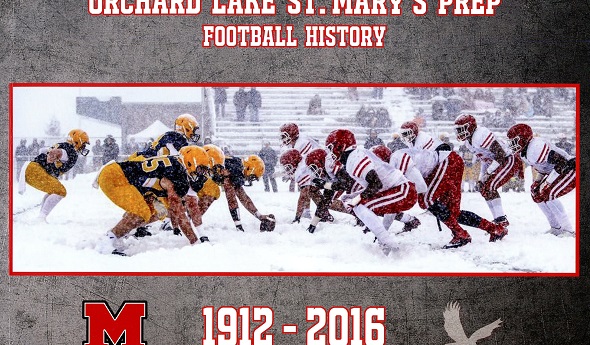
Contained within was the 2016 edition of the book, “Orchard Lake St. Mary’s Prep Football History.” Featuring a glorious image on the cover, it’s a delight to flip through. Rob Goddard and crew are to be commended on the fantastic job they’ve done with this 104-page chronicle.
The package recalled the first in my collection – a publication I helped create.
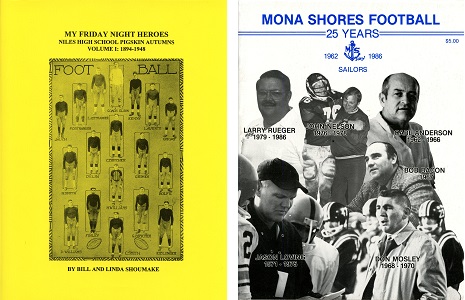
The 25-year celebration of Muskegon Mona Shores football was a modest piece, created before the days of desktop publishing. Because I had assembled the scores of the district’s games, I approached the school and found an individual willing to take a chance. Jerry Fitzpatrick, Sailors athletic director at the time, approved the idea of a booklet celebrating the school’s Silver Football Anniversary.
With gusto, we tapped into a host of resources and dove into digging out photos and details designed to capture everything we could on the years 1962 through 1985, with room for fans to collect details on the coming season. We even included a page on cheerleaders and Homecoming Kings and Queens in hopes of broadening our market.
My second acquisition was a document on Battle Creek Central football, created by MHSAA historian Dick Kishpaugh. It totaled 42 pages in length and included most everything there was to know about the Bearcats, Kishpaugh’s alma mater.
A souvenir football program celebrating Kalamazoo Central’s history followed, also heavily influenced by the work of Kishpaugh. A 60-year history of all sports at Gaylord St. Mary soon landed in my hands, passed on to me by sportswriter and historian Jay Soderberg, editor of the publication. A history of little Grant High School football, published, I believe, in 1979, was the next to arrive.
 In 1993, I partnered with baseball historian Marc Okkonen to produce “100 Years of Muskegon Big Red Football 1895-1994,” a 90-page history of our alma mater. That publication was marketed by the school’s Athletic Foundation as a fundraiser and sold well. To my delight, it seemed to spark the publication by a number of other districts of their football histories. Grand Haven and Escanaba followed a similar format and were both quick to market. Each book also celebrated a centennial of gridiron action. Other publications began to surface.
Riding a string of gridiron championships, Farmington Hills Harrison produced a 108-page program, highlighting the accomplishments from their 25-year football history, in 1994. Additional histories from Cadillac, Frankenmuth, Lowell, Negaunee, Boyne City, Niles, Sturgis and Traverse City appeared, some focused on football, others on all sports. So too did one highlighting the Centennial football game between Saginaw and Saginaw Arthur Hill, as did one a few years later celebrating the M & M game, among the nation’s oldest cross-border battles staged between Menominee and Marinette, Wisconsin.
But since then, things seem to have fallen silent. I believe a lengthy history on Grand Rapids Catholic Central made it to press, although I don’t possess a copy. I’ve seen, but have yet to acquire, a football booklet on Sparta High School football.
Do others exist? Enquiring minds want to know.
 During the gap, John Hulsebus has created, and continues to maintain and enhance a dream website, Michigan-football.com, containing an exhaustive collection of scores, season win-loss marks and records versus opponents for games played since 1950. The site lists schools, past and present for every high school in the state. Like many, I reference it often. Yet, for many schools in the state, that means as many as 55 years of gridiron action remains unrecorded.
Also missing are the stories that sit behind the scores: the players, the coaches, the drama, the locals and pageantry of a Friday night or a Saturday afternoon at the stadium. In the meantime, scrapbooks containing news clippings, game programs, and photographs, once prepared for our fathers, grandfathers and great-grandfathers, gather dust or disappear.
Tell me please, we haven’t forgotten to capture those details from our past?
 Ron Pesch has taken an active role in researching the history of MHSAA events since 1985 and began writing for MHSAA Finals programs in 1986, adding additional features and "flashbacks" in 1992. He inherited the title of MHSAA historian from the late Dick Kishpaugh following the 1993-94 school year, and resides in Muskegon. Contact him at [email protected] with ideas for historical articles.
PHOTOS: (Top) Orchard Lake St. Mary's annually produces an updated history of the school's football program. (Middle) Niles and Muskegon Mona Shores are among other programs that have documented their histories in book form. (Below) The program for the 100th game between Menominee and Marinette, Wis., was a keeper as well.

Kicking Bad Habits
May 4, 2018
Forty years ago, as a youngster on a venerable staff at the national office of the National Federation of State High School Associations, where the playing rules for high school football were published, I would entertain my colleagues with a quixotic proposal – year after year – to eliminate the kickoff from football.
As a college player, I got my first playing time as a member of the kickoff team. I knew it was because the coaches didn’t want to risk injury to better players.
As a high school coach, when I conducted preseason scrimmages, I always insisted that kickoffs not occur because I didn’t want to risk season-ending injuries before the season even began.
So, as the world of football from youth levels to the pros is eliminating kickoffs or altering rules to reduce their frequency, I write smugly, “What took you so long?”
Rules committees on every level for every sport have an obligation to examine the data for their sports closely and determine precisely the circumstances that cause the most injuries. And then they must create and enforce rules that will eliminate or greatly modify that most injurious situation.
If the data tells us now what my gut told me as a young coach and administrator, we should give kickoffs the boot.