

Michigan's Football Past: A Must Read
By
Ron Pesch
MHSAA historian
September 27, 2016
By Ron Pesch
Special for Second Half
This week, the contents of my mailbox reminded me about one of my favorite items to collect – booklets and programs celebrating the history of Michigan high school football.
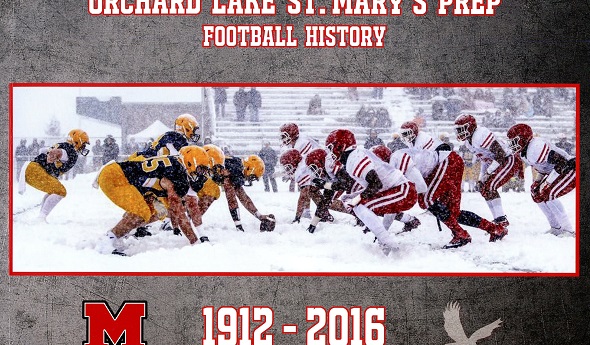
Contained within was the 2016 edition of the book, “Orchard Lake St. Mary’s Prep Football History.” Featuring a glorious image on the cover, it’s a delight to flip through. Rob Goddard and crew are to be commended on the fantastic job they’ve done with this 104-page chronicle.
The package recalled the first in my collection – a publication I helped create.
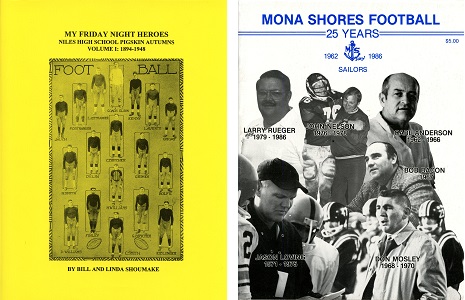
The 25-year celebration of Muskegon Mona Shores football was a modest piece, created before the days of desktop publishing. Because I had assembled the scores of the district’s games, I approached the school and found an individual willing to take a chance. Jerry Fitzpatrick, Sailors athletic director at the time, approved the idea of a booklet celebrating the school’s Silver Football Anniversary.
With gusto, we tapped into a host of resources and dove into digging out photos and details designed to capture everything we could on the years 1962 through 1985, with room for fans to collect details on the coming season. We even included a page on cheerleaders and Homecoming Kings and Queens in hopes of broadening our market.
My second acquisition was a document on Battle Creek Central football, created by MHSAA historian Dick Kishpaugh. It totaled 42 pages in length and included most everything there was to know about the Bearcats, Kishpaugh’s alma mater.
A souvenir football program celebrating Kalamazoo Central’s history followed, also heavily influenced by the work of Kishpaugh. A 60-year history of all sports at Gaylord St. Mary soon landed in my hands, passed on to me by sportswriter and historian Jay Soderberg, editor of the publication. A history of little Grant High School football, published, I believe, in 1979, was the next to arrive.
 In 1993, I partnered with baseball historian Marc Okkonen to produce “100 Years of Muskegon Big Red Football 1895-1994,” a 90-page history of our alma mater. That publication was marketed by the school’s Athletic Foundation as a fundraiser and sold well. To my delight, it seemed to spark the publication by a number of other districts of their football histories. Grand Haven and Escanaba followed a similar format and were both quick to market. Each book also celebrated a centennial of gridiron action. Other publications began to surface.
Riding a string of gridiron championships, Farmington Hills Harrison produced a 108-page program, highlighting the accomplishments from their 25-year football history, in 1994. Additional histories from Cadillac, Frankenmuth, Lowell, Negaunee, Boyne City, Niles, Sturgis and Traverse City appeared, some focused on football, others on all sports. So too did one highlighting the Centennial football game between Saginaw and Saginaw Arthur Hill, as did one a few years later celebrating the M & M game, among the nation’s oldest cross-border battles staged between Menominee and Marinette, Wisconsin.
But since then, things seem to have fallen silent. I believe a lengthy history on Grand Rapids Catholic Central made it to press, although I don’t possess a copy. I’ve seen, but have yet to acquire, a football booklet on Sparta High School football.
Do others exist? Enquiring minds want to know.
 During the gap, John Hulsebus has created, and continues to maintain and enhance a dream website, Michigan-football.com, containing an exhaustive collection of scores, season win-loss marks and records versus opponents for games played since 1950. The site lists schools, past and present for every high school in the state. Like many, I reference it often. Yet, for many schools in the state, that means as many as 55 years of gridiron action remains unrecorded.
Also missing are the stories that sit behind the scores: the players, the coaches, the drama, the locals and pageantry of a Friday night or a Saturday afternoon at the stadium. In the meantime, scrapbooks containing news clippings, game programs, and photographs, once prepared for our fathers, grandfathers and great-grandfathers, gather dust or disappear.
Tell me please, we haven’t forgotten to capture those details from our past?
 Ron Pesch has taken an active role in researching the history of MHSAA events since 1985 and began writing for MHSAA Finals programs in 1986, adding additional features and "flashbacks" in 1992. He inherited the title of MHSAA historian from the late Dick Kishpaugh following the 1993-94 school year, and resides in Muskegon. Contact him at [email protected] with ideas for historical articles.
PHOTOS: (Top) Orchard Lake St. Mary's annually produces an updated history of the school's football program. (Middle) Niles and Muskegon Mona Shores are among other programs that have documented their histories in book form. (Below) The program for the 100th game between Menominee and Marinette, Wis., was a keeper as well.
QB Gives MCC New Look, Same Success
October 31, 2017
By Tom Kendra
Special for Second Half
Beating Muskegon Catholic Central in the playoffs was hard enough before Cameron Martinez came along.
 Martinez, a 5-11, 180-pound, dual-threat sophomore quarterback, has added many new dimensions to the Crusaders’ offense – which had become synonymous around the state with ground-and-pound, power football.
“It’s pretty apparent that if we’re sitting in the T (formation) all the time, we’re not maximizing his abilities or our other guys’ abilities,” said fifth-year MCC coach Steve Czerwon, who has won a Division 8 championship in each of his first four seasons as the Crusaders’ head coach. “Cameron makes us coaches look good, too, because with him sometimes a bad play turns into a good play.”
MCC, which is 8-1 and ranked No. 1 in Division 8 by The Associated Press, goes on the road this week for a showdown with a familiar foe and another playoff powerhouse, Mendon (10-0 and ranked No. 3), in a MHSAA District championship game at 1 p.m. Saturday.
Mendon fans will see a different MCC team than they have become accustomed to during the two schools’ seven prior meetings (MCC has won five) – a team that often operates with Martinez in the pistol formation, with just one running back, no tight ends and four receivers spread wide across the field.
The point man is Martinez, whose athletic ability was noticed by Central Michigan University two years ago as a 14-year-old eighth grader. His potential was so apparent that he was offered a scholarship at the conclusion of that camp, before he ever played a snap of high school football.
Last fall, he split time at quarterback with senior Trenton Bordeaux, and started to prove himself on the field as a quarterback, free safety and punt returner. Many other Division I schools are now following him as he is the unquestioned leader of this year’s Crusaders.
Martinez, who was born on the infamous day of Sept. 11, 2001, knows that college is still three years away. More immediate on his mind is the challenge of a 240-mile roundtrip journey to face a Mendon program which has amassed 10 MHSAA championships, the most recent in 2011. MCC has won 12 MHSAA titles during the playoff era.
“We’re all very excited,” said Martinez, whose older brother, Christian, guided MCC to Division 8 titles in 2014 and 2015 and now plays quarterback at Northwood University. “It’s a little bit of a trip, but I’ve always liked playing on the road. We know all about them and their tradition.”
Mendon will have to, first and foremost, contain Martinez if it wants to snap a three-game losing streak to the Crusaders.
The numbers tell the story: Martinez has rushed for 979 yards on 90 carries (10.9 yards per carry) and 15 TDs, more than double as many yards as MCC’s second-leading rusher, sophomore Tommy Watts (441 yards). Others sharing carries in the backfield-by-committee are juniors Dawson Steigman and Avery Davis and senior Riley St. Amour.
Martinez’ completion percentage is down considerably from a year ago, but he has still hit on 45 of 94 passes for 720 yards, six touchdowns and three interceptions. His primary targets are seniors Ryder Smith (14 catches) and Jackson Riegler (11 catches) and sophomore Nolan Convertini (10 catches).
 Martinez & Company looked flat-out unbeatable and a mortal lock to complete the “Drive for Five” – and join East Grand Rapids and Farmington Hills Harrison as the only schools to win five titles in a row – until Montague rolled into Kehren Stadium on Oct. 20 for the first-ever meeting between the two schools.
Montague frustrated the Crusaders with a disciplined pass rush and stingy coverage, limiting Martinez to just 10 of 31 passing for 131 yards, no touchdowns and two interceptions, as MCC’s 27-game winning streak was snapped in a stunning 34-10 loss.
“I put that loss on me,” said Martinez, who did rush for a team-high 80 yards in the defeat. “I need to react better and make better adjustments during games. All respect for Montague, they are a great team, but that game was a wake-up call for us.”
MCC bounced back with a 42-20 win over visiting Decatur last week, in a game that was much closer than many expected.
Now comes the big test against Mendon, which appears to be back to its old, powerful self after posting its first undefeated regular season since 2104.
“This is a classic Mendon football team,” said Czerwon, who is 2-0 against the Hornets as a head coach, posting playoff wins in 2013 and 2014. “They are a power team that wants to run downhill on you. They make very few mistakes and rarely have a negative-yardage play.”
Mendon, champions of the Southwest 10 Conference, are led by quarterback Cole Decker and running backs Wyatt Cool and Austin Rensi. Bobby Kretschman, a former standout player and 10-year assistant coach for the Hornets, is in his second year as head coach after taking over from legend John Schwartz.
MCC will use many different formations, all directed by Martinez, in an attempt to move the ball against a Mendon defense which has six shutouts in its first 10 games.
“We are very diverse, which is what I like about this team,” said Martinez. “Our coaches come up with a lot of different schemes for every game. We just have to go out and execute it.”
 Tom Kendra worked 23 years at The Muskegon Chronicle, including five as assistant sports editor and the final six as sports editor through 2011. E-mail him at [email protected] with story ideas for Muskegon, Oceana, Mason, Lake, Oceola, Mecosta and Newaygo counties.
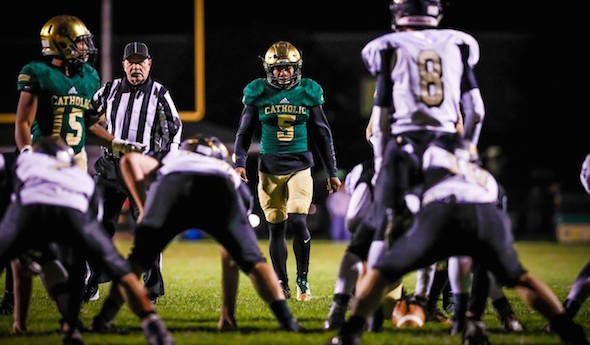
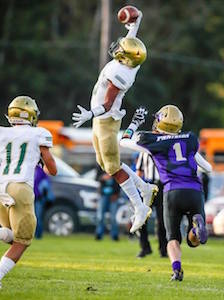
PHOTOS: (Top) Muskegon Catholic Central’s Cameron Martinez, a 5-11, 180-pound sophomore, surveys the field while awaiting the snap from center Owen Linstrom during the Crusaders' 42-20 victory over visiting Decatur in last week's Division 8 Pre-District game. (Middle) Martinez goes airborne for an incredible interception from his free safety position during the Crusaders' 31-6 victory at Frankfort on Sept. 1. (Photos by Tim Reilly.)