

New Coach Takes Next Step at Escanaba
September 1, 2015
By Dennis Grall
Special for Second Half
ESCANABA – When school ended in early June, Dave Howes took a vacation trip to Florida and began thinking about his upcoming fourth season as junior varsity football coach at Escanaba High School.
Within a month he had become the school's varsity head coach, a position he had never thought about taking on.
 "To tell you the truth, I never wanted to be a head football coach," Howes said in the Eskymos’ lockerroom before the start of a recent practice. "It just kind of fell in my lap."
Escanaba had a 10-17 record over the last three seasons under previous coach Jim Hansen, who was dismissed in June, but opened this fall with a 21-7 win over Alpena on Thursday. The Eskymos travel to Petoskey on Friday.
When Howes was contacted about moving up from the jayvees, he said, "I had to make up my mind. Do I want it? It happened real fast. I wasn't expecting it. It just happened."
He was encouraged to apply by several people, including an Escanaba High School administrator, and was given the blessing of his wife, Holly, to pursue the position. He is the second coach in four years to direct the Eskymos, who during the previous 50 years had just two head coaches, Upper Peninsula Sports Hall of Fame inductees Jerry Cvengros and Dan Flynn.
When Howes first joined the Eskymos’ coaching staff in 2005, he said Flynn asked if he ever wanted to become the school's head coach. "I said, I don't know," said Howes. "I didn't envision it. Now I'm more than happy."
Howes said he has received excellent support from family, friends, players, coaches and the community during the short time he has been in charge.
"I want our fans to know that our kids are going to be competitive, and they are going to work hard. They will see there will be an edge about them," he said.
About 100 students came out for the three football levels, with 48 on varsity. Howes didn't have any preseason contact until after July 4, about a month behind the normal period. A big plus in the transition was all the previous assistant coaches stuck with the program, and they have all moved up a level in the process.
"They have all the kids they had in previous years, and we're running the same system," Howes said. "It has been an easy transition. Knowing the kids and knowing the coaches was easy. We had the same kids, the same coaches, the same philosophies. It's made practice easier."
 Athletic director Nick Nolde brought the coaches and players together and provided the introductions, which weren't really necessary because of the carry over. "It's been smooth sailing ever since," said Howes of the best-case scenario coming together.
Nolde said given the way "everything went down, it has been a seamless transition. He is familiar with the kids, and he is familiar with the program."
Howes is a native of neighboring Gladstone, graduating in 1993 and playing against Escanaba teams in football, basketball and baseball. "It's weird. As a kid, I hated Escanaba with a passion. Now, here I am," said Howes, whose older brother Dave is an assistant varsity coach with former Escanaba player Don Koish and former Gladstone athlete Jason Micheau.
"It is so funny how things happen," said Howes, who also coached subvarsity football in Gladstone and Beal City following his 1998 graduation from Northern Michigan University and before coming to Escanaba in 2005.
He does not feel any pressure taking over the tradition-laden, highly-respected program spotlighted by the MHSAA Class A championship in 1981 and 1979 runner-up finish.
"To me, it is just a game and we're going to be competitive and try our hardest," Howes said. "We are moving forward. Every day we come in here and see the (old) pictures. It is a great tradition with great pride. But the focus is now. Everything is about the present."
He already has noticed the difference of being in charge of the whole program, from dealing with the news media to handling financial situations and MHSAA rules and regulations. "There is a lot more on my plate. Instead of being in charge of 30 kids, you are the boss of the whole program grades 7-12," he said.
He has also installed his own touch, starting with practice sessions. "The last couple of years we have had super-paced practices. This year we're doing more teaching in our practices," he said. "We are keeping it as simple as possible and putting kids in position to succeed. We're getting more done in a shorter amount of time."
He is not worried about matching X's and O's against such legendary Upper Peninsula coaches as Chris Hofer at Kingsford or Joe Noha from Menominee, nor is he concerned about the imprint made by Cvengros and Flynn, or even his high school coach, the highly-regarded John Mileski.
"I can't follow in their footsteps," he said. "They are irreplaceable. We've just got to move on."
 Denny Grall retired in 2012 after 39 years at the Escanaba Daily Press and four at the Green Bay Press-Gazette, plus 15 months for WLST radio in Escanaba; he served as the Daily Press sports editor from 1970-80 and again from 1984-2012. Grall was inducted into the Upper Peninsula Sports Hall of Fame in 2002 and serves as its executive secretary. E-mail him at [email protected] with story ideas for the Upper Peninsula.
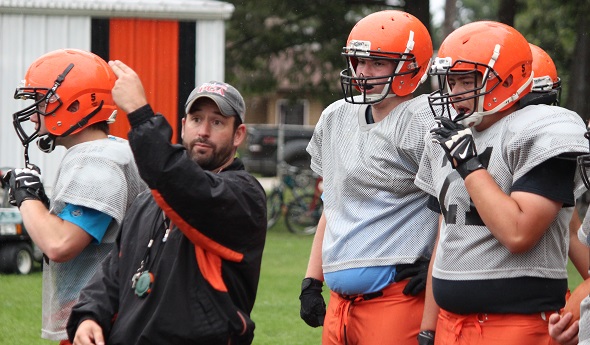
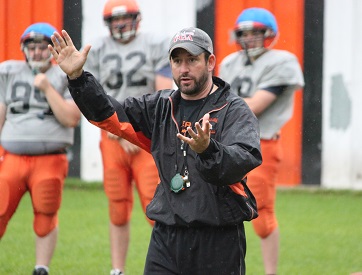
PHOTOS: (Top) Escanaba High School football coach Dave Howes makes a point to members of the Eskymos recently at Escanaba Athletic Field. Howes took over the tradition-laden program in July and is the second head coach in the past four years, after the late Jerry Cvengros and Dan Flynn served as the only head coaches during the previous 50 years. (Middle) Howes encourages his football team during a practice session.
A Game for Every Fan: Week 1
August 28, 2014
By Geoff Kimmerly
Second Half editor
It’s a lot like birds knowing to fly north in the spring.
If you’ve played, coached, parented or followed high school football, you’re likely having a hard time not jumping out of your shoes in anticipation of opening night.
So let’s get right to it; below are some of the most intriguing matchups from this first weekend of the MHSAA football season. More than 250 of the total 310-plus games will be played tonight, with 50 more Friday and a handful Saturday.
Tune in to MHSAA.com’s Score Center all weekend for game times, scores as we get them, standings for those starting league play immediately and all the playoff-point equating that will start to matter to most as we get rolling into the season’s second half. (Records below are from 2013. Games are organized based on the region of Michigan where they'll be played.)
West Michigan
Detroit Catholic Central (11-3) at Muskegon (12-2), Friday
This is set up to be arguably the most high-octane opener in Michigan in some time. DCC is back-to-back-to-back Division 1 runner-up, while Muskegon has finished runner-up in Division 2 the last two seasons. Granted, rosters turn over – but Joeviar Kennedy was Muskegon’s leading receiver in last season’s championship game and Alezay Coleman its leading tackler, and both are back. So are Alex Bock and Jordan Jenkins, two of the most noticeable Shamrocks during their run to Ford Field.
Others that caught my eye: Detroit Country Day (8-4) at Zeeland West (13-1), Grand Rapids South Christian (12-2) at Grand Rapids Christian (8-3) on Friday, Grand Rapids West Catholic (10-4) at Muskegon Oakridge (11-2) on Friday, Grand Rapids Catholic Central (6-4) at East Grand Rapids (5-4).
Greater Detroit
Lansing Sexton (12-1) vs. Detroit East English (9-3), Saturday at Wayne State
Many of the best from Detroit will be playing at Wayne State University over the next three days (see a few more big-time contests listed below), but this one carries the most intrigue because it features one of the best from the city against a Sexton team that missed making last season’s Division 4 Final by a touchdown. The Big Reds have all of their playmakers and much of their outstanding defense back; East English is keyed by run/pass dynamo Anton Curtis, one of the state’s most exciting quarterbacks.
Others that caught my eye: Macomb Dakota (11-1) at Clarkston (13-1), Pewamo-Westphalia (10-2) at Madison Heights Madison (11-1), Detroit Cass Tech (12-1) vs. Oak Park (6-5) on Friday at Wayne State, Southfield (7-3) vs. Orchard Lake St. Mary's (5-4) on Friday at Wayne State.
Bay and Thumb
Saginaw Swan Valley (11-1) at Saginaw Nouvel (9-2)
A nail-biting 27-20 win for Swan Valley in this opener last season kicked off a run to the Regional Finals and the team’s best season in the last eight. Senior running back Alex Grace returns from the most potent offense in school history and arguably is the most potent runner in MHSAA history with more than 5,000 yards in his career and nearly 3,000 last season alone. Nouvel’s lineup will include more new names – but the Panthers rattled off nine straight wins after the 2013 opening loss and will be prepared to get the streak started a week earlier this time.
Others that caught my eye: Flint Carman-Ainsworth (11-2) at Grand Blanc (7-3), Freeland (6-4) at Lake Fenton (8-3), Montrose (12-1) at Reese (8-2), Mount Pleasant (10-2) at Midland Dow (8-3).
Mid-Michigan
Ithaca (14-0) at Clare (7-3), Friday
The Yellowjackets’ 56-game winning streak stretches over four seasons and is the longest of any in MHSAA history achieved entirely during the playoff era. But Clare – the Jack Pine Conference champion for seven years running – should be Ithaca’s toughest regular-season test of at least the last two or three. Ithaca star quarterback Travis Smith is graduated and gone to Wake Forest University, but younger brother Jake Smith has been similarly anticipated and takes over the offense to start his junior year.
Others that caught my eye: Manchester (7-3) at Clinton (13-1), St. Johns (5-4) at East Lansing (4-5), Jackson Northwest (5-4) at Eaton Rapids (7-5), South Lyon (6-4) at Pinckney (7-4).
Lower Up North
New Lothrop (11-1) at Traverse City St. Francis (5-5), Friday
This is the second chapter of a series started a year ago that allows both to start out against a tough opponent before jumping into league play against more familiar foes. New Lothrop won last season’s matchup and went on to make the Division 8 Semifinals for the second time in three seasons. St. Francis hasn’t had two straight middling seasons like this since 2000-01 (it also finished 4-5 in 2012). But the Gladiators are back in a league for the first time since 2011 and should be able to add on last season’s return to the playoffs.
Others that caught my eye: Midland (10-2) at Traverse City West (5-5), Cadillac (11-1) at Big Rapids (3-6), Kingsley (6-4) at McBain (5-5), Marquette (5-4) at Traverse City Central (5-4).
Upper Peninsula
Munising (6-4) at Iron River West Iron County (10-1), Friday
These two did some celebrating in 2013. West Iron tied its school record for wins, while Munising bounced back from 2-7 in 2012 to make the playoffs for the second time in three seasons – and also for only the second time since 1990. Both should be looking for more this fall; West Iron’s lone loss came in the playoffs to eventual Division 7 champion Ishpeming, while Munising – after falling to West Iron 7-0 in last season’s opener – then lost its next two games by a combined six points before rattling off six straight wins.
Others that caught my eye: Houghton (6-4) at L'Anse (8-3), Ishpeming (14-0) at Iron Mountain (4-5), Petoskey (5-4) at Sault Ste. Marie (7-4) on Friday, Posen (4-6) at Cedarville (8-2).
Southwest and Border
Dowagiac (7-4) at Plainwell (8-2)
Dowagiac was cruising along on a 17-game regular-season winning streak when Plainwell broke it last fall with a 10-0 win on the way to a third straight playoff berth. These two haven’t played in the same division of the Wolverine B since 2011, but the rivalry continues to run hot now that both are division favorites on an annual basis.
Others that caught my eye: Watervliet (10-1) at Gobles (5-4), Parchment (7-4) at Schoolcraft (10-2), Edwardsburg (9-1) at Three Rivers (5-4), Portage Central (12-1) at Mattawan (4-5).
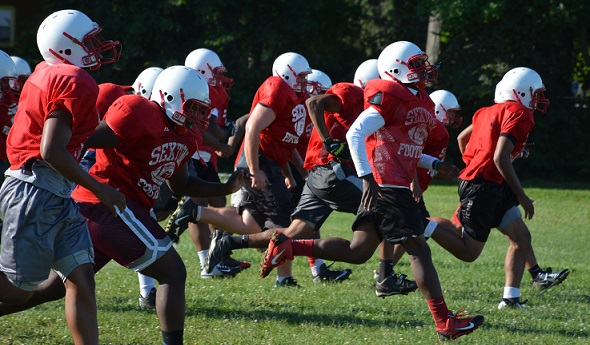
PHOTO: Lansing Sexton, practicing earlier this month, fell just a touchdown shy last season of reaching its first MHSAA Final.