


New Football Practice Policies
March 25, 2014

Meet Jared Smith, P-W's Record Setter
November 10, 2016
By Geoff Kimmerly
Second Half editor
WESTPHALIA – Jared Smith saw the parking lot full and cars lining Clintonia Road to the west and Centerline Road south of Pewamo-Westphalia’s stadium Saturday as his Pirates prepared to kick off their District Final against Saugatuck.
 He knew once again there was no place else he’d rather be.
And that goes to the core of what Smith would tell anyone who might be curious about the senior back making a run at the MHSAA’s career rushing yards record.
Smith showed a little to the statewide audience with 149 yards and a touchdown in P-W’s 22-16 loss to Ishpeming in last season’s Division 7 Final at Ford Field. But with most of his games over the last three-plus seasons played for a 300-student school on rural fields like his on the Clinton/Ionia County line, there are probably a few more eager to see the back they’ve mostly only read about as he’s made his run at 8,000 yards.
“I guess I’m just a hard-working kid from a small town,” he said Monday in explaining how he’d describe himself to those who haven’t seen him play. “I grew up in a great community that loves football, and they’re always out here supporting it. And I wouldn’t rather be anywhere else.”
Smith heads into the Pirates’ Division 7 Regional Final on Saturday at Traverse City St. Francis with five MHSAA football records and ranking second or third in three other categories, and he will graduate in the spring on a short list of the most accomplished high school backs in Michigan history.
He helped carry the Pirates to the cusp of their first MHSAA title last fall with a single-season record 3,250 yards and 53 touchdowns – his scores set records both for total touchdowns and total rushing TDs in one season – on 315 carries, which came out to 10.3 yards per carry and a touchdown every sixth time he ran the ball.
This fall, Smith has only 2,318 yards on 197 carries (11.8 per rush) with 34 scores on the ground – giving him an MHSAA-record 119 rushing touchdowns for his career with at least one more game to play. Total over three seasons and parts of a fourth – Smith came up in Week 6 to back up Ross Wolniakowski as a freshman in 2013 – he has run for 7,930 yards, only 501 shy of the career record set by East Grand Rapids’ Kevin Grady, Jr., from 2001-04.
Another big finish would allow fans outside mid-Michigan and those who follow our smallest schools one more glimpse at the player who will end up all over the MHSAA record book. But in the meantime, here’s a primer based on viewpoints from those who have coached the 6-foot, 205-pound hammer, and those who have tried to stop him.
“I tell them that he is the same kid that he was when I brought him up as a freshman,” P-W coach Jeremy Miller said. “He hasn’t changed. His outlook, his work ethic. He’s a tremendous teammate, a tremendous kid to coach. I’ve never had to say two words to him: ‘Hey, knock it off. Be quiet. Pay attention. You’re not working hard.’ So he’s a tremendously gifted athlete, but he has all the intangibles to be every coach’s dream. He really does.”
Smith came up to varsity as a freshman, again mostly as the scout team back, but he picked up 226 yards and four touchdowns to begin his record book march.
He’ll be the first to explain how much of his last three seasons have been a result of a strong cast around him. Anchor Matt Fox was the only member of last season’s offensive line to graduate – leaving now-seniors Dominic Spitzley, Austin Thelen and Devon Pung and junior Isaiah Schafer to form a veteran nucleus. Thelen suffered a season-ending knee injury on the first play of this season, but senior Nick Jandernoa – pulling off the rare double as a cornerback on defense – took Thelen’s spot at offensive guard, while 6-foot-5 senior Nolan Hagen has moved from tight end last year to play the other guard and senior Jason Smith has taken on that tight end spot key to the blocking scheme.
Smith also has benefitted from last season’s starting tight end, junior Bryce Thelen, now playing fullback, and the return of junior quarterback Jimmy Lehman, a threat through the air. Senior Ryan Smith is an option quarterback who switches in and can pull some of the attention away from his lead back.
But if Jared Smith was just a great small-town back, more programs would have one like him – and only a few players at that level the last few years have been comparable.
One is Saugatuck’s Blake Dunn, who Saturday finished his four-year varsity career with 6,954 yards on the ground. The Indians are one of few teams to play P-W close the last two years, falling 38-28 in a 2015 District Final before being edged 25-19 last week – games in which Smith ran for 300 yards and two touchdowns and then 210 yards and two scores, respectively.
“He has great leg strength, great balance, and then on top of that, his vision and his ability to cut back really make him unique,” said Saugatuck coach Bill Dunn, also Blake’s dad, whose team has navigated the Southwestern Athletic Conference the last two years to go a combined 20-2. “What he did last year versus this year was very similar. His running style was very similar. Our preparation was to not let him cut back, but he’s got a very good offensive line, and you have to give credit to those guys as well.
“(But) absolutely, I think he’d do well in any league. Just with his size alone, and the fact that he can run.”
 Laingsburg coach Brian Borgman is among those from the Central Michigan Athletic Conference who have appreciated Smith’s work – but won’t miss trying to stop it. The 15-year Wolfpack coach, who played collegiately at Bowling Green, has watched Smith help the Pirates win 14 straight league games and 27 of 28 over the last four seasons.
After this fall’s 40-7 P-W win over Laingsburg – which won eight games for the second straight season – Borgman told Smith, “Congratulations” and also he was glad he wouldn’t have to plan for him again.
“When he was a sophomore, he basically was just an outside runner, able to take the ball to the edge. They didn’t ask him to take it between the tackles much,” Borgman said. “But as he’s matured, as he’s been lifting, with his strength – he’s become a bear to take down. (And) just his confidence. Our game we played in a downpour. They direct snapped to him and we were able to corral him for a quarter and a half, but you never saw him get worried. He kept his cool, kept his poise and eventually ran right past us” for 271 yards and two touchdowns.
“He is by far the most talented player I’ve had to try to defend,” Borgman added. “His special blend of power, speed, vision and balance make him so dangerous. He gives a lot of credit to the O-line in front of him, as well he should, but I’ve seen him turn a blown play into an 80-plus yard TD all by himself. He is a rare talent, and I wish him well in the future.”
That future is something Smith knows he’ll eventually have to figure out and feels a little bit of pressure to get started – but there’s another potential trip to Detroit to plan first.
Despite his success, while also starting at linebacker – and carrying a 3.97 grade-point average – Smith isn’t getting as much college interest as one might expect. He mixes that physical running style with speed; he made the MHSAA Lower Peninsula Division 3 Track & Field Finals in the spring for 300-meter hurdles and as part of the 1,600 relay. But his 4.65-second 40 time isn’t considered “top-end” – “But give him the football and see if you can tackle him,” Miller said.
And Smith learns. He scored the first points of the Division 7 Final and had 100 yards by halftime. But what Smith remembers instead is that he fumbled – a rarity at the time, but Smith hasn’t fumbled once this season.
And he’s only improved as a leader too, driven more by team aspirations than trying to one-up his records or add to the growing pile.
“The biggest motivator for me was coming off that loss at states,” Smith said. “Other than that, I just enjoy coming out here and working.
"(The 2015 Final) was just a game where we could've come out and done a lot of things better. We were so close, and just came up a little short. ... Now that's our ultimate goal. Everyone is working for it."
 Geoff Kimmerly joined the MHSAA as its Media & Content Coordinator in Sept. 2011 after 12 years as Prep Sports Editor of the Lansing State Journal. He has served as Editor of Second Half since its creation in Jan. 2012. Contact him at [email protected] with story ideas for the Barry, Eaton, Ingham, Livingston, Ionia, Clinton, Shiawassee, Gratiot, Isabella, Clare and Montcalm counties.
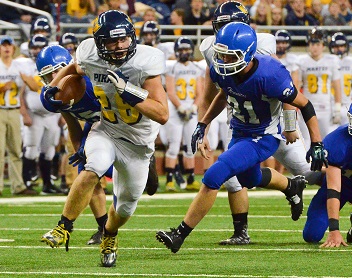
PHOTOS: (Top) Pewamo-Westphalia's Jared Smith came into this season with single-season rushing and touchdown records. (Middle) Smith works for yardage against Ishpeming during last season's Division 7 Final. (Click to see more from HighSchoolSportsScene.com.)