


New Football Practice Policies
March 25, 2014
Football Families Carry on Tradition
By
Tom Markowski
Special for Second Half
November 12, 2015
WATERFORD – Football always has been a family affair at Waterford Our Lady of the Lakes.
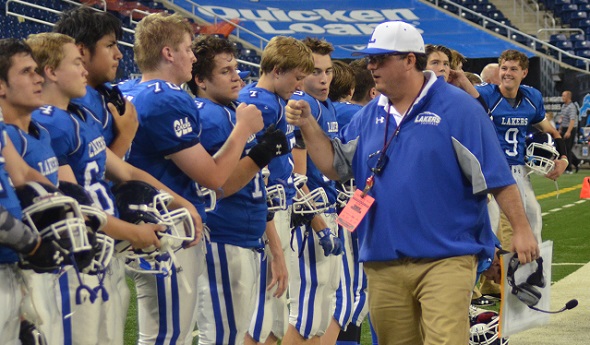
 It started with longtime coach Mike Boyd and continues on with Josh Sawicki, who’s in his third season as Lakes’ football coach.
Boyd retired after 2012 with 361 career victories, third most in MHSAA history. His sons, Mike, Jr., and Andy, played for him and contributed significantly to the Lakers’ success.
Mike Boyd played for his cousin, Leo “Smokey” Boyd, at Saginaw St. Peter & Paul.
And Boyd coached a number of siblings in his 48 seasons at Lakes. Josh and Jake Sawicki were two. Josh played linebacker and guard for four seasons, three times selected to all-state teams. Jake was a running back.
Sawicki took over for Boyd and has continued the winning tradition. Lakes was 8-3 his first season, 9-2 last season, and the Lakers are 11-0 heading into Saturday’s 1 p.m. Division 8 Regional Final against Saginaw Michigan Lutheran Seminary (10-1).
Those family ties continue as well. Quarterback Clay Senerius and receiver Devin Senerius are fraternal twins.
Clay is a three-year starter and is one of the top quarterbacks in Division 8. He’s 6-foot-3, 185 pounds and has been offered a scholarship by Avila University, an NAIA school in Kansas City (Mo.). Kalamazoo College, Hope College and St. Francis, located in Fort Wayne (Ind.) have also shown interest.
Senerius threw a school-record seven touchdown passes in a game as a junior. During his career he’s thrown at least five touchdown passes in a game five times. Through 10 games this season, he’s completed 107 of 171 attempts for 2,226 yards, 26 touchdowns and five interceptions.
And if Lakes wasn’t such a well-balanced team, those statistics would be even more impressive.
 “He’s a drop-back passer,” Sawicki said. “He has some athletic ability. What I like about him is he’s coachable. He throws a pretty pass. When he’s locked in, it’s like a video game.
“We throw it, but we don’t throw it that much.”
To the point, Lakes – Senerius, that is – threw for 2,900 yards last season and rushed for 1,200. This year the Lakers have gained half of their yards on the ground.
This team is primed to make a long playoff run. It’s dominated by seniors, and for a small school, the linemen are big. The offensive linemen average 235 pounds, the defensive linemen 260.
The best on offense is left guard Liam Sutton (6-0, 280), one of four seniors on the line. Sawicki will often run plays to Sutton’s side or use him as a pulling guard.
At nose guard is senior Anthony Clark (6-1, 310). Clark started playing football last season and is still developing. A state champion powerlifter, Clark is used just on defense.
Sawicki said a family member discouraged Clark from playing football.
“It took a while for his mom to allow him to play,” Sawicki said. “She was afraid he was going to get hurt. I assured her that Clark wasn’t going to be the one getting hurt.”
But what makes Lakes a team to be reckoned with is its offense, led by the Senerius twins and their other playmakers like Ryan Kostich, a 6-1, 215-pound linebacker and slot receiver, and running back-receiver Chris Cartier. Devin Senerius has 12 touchdown receptions and Cartier is averaging 13 yards every time he touches the ball, rushing and receiving.
“We have some really good receivers,” Clay Senerius said. “The last few weeks we’ve run the ball well, too. The offensive line is excelling.
“It’s great playing with my brother. I know typically what he’s going to do. I know where he’s going to be."
 Tom Markowski is a columnist and directs website coverage for the State Champs! Sports Network. He previously covered primarily high school sports for the The Detroit News from 1984-2014, focusing on the Detroit area and contributing to statewide coverage of football and basketball. Contact him at [email protected] with story ideas for Oakland, Macomb and Wayne counties.
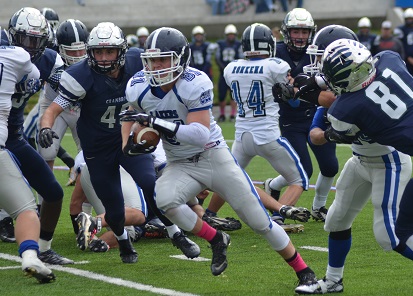
PHOTOS: (Top) Waterford Our Lady of the Lakes football coach Josh Sawicki fist-bumps his players during a Prep Bowl appearance at Ford Field. (Middle) Receiver Ryan Kostich (81) races through an opening during a 36-10 win over Bloomfield Hills Cranbrook Kingswood. (Photos by Paula Imboden.)