


New Football Practice Policies
March 25, 2014

Clarkston Kicker Grabs QB Opportunity
By
Tom Markowski
Special for Second Half
October 13, 2015
CLARKSTON – This season seemed to be going from bad to worse for Clarkston.
The Wolves were blitzed by Macomb Dakota, 35-10, in the opener and in their third game were tied 14-14 with West Bloomfield when starting quarterback Anthony Reiner suffered a broken hand.
 The two-time defending Division 1 champion went on to lose that game, 35-21, to fall to 1-2.
As poorly as Clarkston started the season, its fortunes changed. Alex Kessman, a senior who will in all likelihood be a place kicker at a Division I college next season, got an opportunity he really didn’t expect.
Kessman hadn’t played quarterback since the ninth grade, when he led Clarkston’s freshmen team to an undefeated season. When Reiner went out last month, coach Kurt Richardson went to Kessman – and he’s responded as if he was an experienced quarterback.
Kessman couldn’t rescue Clarkston against West Bloomfield, but the Wolves are 4-0 since with Kessman as the starter. He’s thrown seven touchdown passes including three in a 28-0 over Troy Athens.
If Kessman wasn’t such a fine place kicker and punter he likely would have started the season at quarterback. Instead he was in the secondary, kicked and was Reiner’s backup.
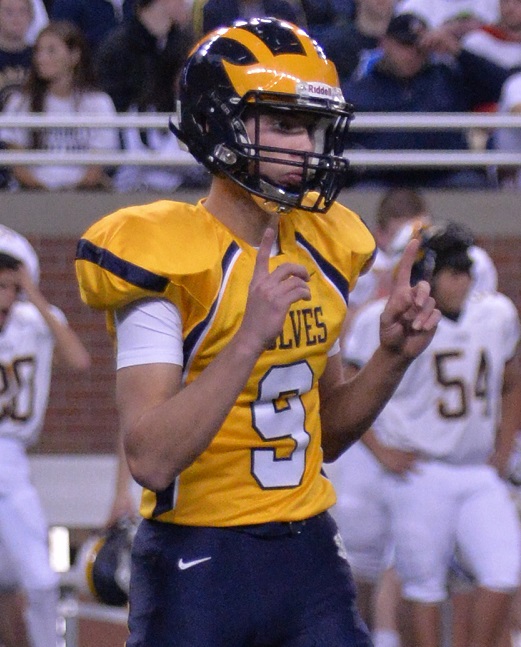 “We wanted to groom (Kessman) during the summer but he was always at kicking camps,” Richardson said. “The other guy was working real hard and we went with (Reiner).
“When Anthony got hurt it was a natural thing. I told him he was our best quarterback. At first it didn’t come quick. He’s gotten better every week. He’s got a very strong arm. We still run the same offense. We’re throwing more (with Kessman).”
Kessman no longer plays defense but he is still kicking, and kicking well. He kicked a 56-yard field goal against Dakota and has since kicked one from 53 yards out.
Kessman made his third visit to University of Pittsburgh last weekend and said the Panthers are at the top of his college list at this point. Mississippi State has offered Kessman preferred walk-on status and other schools such as Michigan, Florida and Tennessee also are in the mix.
Physically, Kessman is not your typical kicker. He’s 6-3 and weighs 185 pounds. He played basketball until his sophomore year, when he decided to concentrate on his kicking.
Kessman started playing football in the seventh grade and was a kicker even back then. As a sophomore he played safety and kicked as a member of the junior varsity. Last season Kessman was the punter and place kicker on varsity but did not play defense.
Now he’s showing he’s more than just a kicker, at least at this level.
“I wasn’t really rusty,” he said. “I was prepared if Anthony went down. I didn’t practice a lot (at quarterback). I threw occasionally. The first couple of plays I was nervous. I got comfortable. It was at halftime of the West Bloomfield game. Thanks to my teammates I have no trouble getting comfortable now.”
As one would guess, one of his biggest challenges was learning an extensive playbook. Richardson’s quarterbacks have much responsibility making proper decisions on read option plays and checking down on second and third receivers.
“I know the ins and outs now,” Kessman said. “That comes from off-the-field stuff. I put a lot of time in on my own. The toughest part is reading the corners and reading the safeties.”
Clarkston is averaging 40 points a game in Kessman’s four starts but it would be unfair to give him all the credit. The five offensive linemen who started in last season’s MHSAA Final graduated, and Clarkston is starting three underclassmen up front including two sophomores. The line struggled early on, but is playing much better now.
Then there’s Nolan Eriksen, a senior running back. Eriksen suffered a high ankle sprain in Clarkston’s inter-squad game during the preseason and made his season debut against Troy Athens. He scored four touchdowns in last week’s 42-0 victory over Troy.
“Eriksen is obviously fantastic,” Kessman said. “I know when I hand it off to him he’ll get at least five yards or take it all the way.”
 Tom Markowski is a columnist and directs website coverage for the State Champs! Sports Network. He previously covered primarily high school sports for the The Detroit News from 1984-2014, focusing on the Detroit area and contributing to statewide coverage of football and basketball. Contact him at [email protected] with story ideas for Oakland, Macomb and Wayne counties.
PHOTOS: (Top) Clarkston’s Alex Kessman lines up for a punt during last season’s Division 1 Final at Ford Field (Middle) Kessman signals before another punt. (Below) Kessman is considered a Division I college prospect as a kicker.