


New Football Practice Policies
March 25, 2014
A Game for Every Fan: Week 2
September 2, 2015
By Geoff Kimmerly
Second Half editor
Most of this week’s MHSAA varsity football games will again be played over both Thursday and Friday, similar to last week and this time in anticipation of travelers leaving town for an extended Labor Day break. In fact, nearly 80 percent of games will be played tonight.
But unlike last week, there aren’t a ton of matchups that jump out and announce, “You can’t miss this.” And that’s where we come into the mix.
See below for some of the possible jewels from this weekend’s schedule, all to be played tonight unless noted. And remember to follow all of the results as they come in at the MHSAA Score Center.
Bay & Thumb
Freeland (1-0) at Chesaning (1-0)
It’s tough to believe once-powerful Chesaning hasn’t made the playoffs since 2007. But the Indians finished with a winning record last fall for the first time since that season, and debuted a snazzy synthetic turf field last week. Anticipation is high, and they now host Freeland, which is coming off a 10-2 finish in 2014 and beat Chesaning 42-0 a year ago.
Others that caught my eye: Frankenmuth (1-0) at Birch Run (0-1), Bad Axe (1-0) at Marlette (1-0), Richmond (1-0) at Yale (0-1), St. Clair (0-1) at Marine City (0-1).
Greater Detroit
Clinton Township Chippewa Valley (1-0) at Macomb Dakota (1-0)
This continues to be the most exciting rivalry in Macomb County after a third straight season of multiple matchups a year ago – the teams split, with Dakota winning in Week 2 by 21 points and the Big Reds claiming the District Final 28-27. The Cougars are coming off arguably the most notable victory of Week 1, a 35-10 defeat of reigning MHSAA Division 1 champion Clarkston. But Chippewa Valley downed generally-strong Lake Orion top open for the second season in a row and is plenty capable of making this the state’s best matchup of the week.
Others that caught my eye: Detroit Country Day (1-0) at Detroit U-D Jesuit (1-0), Grosse Pointe South (1-0) at Romeo (1-0), Sterling Heights Stevenson (1-0) at Utica Eisenhower (1-0), Allen Park (1-0) at Wyandotte Roosevelt (1-0).
Mid-Michigan
Mason (1-0) at Eaton Rapids (1-0)
Mason’s experienced offense showed the difference a year can make by putting up 56 points in a win over Okemos last week after scoring only 14 against the Chieftains on opening night 2014. The Bulldogs went on last year to score a season-low 10 points in three games – including in a Week 2 10-7 win over Eaton Rapids. The Greyhounds are seeking to take the next step in their revival with a first win over Mason since 1993.
Others that caught my eye: Laingsburg (1-0) at Fowler (1-0), Sand Creek (1-0) at Stockbridge (1-0), Beal City (1-0) at Clare (0-1) (Fri.), Grand Rapids NorthPointe Christian (1-0) at Mount Pleasant Sacred Heart (0-1) (Fri.).
Northern Lower Peninsula
Escanaba (1-0) at Petoskey (1-0)
The coach Dave Howes era at Escanaba began last week with a win over Alpena, which actually counts as the team’s third victory in four games going back to last fall. That’s something to build on for a program seeking its first winning season since 2011 and facing an opponent that has won 14 of its last 18 games. Petoskey could be a Big North Conference contender and would love to enter league play 2-0 for the third straight season.
Others that caught my eye: Boyne City (1-0) at Charlevoix (1-0), Gaylord (1-0) at Grayling (1-0), Whittemore-Prescott (0-1) at Oscoda (1-0), Traverse City St. Francis (1-0) at McBain (1-0).
Southeast & Border
Morenci (1-0) at Hudson (1-0)
Morenci burst back among this area’s elite last fall with its best finish (10-2) since 1996, and continued by beating another 2014 playoff team, Pittsford, 44-6 last week. The 21-16 victory over Hudson in Week 2 last season got momentum rolling in a big way for the Bulldogs and could do so again – but also was Hudson’s only regular-season loss, meaning the Tigers will be more than ready for the rematch.
Others that caught my eye: Portland (1-0) at Hillsdale (1-0), Concord (1-0) at Union City (1-0), Onsted (1-0) at Adrian Madison (1-0), Detroit Cesar Chavez (1-0) at Ida (1-0).
Southwest Corridor
Portage Central (1-0) at Battle Creek Lakeview (1-0)
After facing each other in a 2013 District Final, these two Southwest Michigan Athletic Conference contenders didn’t get to play each other last fall because weather washed the Week 2 game out. Lakeview went on to win the SMAC East and Portage Central was second in the SMAC West, and this should again be a matchup of contenders in their respective divisions.
Others that caught my eye: Decatur (1-0) at Constantine (0-1), Vicksburg (1-0) at Edwardsburg (1-0), Paw Paw (1-0) at Plainwell (1-0), Richland Gull Lake (1-0) at St. Joseph (1-0).
Upper Peninsula
Calumet (1-0) at Negaunee (1-0)
These northern U.P. neighbors re-started their series three seasons ago, and two of the first three games have been decided by eight or fewer points – although Negaunee has won all three of their matchups. Last season’s 31-22 win was a big reason why the Miners were able to qualify for the playoffs at 5-4 – and also ended up the closest loss for the Copper Kings, who ended 7-4.
Others that caught my eye: L’Anse (1-0) at Iron River West Iron County (1-0), Traverse City Central (1-0) at Marquette (0-1) (Fri.), Bark River-Harris (1-0) at Gogebic (1-0) (Fri.), Hurley, Wis. (2-0) at Lake Linden-Hubbell (1-0) (Sat.).
West Michigan
Detroit Loyola (0-1) at Muskegon Oakridge (1-0), Friday
Oakridge loaded its schedule with two reigning MHSAA champions to start things off this fall and last week ended Division 8 champ Muskegon Catholic Central’s 26-game winning streak. Like MCC, Loyola – the reigning winner in Division 7 – graduated many of its top contributors from the last few seasons. But the Bulldogs looked capable again in falling to reigning Division 3 champion Orchard Lake St. Mary’s 24-12 in their opener.
Others that caught my eye: Grand Rapids South Christian (0-1) at Caledonia (1-0), Ravenna (1-0) at Montague (1-0), Holt (0-1) at Rockford (0-1), Muskegon (0-1) at Grand Rapids Christian (1-0) (Fri.)
8-Player
Engadine (1-0) at Powers North Central (1-0), Friday
North Central, home to the reigning Class D boys basketball champion as well, is new to 8-player this season and put up a basketball-like 82 points last week. The Jets are only two seasons removed from an 8-3 record in 11-player, but should get more of a test from Engadine, a playoff team in 8-player three of the last four seasons.
Others that caught my eye: Onaway (0-1) at Brimley (0-1), Tekonsha (1-0) at Webberville (1-0).
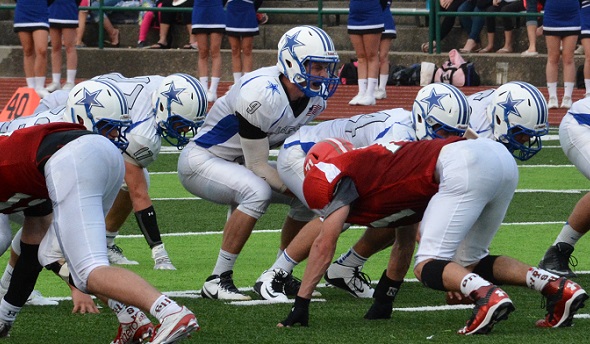
PHOTO: Beal City quarterback Tucker Gross prepares to receive the snap during Friday’s win over Mount Pleasant Sacred Heart.