


NFHS Voice: Campaign Touts Benefits of High School Football
By
Karissa Niehoff
NFHS Executive Director
May 21, 2021
A full return to high school sports and performing arts programs – that’s the hope for this fall in schools across the country.
After a year of unprecedented challenges in keeping these programs going due to the pandemic, which included 11 states that conducted their primary football season this spring, there is great optimism as we look to a new school year.
Even in those states that were able to conduct activities last fall, attendance restrictions kept many fans out of stadiums and watching games online. However, with vaccine eligibility now at 12 years of age and older and with vaccinations continuing during the next three months, the likelihood of routines and traditions returning this fall grows stronger each day.
And there is no tradition more anticipated than the full-scale return of high school football. While there were 34 states there were fortunate enough to conduct football at some level last fall, the routines were anything but normal.
This fall, however, we anticipate a return to the energy and excitement of the 2019 season when 1,003,524 boys participated in 11-player football. That total marked a decline of only 2,489 from the previous year and was a good sign of a renewed confidence on the part of parents and student-athletes that concerns about the risk of injury were being addressed.
While boys participation in 11-player football has exceeded one million participants every year since 1999 and is overwhelmingly the most popular boys sport, there have been concerns about declines in past years.
Last fall, the NFHS and the National Football League announced a partnership to promote the growth, understanding and support for football at the high school level. The NFHS and NFL have been studying participation trends, developing educational tools and striving to restore confidence in students and parents that the sport is, in fact, more focused on risk minimization than ever before.
As a result, the springboard to the return of high school football next fall begins this week with the launch of the #ThisIsHSFootball campaign. Through this effort over the next few months, the NFHS will be reaching out to coaches, students, parents, officials, athletic directors and others with research information, participation trends and data on various risk mitigation efforts that, we believe, continues to make high school football safer than it has ever been.
As a part of this effort, the NFHS produced a video entitled “This is High School Football” designed to detail the benefits of participation in high school football.
As the video states, more so than at any other level of play, parents should feel good about their kids playing high school football.
>Here are some of the many educational and medical safeguards put in place the past 12 years to offer parents a comfort level about the safety standards that are a part of high school football.
► Concussion research and education. All NFHS high school playing rules require a student who is exhibiting signs of a concussion to be removed from the game and not allowed to return until the student has been cleared by a medical professional. Thanks to education and training on the part of students, coaches, trainers, parents and others, research data has shown positive trends in concussion rates. In a recent five-year period, concussion rates during practices dropped from 5.47 to 4.44 concussions per 10,000 athletic exposures.
► Concussion in Sport Course. This free online education course has been available through the NFHS Learning Center since 2010, and millions of individuals have taken the course for a deeper understanding about concussions.
► Concussion Laws. By 2014, every state had adopted state concussion laws that established mandatory protocols, and every state high school association has adopted policies that limit contact during preseason drills and in practices during the season.
► Football equipment. Manufacturers continue to produce higher quality equipment every year, and high school coaches are doing a much better job at teaching and coaching the rules of the game and making attempts to minimize risk of injury for players.
► Emergency Action Plans. Thanks to the NFHS Foundation, a copy of the “Anyone Can Save a Life” emergency action plan originally developed by the Minnesota State High School League was sent to all state high school associations and their high schools, and all schools have access to an AED to help save lives.
► Playing Rules. Risk minimization is a major focus of every NFHS sports rules committee. In football, helmet-to-helmet hits are not allowed.
High school football has been a significant part of schools, towns and communities across America for almost 100 years. The NFHS is committed to making the sport as safe as possible for the millions of kids who will play the sport in the years to come.
Dr. Karissa L. Niehoff is in her third year as executive director of the National Federation of State High School Associations (NFHS) in Indianapolis, Indiana. She is the first female to head the national leadership organization for high school athletics and performing arts activities and the sixth full-time executive director of the NFHS, which celebrated its 100th year of service during the 2018-19 school year. She previously was executive director of the Connecticut Association of Schools-Connecticut Interscholastic Athletic Conference for seven years.
1st & Goal: 2025 Playoffs Week 3 Preview
By
Geoff Kimmerly
MHSAA.com senior editor
November 12, 2025
The MHSAA Football Playoffs turn into a second season for teams still alive at this late date – and it’s impossible to not begin sensing the opportunities opening up for those teams as we move into mid-November.
 With two weeks remaining in the 8-player season, we’re running a counter and starting this week with a little deeper dive into our four Semifinals in those divisions. One reigning champion is still in pursuit of a Superior Dome return, and two teams are seeking Saturday to reach Finals for the first time.
After that, we check out Regional Finals in every 11-player division, with four games matching undefeated opponents. All of those games are Friday unless noted below, and Semifinals sites will be announced Sunday.
Tickets this weekend are $9 for 11-Player Regional Finals and $10 for 8-Player Semifinals and can be purchased at GoFan.co. All four 8-Player Semifinals and all 32 11-Player Regional Finals will be broadcast and available to watch with subscription on the NFHS Network.
8-Player Division 1
Blanchard Montabella (10-1) vs. Norway (11-0) at Traverse City’s Thirlby Field WATCH
Montabella has pulled within one more win of reaching the Finals for the first time, its only loss this season to Division 2 semifinalist Portland St. Patrick. As a team, the Mustangs are averaging 8.5 yards per carry, paced by senior Brady Kieff (1,475 yards, 8.5 per carry, 16 touchdowns rushing). Norway last reached the Semifinals in 2006 (in 11-player) but has seemed on the verge of a run since moving to 8-player in 2021. Senior quarterback Owen Baij has run for a team-high 1,443 yards and 30 touchdowns and thrown for 817 yards and 13 more scores.
Kingston (10-1) vs. Martin (11-0) at Chelsea WATCH
Martin moved to a combined 13-2 in playoff games this decade with last week’s 36-20 win over Climax-Scotts, and the Clippers are once again led by a two-way threat in senior quarterback Haylen Buell, who has run for a team-high 1,528 yards and 32 touchdowns and thrown for 866 and 13 scores. Kingston has run into eventual champions the last two seasons, falling to Martin in a Semifinal in 2023 and then Deckerville in a Regional Final last year. The Cardinals are attempting to reach their first championship game powered as well by a dangerous two-way quarterback in senior Tanner James (524 yards/11 TDs rushing, 902/20 passing).
8-Player Division 2
Felch North Dickinson (11-0) vs. Onekama (11-0) at Marquette WATCH
North Dickinson has stormed into its first Semifinal since 2001 (in 11-player) with senior quarterback Brady Jungwirth directing an offense that has outpaced every opponent by at least three touchdowns, including adding to a 38-34 win over Lake Linden-Hubbell in Week 1 with a 32-12 win in their rematch last weekend. Jungwirth has thrown for 1,888 yards and 28 touchdowns, with just three interceptions. Onekama is playing in a second-straight Semifinal seeking to get to the Superior Dome for the first time since 2018, paced by a pair of running backs both averaging more than nine yards per carry – senior Tyler Hart (859 yards, 15 TDs rushing) and freshman Bennett Zeller (821/13).
Deckerville (10-1) vs. Portland St. Patrick (11-0) at Mount Pleasant WATCH
Deckerville won Division 1 last season and is seeking to return to Superior Dome with junior Brandon Salowitz moving up from supporting cast in 2024 to the starring role. He’s the leading rusher with 1,311 yards and 24 touchdowns, starts at linebacker and punts. The Shamrocks are working to get back to the Finals for the first time since 2020 and showed off a dynamic playmaker as well last week in senior running back/linebacker/punter Brady Leonard, who has run for 1,091 yards and 14 touchdowns and intercepted 10 passes. He scored five touchdowns in last week’s 51-22 win over previously-undefeated Mendon.
11-Player Division 1
Detroit Catholic Central (11-0) at Clarkston (10-1) WATCH
These two have met twice previously in playoff games, with Clarkston winning both including their Division 1 championship matchup in 2013. These days, Detroit Catholic Central has won 22 of its last 23 games – the only loss to eventual champion Detroit Cass Tech during last year’s Semifinals – and perhaps most impressively this fall hasn’t given up more than 14 points in a game despite playing Grand Ledge and Detroit Martin Luther King on top of a loaded Catholic High School League Central slate. Clarkston is a 27-21 Week 2 loss to undefeated Harper Woods from a perfect run through this season as well, and handed previously-unbeaten Grand Blanc its only loss last week – doubling up the Bobcats 44-22. The Wolves also won all of their games in the power-packed Oakland Activities Association Red by at least two touchdowns.
Other Regional Finals FRIDAY Detroit Cass Tech (11-0) at Saline (10-1) WATCH, Romeo (8-3) at Rochester Adams (9-2) WATCH. SATURDAY East Kentwood (9-2) at Hudsonville (11-0) WATCH.
11-Player Division 2
Orchard Lake St. Mary’s (8-2) at Midland Dow (10-1) WATCH
Reigning Division 2 champion St. Mary’s cleared a major hurdle last week, avenging a Week 8 loss with a 35-14 win over rival Bloomfield Hills Brother Rice. But the Eaglets obviously can’t rest this weekend. Dow played three teams during the regular season playing this weekend for Regional championships (and went 2-1 against them), and a win would send the Chargers to the Semifinals for the first time since 1997. That only loss this fall came to still-undefeated Mount Pleasant in Week 3, and Dow hasn’t given up more than 15 points since.
Other Regional Finals FRIDAY Traverse City Central (7-4) at Portage Central (11-0) WATCH, Dexter (10-1) at Gibraltar Carlson (11-0) WATCH, Birmingham Groves (8-3) at St. Clair Shores Lakeview (9-2) WATCH.
11-Player Division 3
Warren De La Salle Collegiate (5-6) at Detroit Martin Luther King (7-4) WATCH
As likely anticipated, both of these teams have surged in the postseason after navigating two of the toughest schedules in the state. The Pilots actually have won four of their last six games and opened the playoffs with a 56-34 victory over Macomb Area Conference Gold champion Warren Fitzgerald before downing Port Huron last week. King provides another level of challenge, and it opened the playoffs defeating Huron League co-champ Riverview before downing Trenton to clinch a District title.
Other Regional Finals FRIDAY East Grand Rapids (9-2) at Mount Pleasant (11-0) WATCH, Zeeland West (8-3) at Lowell (9-2) WATCH, Fenton (8-3) at DeWitt (11-0) WATCH.
11-Player Division 4
Goodrich (11-0) at Williamston (11-0) WATCH
This could be a clash of styles as Williamston rode big plays to a comeback win last week over Haslett, while Goodrich has won 24 straight games (including last season’s championship decider) with a powerful running attack and physical defense that earned its first shutout of this season last week against Chelsea. The Hornets trailed Haslett 21-7 at halftime last week before scoring 28 third-quarter points mixing speed to get to the perimeter and a potent downfield passing attack.
Other Regional Finals FRIDAY Big Rapids (10-1) vs. Hudsonville Unity Christian (10-1) at Hudsonville Baldwin WATCH. SATURDAY Vicksburg (7-4) at Portland (11-0) WATCH, Dearborn Divine Child (10-1) vs. Harper Woods (11-0) at Westland John Glenn WATCH.
11-Player Division 5
Frankenmuth (10-1) at Pontiac Notre Dame Prep (9-2) WATCH
It was easy at the start of these playoffs to circle this rematch of last year’s Division 5 championship game as one of the most notable matchups in the entire bracket. Notre Dame Prep won last season’s 42-7 and has continued to follow the lead of quarterback San Stowe, putting up 50 or more points against five playoff teams over the course of this fall. The Eagles will counter with a defense that has shown itself plenty capable allowing only 10 points a game and giving up only 17 in its lone loss to reigning Division 4 champ Goodrich.
Other Regional Finals FRIDAY Kalamazoo United (9-2) at Grand Rapids West Catholic (10-1) WATCH, Michigan Center (10-1) at Monroe Jefferson (10-1) WATCH. SATURDAY Ogemaw Heights (10-1) at Saginaw Swan Valley (10-1) WATCH.
11-Player Division 6
Montrose (11-0) at Kent City (11-0), Saturday WATCH
Montrose has built on its first perfect regular season since 2013 with a pair of big home playoff wins the last two weeks, but will travel for this one to take on a Kent City team that finished the regular season undefeated for the first time since 2017 and has added the first District championship in program history. The Eagles no doubt are enjoying a little bit of an additional bump this week with this game at home after playing their first two playoff games – and five of their last seven total – on the road.
Other Regional Finals FRIDAY Reed City (9-2) at Kingsley (9-2) WATCH, Ida (9-2) at Jackson Lumen Christi (8-3) WATCH, Detroit Edison (9-2) at Almont (11-0) WATCH.
11-Player Division 7
Clinton (9-2) at Millington (9-2), Saturday WATCH
This will be the first playoff meeting between these two annual contenders, and neither will shy away from taking on an unfamiliar but powerful opponent. Clinton’s losses this season were to undefeated Hudson and last year’s Division 7 runner-p Monroe St. Mary Catholic Central, and the Redwolves avenged the latter last week by a 22-14 score. The Cardinals won the Division 7 title a year ago downing SMCC 24-0. They lost early this fall to Cass City and then to undefeated Harbor Beach in the regular-season finale – but stormed back to win both of their first two playoff games 49-0.
Other Regional Finals FRIDAY Ithaca (8-3) at Pewamo-Westphalia (10-0) WATCH. SATURDAY Shelby (7-4) at Menominee (11-0) WATCH, Schoolcraft (9-2) at Hanover-Horton (9-2) WATCH.
11-Player Division 8
Beal City (11-0) at Harbor Beach (11-0), Saturday WATCH
The reigning Division 8 champion Aggies have rumbled through their competition this season, winning all of their games by at least two touchdowns and by 40 points on average. Harbor Beach is pursuing a first Regional title since 2018 and has been similarly dominant, winning its games by an average score of 41-8. Both closed the regular-season with a notable nonleague win as well – Harbor Beach over reigning Division 7 champion Millington, and Beal City over Ithaca, which like the Cardinals is also playing for a Division 7 Regional title this weekend.
Other Regional Finals FRIDAY Springport (11-0) at Hudson (11-0) WATCH, Bark River Harris (9-1) at Maple City Glen Lake (9-1) WATCH, Allen Park Cabrini (10-1) at Madison Heights Madison (10-1) WATCH.
MHSAA.com's weekly “1st & Goal” previews and reviews are powered by MI Student Aid, a division within the Department of Lifelong Education, Advancement, and Potential (MiLEAP). MI Student Aid encourages students to pursue postsecondary education by providing access to student financial resources and information. MI Student Aid administers the state’s scholarship and grant programs that help make college Accessible, Affordable and Attainable for you. Click to connect with MI Student Aid and find more information on Facebook and Twitter @mistudentaid.
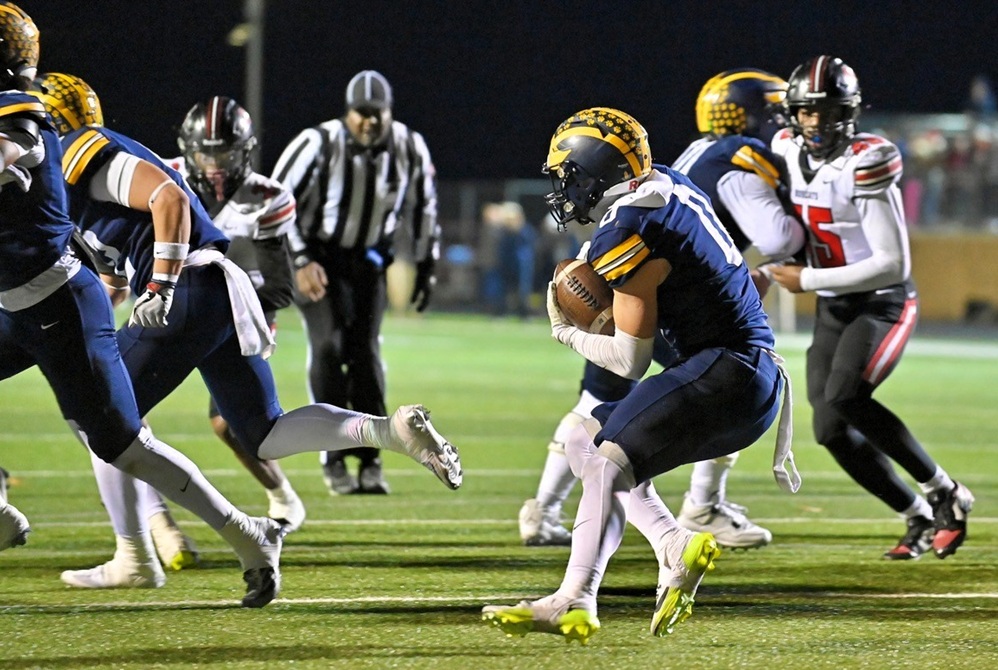
PHOTO Clarkston's Griffin Boman (0) follows his blockers as a Grand Blanc defender pursues during the Wolves' District Final win last Friday. (Photo by Terry Lyons)