


NFHS Voice: Fall Fridays for HS Football
October 28, 2019
By Karissa Niehoff
NFHS Executive Director
Some of the top football matchups featuring Ohio teams Friday, Oct. 18, were Mentor vs. Shaker Heights, Cleveland St. Ignatius vs. Cincinnati Archbishop Moeller, Cincinnati St. Xavier vs. Massillon Washington and Northwestern vs. Ohio State.
That’s correct, Northwestern University vs. Ohio State University, on Friday night. While the game was in Evanston, Illinois, and not Columbus, it was televised on the Big Ten Network. Ohio State, one of the nation’s top-ranked college teams with one of the strongest fan bases, played on Friday night in direct competition with the several hundred high school games across the state.
And that wasn’t the only college football game on Friday night. There were three other FBS (I-A) matchups, including an Atlantic Coast Conference game between Pittsburgh and Syracuse. Through the first eight weeks of the season, there have been about 25 major college football games on Friday night.
A number of high schools in Ohio moved their games earlier in the hope of finishing before the start of the Ohio State-Northwestern game. Others moved their games to Thursday or Saturday. At least one school – Ursuline Academy in greater Cincinnati – urged its fans to not watch the Ohio State game:
“Please make a statement to Ohio State by NOT watching their Friday night game this week. Friday nights are for HS football. Let’s keep it that way. Support your local team. We play Boardman, and would love to have you in our stands, but that’s not the point. Support HS football.”
High schools should not have to adjust their schedules to accommodate colleges playing on Friday nights. High school coaches, administrators and fans are opposed to colleges playing on Friday nights. The NFHS and its member state associations are opposed. Even leaders in the Ohio State administration did not initially support the idea of the Buckeyes playing on Friday night. Friday nights are for high school football and should remain that way.
Two years ago, the NFHS membership adopted the following resolution:
“Be it RESOLVED that every Friday night during the fall in America is ‘High School Football Night.’
“Be it FURTHER RESOLVED that college and professional football teams should refrain from scheduling contests on Friday nights. Such restraint would be an investment in their own future success. It would also demonstrate that high school football has value well beyond the field of play. Schools, communities and scholastic teams for girls and boys all benefit when football is strong.
“THEREFORE, the National Federation of State High School Associations urges all parties to observe the central premise of this resolution.”
In addition to the Big Ten Conference, teams in the Pac-12, Mountain West, Atlantic Coast and American conferences, as well as Conference USA, have played on Friday nights. When these current television contracts expire, it is the desire of everyone within the high school community that new deals would preserve Friday nights for high school football.
Friday nights offer communities a traditional time and place to congregate and support their students. As was the case last week in Ohio, a college game on Friday night impacts interest and attendance at high school games.
Let’s maintain Friday nights in the fall for high school football. It is a win-win for everyone.
Dr. Karissa L. Niehoff is in her second year as executive director of the National Federation of State High School Associations (NFHS) in Indianapolis, Indiana. She is the first female to head the national leadership organization for high school athletics and performing arts activities and the sixth full-time executive director of the NFHS, which celebrated its 100th year of service during the 2018-19 school year. She previously was executive director of the Connecticut Association of Schools-Connecticut Interscholastic Athletic Conference for seven years.
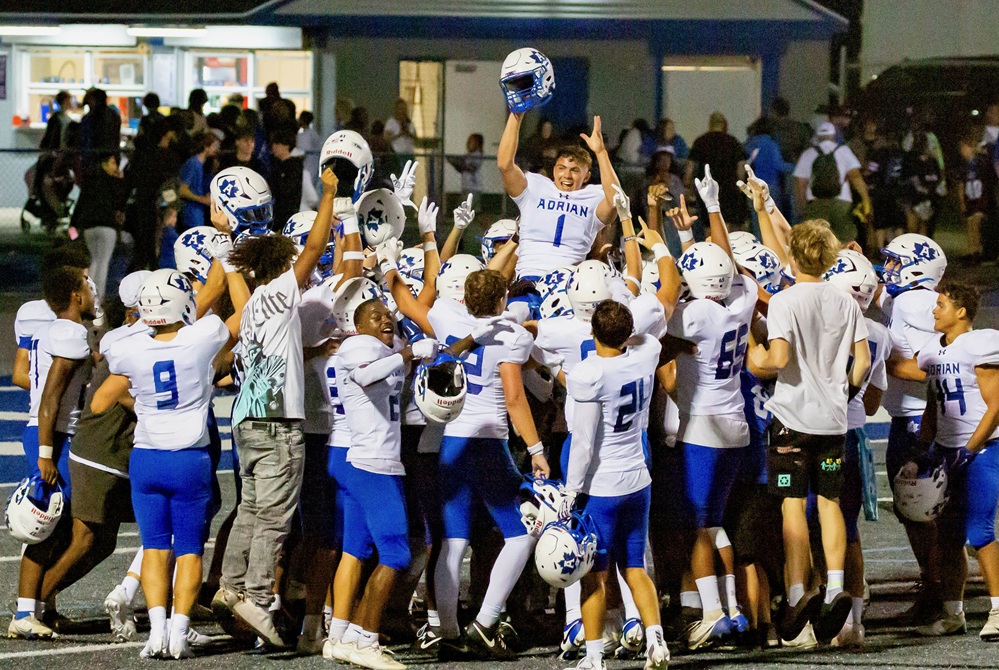
Friday's Game-Winner Latest, Greatest Highlight for Adrian Kicker Hassan
By
Doug Donnelly
Special for MHSAA.com
September 30, 2025
When Zack Hassan was a freshman, he decided to play two sports at Adrian High School – soccer and football.
 Because he was a soccer player, the Maples’ football coaches decided he would be a good candidate to be a kicker.
“I had never really kicked a football before, but they thought I could because I played soccer,” Hassan said. “I thought, ‘Sure, why not?’”
Fast forward four years and Hassan is no longer a soccer player. He not only is the Adrian kicker – he is eying a college football scholarship and Friday had the biggest moment of his career when he booted a 37-yard field goal as time expired to give Adrian its biggest football win in years.
“I love the pressure moments,” Hassan said. “I like having all of the eyes on me and going out there and kicking.”
Hassan also played receiver and defensive back the last couple of years, but is focused entirely on kicking this season because of a knee injury suffered toward the end of basketball season. He’s delayed surgery because he didn’t want to miss his senior year of football.
“I could have played receiver this season, but I wanted to be safe,” Hassan said. “I had a choice. I could have had surgery before the season or in the middle, but I just wanted to finish out my last year.”
The injured knee part of his kicking leg – but that’s probably for the best if he had to be injured at all.
“As a kicker its almost better because I don’t have to worry about planting,” he said. “That would be constant impact on it. It’s not super bad. I think I will recover quickly. I should be 100 percent by April or May. I should probably try to save the leg, but I enjoy kicking. I like to kick as much as possible in practice.”
Hassan handles all placekicking duties for Adrian, but doesn’t punt. Maples coach Joel Przygodski said Hassan would make a good punter, though.
“He has a strong leg,” he said. “He regularly kicks off to the 10-yard line. It’s a nice weapon to have.”
Hassan’s family moved to Adrian from Sylvania, Ohio, when he was in middle school.
“When I was growing up, I thought I was going to be a basketball player,” he said.
After he joined the varsity football team as a freshman, he decided he liked kicking.
“After freshman year I thought maybe I could get some free tuition out of this,” he said.
 He’s made two college visits already – to Baldwin Wallace in Ohio and Macalester College in Saint Paul, Minn., which has offered him a scholarship. He’s headed back to Macalester in a few weeks to check out what it’s like on game day.
“They are a very good school to get an education,” said Hassan, who has a grade point average above 4.0.
Hassan’s siblings stayed on the soccer route. His older sister was a college goalkeeper and his younger sister plays soccer for Adrian.
On Friday, Adrian was locked in a 0-0 tie with unbeaten Ypsilanti Lincoln. In the fourth quarter the two teams exchanged punts, swapping field position. Adrian got the ball back with fewer than 40 seconds left.
“As coaches, we talked about whether or not we wanted to play it safe, play for overtime,” Przygodski said.
After an incomplete pass on first down, running back Luke Bruggeman carried the ball up the middle and broke a tackle to put the ball past midfield. He even got out of bounds to stop the clock.
“I was thinking, okay, we are in business,” Przygodski said.
After quarterback Jaxon Dowling connected with receiver Adam Parker to reach the Lincoln 25-yard line, Przygodski knew the Maples had a chance. Hassan was warming up.
“We were telling him to be ready,” Przygodski said.
Hassan had missed two field goals earlier in the game. One of those attempts was from 48 yards out.
“My coaches just told me to get ready and told everyone else to stay away from me,” Hassan said.
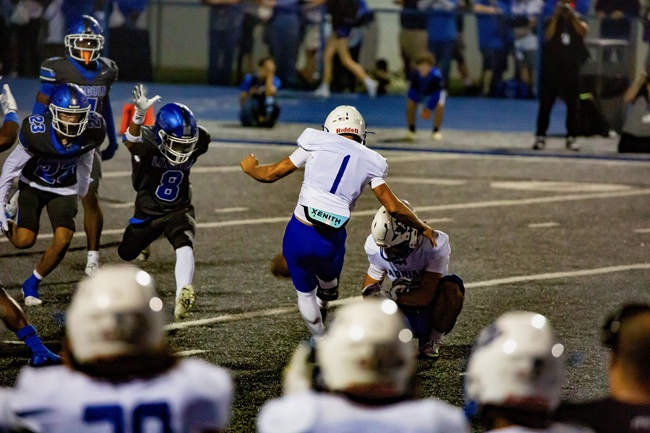
With less than 1.5 seconds to play, Adrian reached the 20-yard line and called timeout. Hassan trotted out onto the field. The snap was a little slower than he was used to, he said, but he lined up perfectly and hit the 37-yarder, sending the Maples into a frenzy and stunning the home crowd of about 3,000 people at Lincoln’s homecoming.
Hassan was carried off the field by teammates – and not because of an injury.
“After we shook hands, we went into huddle and everyone was like, ‘Lift him up, lift him up,’” he said.
The win was a big one for Adrian, which continues to make strides under Przygodski’s leadership. Adrian is 4-1 with chief rival Tecumseh coming up this week. The Maples have a lot of momentum for the rest of the season.
“Going into the season we were really unsure how we were going to be, because we lost a lot of seniors last year,” Hassan said. “It’s good. We’ve had a lot of people step up. We are turning a lot of eyes right now.”
 Doug Donnelly has served as a news and sports reporter at the Adrian Daily Telegram and the Monroe News for 30 years, including 10 years as city editor in Monroe. He's written a book on high school basketball in Monroe County and compiles record books for various schools in southeast Michigan. He is now publisher and editor of The Blissfield Advance, a weekly newspaper. E-mail him at [email protected] with story ideas for Jackson, Washtenaw, Hillsdale, Lenawee and Monroe counties.
PHOTOS (Top) Adrian kicker Zack Hassan is carried by his teammates after making the game-winning field goal Friday against Ypsilanti Lincoln. (Middle) Hassan steps into his winning kick. (Photos by Marnette Sutherland.)