

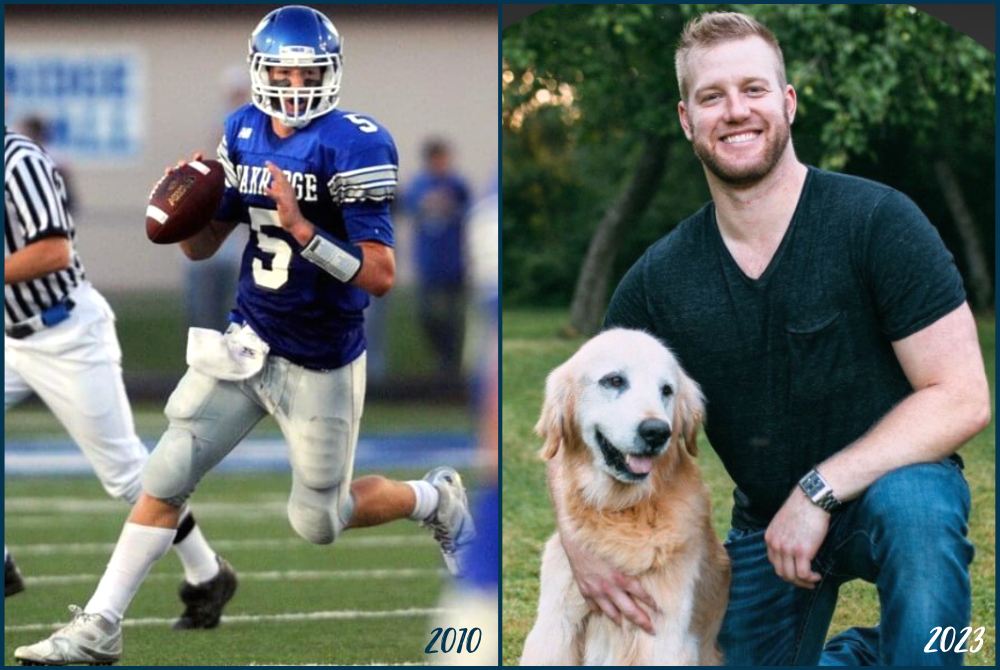
Oakridge 3-Sport Star Potts Applying Lessons to 'Second Chapter' in Sales
By
Tom Kendra
Special for MHSAA.com
July 20, 2023
Jamie Potts put a major strain on his feet and ankles for many years.

Potts was constantly twisting and contorting in cleats and sneakers as a three-sport standout at Muskegon Oakridge and later as a rare two-sport star at Grand Valley State University, where he is still listed in the school’s football and baseball record books.
So it’s fitting that the 30-yeaar-old Potts is now helping to heal feet and ankles as a medical device salesman for Stryker.
“It’s a very competitive, fast-paced job and lifestyle,” said Potts, who graduated from Oakridge in 2011.
“I am very thankful for that because there is a huge void there. When you put so much of your time and energy into it, transitioning out of competitive sports is difficult.”
Potts is the youngest of four boys, so he practically grew up in the bleachers at Oakridge. By the time he got to high school, he fell effortlessly into the rhythm of football in the fall, basketball in the winter and baseball in the spring – all while maintaining a 4.1 GPA, good for fifth overall in his class.
Potts did everything on the football field at Oakridge, as a 6-foot-3, 200-pound dual-threat quarterback. As a senior, he rushed for 1,561 yards and 24 touchdowns and threw for 696 yards and 10 TDs – along with totaling 64 tackles and successfully booting 9-of-13 field goal attempts.
“He was a fantastic high school athlete and one of the best athletes to ever come out of Oakridge,” said former Eagles coach Jack Schugars, the all-time winningest high school coach in the Muskegon area who is now the special teams coordinator at Ferris State. “He was a tremendous leader and the epitome of a role model for younger kids.”
Potts was a solid, if not spectacular, basketball player, known as a defensive specialist who wasn’t afraid to guard anybody.
Then in the spring, he was back to all-state status in baseball as an outfielder, batting .584 his senior year with six home runs, 38 RBIs and 34 stolen bases.
That meant it was decision time when it came to college – would it be football or baseball?
Potts received several Division I offers, including from Central Michigan University for football and Oakland University for baseball.
But it was Division II Grand Valley, particularly then-assistant coach Matt Yoches (now the director of football operations at Miami of Ohio) that floated the possibility of playing both sports – a very rare feat at the DII level.
Potts made the GVSU coaches look like geniuses. He was a four-year starter at tight end and receiver, finishing his career second all-time for the Lakers in TD receptions (35) and third in career receptions (169). In baseball, he finished with 241 career hits, the fifth-most in school history at the time.
“People told me that playing both in Division II wasn’t realistic,” said Potts, who now lives on the east side of the state in Fenton, with his 1-year-old daughter, Brooklyn. “But I wanted to give it a shot and I think I did all right with it. Growing up in Oakridge, my life was all about sports, so it prepared me.”
 Potts was drafted by the Texas Rangers shortly after his senior collegiate baseball season in 2015 and played that summer for Class A Spokane (Wash.), batting .217 with four home runs in 57 games. He missed training camp and the first two games of the 2015 football season, but returned to help the Lakers to the DII Semifinals his senior year.
He prepared to resume his baseball career and left in late February for the Rangers spring training complex in Surprise, Ariz., before announcing his retirement in March with a long and heartfelt Facebook post, which concluded:
“My best advice I can give is that you should always chase your dreams until your heart says it’s time to stop,” Potts wrote. “No matter how far out of reach you think it is or how old you are, you can do it with enough hard work and preparation.”
Potts, who completed his degree in allied health sciences with a minor in psychology during the Lakers’ 2015 football run, then had to shift gears and find his place in the “real world,” outside of competitive sports.
Potts said Oakridge, in addition to being a hard-working sports community, also did a mighty fine job preparing him and his three older brothers, sons of Tom and Kathy Potts, for life after athletics. Oldest brother Chris is an engineer, Andy works as a logistics manager and Aaron is an orthopedic surgeon.
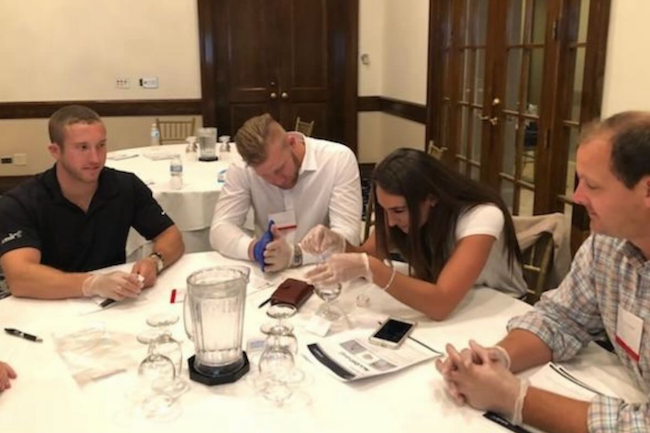
It was actually Aaron who pointed him in the direction of medical device sales. He went through five interviews shortly after his retirement before landing his first job in the field at Arthrex in Grand Rapids, before moving on to Kalamazoo-headquartered Stryker last year.
“A big part of my job is being in the operating room with the surgeons and making sure that everything is working,” explained Potts, who is part of a six-member team which covers much of eastern Michigan. “It’s very intense, very much like the feel of a close game. No doubt all of those years of sports help me every day.”
But Potts could not leave sports behind completely after his baseball retirement.
He was back in Muskegon in the spring of 2016 and attended a Muskegon Ironmen indoor football game. He spoke with team owner TJ Williams, who Potts used to watch playing for Oakridge as a kid, and a few weeks later, he was in an Ironmen uniform.
Potts played two years with the Ironmen as a receiver, linebacker and kicker.
“It was a lot of fun, really, getting to play in front of fans in Muskegon again,” said Potts. “The worst part was the walls. I’ve never experienced getting tackled into walls before and, I tell you, that takes some getting used to.”
More recently, Potts helped out last month as a coach at Schugars’ kicking camp at Oakridge, getting him back on the turf at Russell Erickson Stadium, where the field is now known as Jack Schugars Field.
“I’m happy to be a role model for kids,” said Potts. “You learn so many life lessons from playing sports. It really gets you ready for the second chapter of life.”
2023 Made In Michigan
July 18: Frankfort Hoops Staff Bolstered by Past Stars Giving Back in Banktson, Kreski - Read
July 12: Championship Memories, High School Tennis' Impact Stick with Hackett Pair - Read
July 6: Brother Rice Finals Hero Aiming to Ace Family Life, Financial World - Read
July 5: Lapeer West 4-Time Finals Winner Set to Build Champions at Oklahoma - Read
PHOTOS (Top) Jamie Potts runs the offense for Muskegon Oakridge as a senior in 2010, and now. (Middle) Potts, second from left, is advancing in his career in medical device sales. (Photos courtesy of Jamie Potts.)

Gorham Rewriting Record Book as Mendon Pursues Superior Dome Return
By
Scott Hassinger
Special for MHSAA.com
November 4, 2025
MENDON – Mendon football star Owen Gorham finds enjoyment in being a mentor for younger kids in his community – so much so that he one day aspires to have his own classroom and pursue a career as an elementary teacher.
 If his success on the football field the last four years is any indication, the 5-foot-10, 180-pound senior tailback should be a smashing hit in the education field as well.
Gorham has made a significant impact in 8-Player Division 2 football as top-ranked Mendon (10-0) prepares to travel and face No. 3 Portland St. Patrick this weekend in a Regional championship matchup.
The three-sport athlete already owns MHSAA 8-player career records for scoring with 696 points and touchdowns with 97. Both records were previously held by Bridgman's Reid Haskins (2019-22).
Gorham broke Haskins' career scoring mark in Mendon's 62-0 win over Battle Creek St. Philip in Week 7 before adding the TD record to his resume in a 76-43 victory over Adrian Lenawee Christian to end the regular season.
"I was able to put up pretty good numbers last year as a junior thanks to a good offensive line and a really good team,” said Gorham, who also has lettered in basketball and track & field. “I feel my speed is one of my biggest strengths. Reaching some of these records was among my goals when this season started. I couldn't have done it though without the support of my family, my twin brother Ryder at quarterback, JT Lux my fullback and the guys on my offensive line.”
Owen Gorham has run 471 times for 4,905 career yards and needs just 122 more yards to surpass Haskins as the state's all-time leading rusher. As a senior, Gorham has churned out 1,569 yards – 13.53 per carry – with 27 rushing TDs and two more on receptions.
"Owen works his tail off. We never question his work ethic. I always tell him he's his own worst critic. The time that he puts into the game, like watching film and lifting weights, makes him the player he is," said Mendon head coach Bobby Kretschman, an all-state linebacker during his playing days at Mendon and currently the high school’s principal as well.
 "What you see out of Owen on Friday nights is just a small part of what he does. He's got good speed, power, makes good cuts and choices on the field. He's carried the ball close to 500 times for us in his career. That's a testament to his durability to be able to run for that much yardage. Defensively, he has a good nose for the football and his speed allows him to post up on tight ends and cover well out in space. That's huge in 8-man football because of the multiple offenses you see out of opposing teams.”
Mendon has scored 502 points this fall, an average of 55.8 per game. A great deal of that production has come on the ground, where the Hornets have rolled up 3,439 yards – 11.2 yards per carry and 382.1 per contest.
Directing Mendon's offense is Owen's twin brother Ryder, the Hornets' three-year starting quarterback, with Owen at halfback and Lux at fullback. Halfback Xavior Zinsmaster has 32 carries for 512 yards and seven TDs.
"Ryder is my biggest influence. We're twins so we do everything together, and he pushes me in everything I do and I try to do the same for him," Owen Gorham said.
Lux has run for 444 yards on 60 carries, with eight TDs.
"I think Owen and I bring two different types of running styles to the game and complement each other well. You have Owen's speed and my strength. I love blocking for him, and our offense has been very explosive this year," Lux said.
Senior tight end Brayden Crites (6-3, 200) is Mendon's top receiver with 10 catches for 249 yards and seven TDs.
Mendon's standouts on the offensive line, along with Crites, include seniors Adain McCall and Jayden Haigh, big sophomore center Jorden Palmer (5-10, 260) and junior guard Tristan Wood.
"Adain and Brayden do a lot of the dirty work for us. Our offensive line was a big question mark coming in this season. But the kids up there understand their roles well and do a good job staying on blocks for the most part.” Kretschman said. “Ryder runs the offense smoothly and is a good coverage kid, along with Xavior on defense."
Ryder Gorham is Mendon's third-leading rusher with 38 carries for 372 yards and seven TDs, while completing 21-of-43 passes worth 445 yards and eight TDs with just two interceptions. He's also a starter in the Hornets' secondary, where he has 23 tackles and one interception.
Defensively, Mendon is led in tackles by junior linebacker Zak Iobe (5-10, 165) with 77, followed by Zinsmaster and Wood with 57 stops apiece. Lux (5-10, 195) has 16 tackles, a sack and one fumble recovery at defensive tackle.
 Mendon's seven seniors and their teammates are primed for the biggest game of their careers after receiving a 1-0 forfeit win over No. 7-ranked Grand Rapids Sacred Heart last week.
Mendon won 12 state championships during its era in 11-Player football, including 10 titles under legendary coach John Schwartz.
Mendon lost 66-26 to Powers North Central in the 2022 8-Player Division 1 championship game, which concluded the Hornets’ second season playing the new format. They look to return to the Finals this month at the Superior Dome in Marquette after losing 49-32 to eventual champion Deckerville in a Division 1 Semifinal last season.
Deckerville also is in Division 2 this season and a possible opponent if Mendon wins this week.
"That game didn't go as well as we wanted. Our goal is to get another shot at them and hopefully we do," Owen Gorham said.
He said he and his Mendon teammates spent the offseason working to achieve bigger things this fall.
"We were out here three days a week in the summer lifting weights, running and doing agility drills. During the season we lift on Wednesday and Saturdays and watch film,” Gorham said. “We never stop working hard to keep our season going. We all want it really bad. Losing to Deckerville last year just gave us more fire coming into this season.”
He also feels a great sense of pride whenever he steps onto the field.
Dan Kennedy, Owen's grandfather, was an all-state player at Mendon during the mid-1970s, and cousins Greg Bingaman and Clint Wagner both played on Hornets teams that claimed state titles.
"It's a tremendous honor to put on the Green and White jersey. I've had many family members who have played at Mendon on state title teams. I just feel honored to have a chance to repeat history with what they've done here in the past," Gorham said.
A starter at outside linebacker as well, he also plays a critical role on a Hornets' defensive unit that has allowed just 14.7 points per contest. He has 32 tackles, including four for loss of yardage, to go with 3.5 sacks, one interception and one caused fumble. Rarely does Gorham leave the field as he is also Mendon's punter, averaging 42 yards per attempt.
While Gorham's success has generated interest from college coaches, he has already made a decision to end his football career after Mendon's final game this season.
"I thought about playing college football but decided not to. I want to go to Western Michigan and study elementary education,” Gorham said. “Every Friday I go to our elementary school and help mentor kids. I love volunteering to help little kids get a good future just like where I'm at right now. That has really sparked my interest in having my own classroom some day and helping kids.”
 Scott Hassinger is a contributing sportswriter for Leader Publications and previously served as the sports editor for the Three Rivers Commercial-News from 1994-2022. He can be reached at [email protected] with story ideas for Berrien, Cass, St. Joseph and Branch counties.
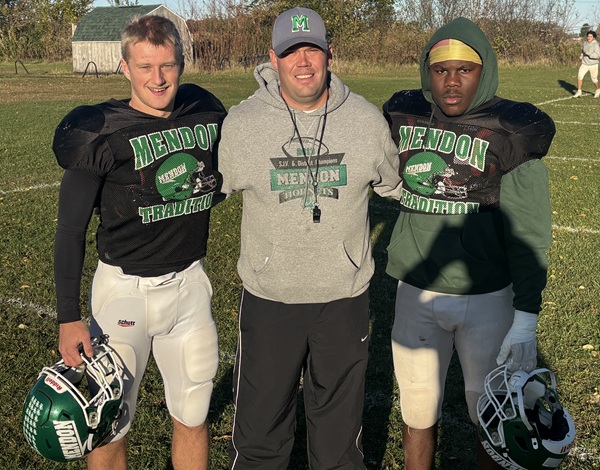
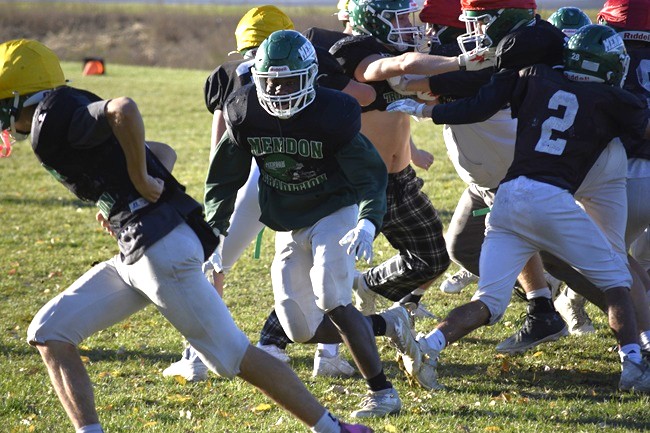
PHOTOS (Top) Mendon senior tailback Owen Gorham (20) nears the end zone during a 46-20 win over Climax-Scotts this fall. (Middle) Pictured at practice last week, from left: Gorham, Mendon head coach Bobby Kretschman and JT Lux. (Below) Lux (23) pursues a ballcarrier during a practice drill. (Top photo by Brandon Watson/Sturgis Journal. Practice photos by Scott Hassinger.)