

Program Builder Boyd Honored by Our Lady
October 12, 2016
By Keith Dunlap
Special for Second Half
WATERFORD – Mike Boyd always had a grand vision how his last home game as head coach at Waterford Our Lady of the Lakes would play out.
 As it got into the later stages of a nearly 50-year tenure as football coach, athletic director and so much more at the school, Boyd had one specific idea for how he wanted to go out.
“I always said that the last game I coached before I retired, I was going to play it here under the lights,” said Boyd, referring to the field at the school that doesn’t have permanent lights. “I didn’t get a chance.”
Boyd did not, since in April 2013 he decided to retire as football coach from WOLL after a 46 year-career in order to move full-time to Sarasota, Florida.
However, last Friday proved to be the next best thing for Boyd and the Our Lady of the Lakes community.
In a ceremony that was more than three years in the making after he made his retirement official, Boyd was brought back for the honor of having the entire athletic complex at Our Lady of the Lakes named after him.
To top it all off, the ceremony took place under portable lights in what doubled as the first night game ever at the school.
The game was against Royal Oak Shrine, which is not only the biggest rival for Our Lady of the Lakes, but coached by Boyd’s longtime best friend in coaching, John Goddard.
All anyone needs to do is look at MHSAA record book for evidence that it was a no-brainer for Our Lady of the Lakes to name the athletic complex after Boyd, one of the state’s all-time greatest prep athletic figures.
As football coach, Boyd won 357 games in his 46 years, which currently is good for fourth place on the all-time wins list for coaches in that sport.
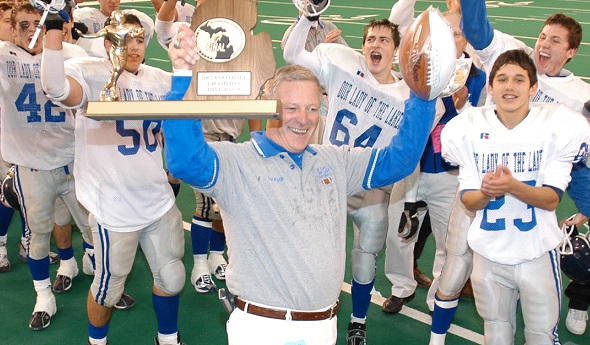
He led the Lakers to three appearances in MHSAA football championship games, with the zenith of his coaching career on the gridiron coming in 2002 when his Our Lady of the Lakes team won its only Finals title in school history with a 13-10 overtime win over Gaylord St. Mary in Division 8.
Facing a 4th-and-goal from the 1-yard line that day, Boyd didn’t hesitate in sending his offense out to go for the win on a do-or-die running play, and the decision paid off when running back Murray Percival broke the goal line to give Boyd his long-awaited title.
The jubilation was apparent on Boyd with how high he jumped over and over again in celebration following the handshake line.
While that was the only time Boyd celebrated an MHSAA championship in football, he did so plenty of times on the softball diamond.
Boyd led Our Lady of the Lakes to what remains a team state-record eight MHSAA championships in softball, going a perfect 8-for-8 in title game appearances and finishing with 703 career wins before retiring from that sport in 2007.
During his tenure, Boyd also coached two games for the hockey team, track & field and started the baseball program by coaching it for its first year of existence.
When not on a playing surface, Boyd was a principal, bus driver, the athletic director and overall face of not only what has become one of the state’s best small-school athletic programs, but the school as a whole.
One of Boyd’s big contributions was creating the home football field at Our Lady of the Lakes behind its school in stunningly quick fashion after some unexpected news.
Our Lady of the Lakes used to play home games at other high schools or middle schools in Waterford, but that changed suddenly in 2001 before a scheduled home game against Royal Oak Shrine.
“They got a new school board one year,” Boyd said. “We used to pay like $250 a game. They came back and said ‘We want $1,200 a game.’ The Dads club got together and put (the press box) up on one week and got the field ready.”
Indeed, in a matter of days a three-story press box was built (fully furnished later in the season) and space for a football field was created (the right side of it through the infield of the baseball diamond) to allow Our Lady of the Lakes to play games on its campus.
 It was fitting that the first home game in 2001 was against Shrine and that the ceremony last week was against Shrine, given his nearly 50-year friendship with Goddard.
The two had a nice chat on Shrine’s bench before the game last Friday, and one can only imagine the stories that were re-hashed.
In fact, when Boyd announced his retirement in 2013, he said how much he would miss playing against “that old turkey” in Goddard.
No doubt, Goddard misses competing against Boyd just as much.
“One year he had a kid that got hurt during practice during that week and he shows up at our place for a game, and after kickoff he comes out and starts running a single-wing,” Goddard said. “I go, ‘What the heck is this offense he is running?’ We beat them, but it took us half a game to figure what he was doing. He made it up on Saturday and we played on Sunday. He was a great coach.”
Boyd still follows the Our Lady of the Lakes program from Florida, watching film online and communicating regularly with current Our Lady of the Lakes head coach Josh Sawicki, a player on that 2002 title team – although Boyd was quick to point out he wants no part in decision-making with the Lakes team. “He’s his own coach,” Boyd said of Sawicki.
Boyd also returns to Michigan every August to help out with preseason practices for Lake Orion, which is coached by his son-in-law, Chris Bell, and he visits Sawicki at his preseason practices while in the area.
Before the game last Friday, Sawicki spoke about how little the topic of the ceremony came up with Boyd during conversations in the days leading up to the game.
“He was talking to me Wednesday or Thursday night, and there was not one question about (the ceremony),” Sawicki said. “It was all about the game plan. ‘What have you got? What have they got? What will you do if they do this? Watch out for Goddard because he likes to do this and likes to do that.’ Still to this day, that was all he was talking about.”
Sawicki said doing things without fanfare is who “Coach” has always been, and it’s a legacy that will be carried on in name now that the athletic complex is named after Boyd.
More importantly, it will also be carried on in spirit.
“He built that brand,” Sawicki said. “It’s the responsibility of the coaches and the players to continue that brand on. That is what we are focused on doing.”
PHOTOS: (Top) Our Lady of the Lakes football coach Mike Boyd hoists the Division 8 championship trophy in 2002 after his team defeated Gaylord St. Mary at the Pontiac Silverdome. (Middle) Boyd (left) receives a plaque from Rev. Lawrence Delonnay, Our Lady’s pastor, on Friday to recognize the naming of the school’s athletic complex in Boyd’s honor.
A Game for Every Fan: Week 3
September 10, 2015
By Geoff Kimmerly
Second Half editor
League play begins this week for many teams across Michigan – and with favorites facing off immediately in games that eventually could decide who wins those conference titles.
The highlighted matchups below include a few of those, but mostly some of the last titanic nonleague battles we'll see this fall – at least, until we reach the MHSAA playoffs.
All games below are tonight unless noted. Follow all of the results as they come in at the MHSAA Score Center. And keep an eye on Muskegon vs. Grandville; with their next win, the Big Reds will become the first program in state history with 800 victories.
Bay & Thumb
Millington (2-0) at Essexville Garber (1-1)
This might not seem the caliber of a “best game of the week” from this area, but it’s been a sneaky-good matchup the last few years as Garber won in 2013 and Millington came back with a 28-19 victory on opening night in 2014. The Cardinals’ opening-night victory over Vassar this fall was a solid start, and the Dukes have scored 80 points total despite splitting their first two matchups.
Others that caught my eye: Marine City (1-1) at Marysville (1-1), Sandusky (2-0) at Bad Axe (1-1), Ortonville-Brandon (2-0) at Clio (2-0), Corunna (2-0) at Goodrich (1-1).
Greater Detroit
Detroit East English (2-0) at Detroit Martin Luther King (2-0)
King is expected by many to be the team to beat from the Detroit Public School League this season, and its first five opponents include reigning Division 2 champion Warren DeLaSalle (a 12-10 win), now East English and in two weeks rival Cass Tech. East English has opened with victories over 2014 playoff teams Walled Lake Central and Detroit Renaissance.
Others that caught my eye: Southfield (1-1) at Farmington (2-0), Lincoln Park (2-0) at Trenton (2-0), Clarkston (1-1) at West Bloomfield (2-0), Farmington Hills Harrison (1-1) at Oak Park (0-2).
Mid-Michigan
Grand Ledge (2-0) at Lansing Sexton (0-2)
While Grand Ledge looks early like possibly the Lansing area’s best team (Lansing Catholic is on the other side of that argument), the Comets can't look past an old rival. Sexton graduated a lot from last season’s Division 4 runner-up team, including the majority of its skill players on offense, but a new group is coming along – with the 0-2 start coming against two 2014 playoff teams.
Others that caught my eye: Lansing Catholic (2-0) at Williamston (2-0), Jackson (2-0) at East Lansing (0-2), Oscoda (1-1) at Vestaburg (2-0), Eaton Rapids (1-1) at Ionia (1-1).
Northern Lower Peninsula
Escanaba (2-0) at Gaylord (2-0)
There’s tons of excitement surrounding these programs as we head toward the middle of September. Escanaba is off to its first 2-0 start since 2011 and a win away from equaling its total from each of the last two seasons. Gaylord missed the playoffs a year ago and came back by starting this fall outscoring its first two opponents 94-6 – and won all three meetings the last time these teams had a series, from 2008-10.
Others that caught my eye: Lincoln Alcona (2-0) at Rogers City (2-0), Fife Lake Forest Area (1-1) at Indian River Inland Lakes (2-0), Grayling (1-1) at Maple City Glen Lake (2-0), Traverse City Central (2-0) at Traverse City West (0-2).
Southeast & Border
Saline (2-0) at Ann Arbor Skyline (2-0)
This might be the most highly-anticipated game in Michigan this weekend. Saline is playing like a team with arguably the state’s top quarterback (Josh Jackson) and coming off finishing runner-up in Division 1 – the Hornets then beat Rockford by 13 on opening night. And Skyline is playing like a team with two of the state’s most dynamic players in Daelin Hayes and Hunter Rison, opening with a pair of double-digit wins after entering the season with 12 straight losses.
Others that caught my eye: Morenci (2-0) at Petersburg-Summerfield (2-0), Hillsdale (1-1) at Brooklyn Columbia Central (2-0), Climax-Scotts (2-0) at Adrian Lenawee Christian (2-0), Homer (1-1) at Concord (2-0).
Southwest Corridor
Portage Central (2-0) at Stevensville Lakeshore (2-0)
These Southwest Michigan Athletic Conference West rivals again kick off the league schedule against each other after last season’s 20-17 Lakeshore win in Week 3 eventually decided the title. Five of their six meetings since joining the same SMAC division have been decided by 10 points or fewer – and those six meetings have resulted in three wins for each team.
Others that caught my eye: New Buffalo (1-1) at Cassopolis (2-0), Battle Creek Pennfield (1-1) at Coldwater (2-0), Paw Paw (2-0) at Sturgis (1-1), Kalamazoo Loy Norrix (1-1) at Kalamazoo Central (2-0), Battle Creek Lakeview (1-1) at Battle Creek Central (0-2).
Upper Peninsula
Negaunee (2-0) at Gladstone (2-0)
Gladstone likely was feeling similarly excited this time last fall when it ended a 22-game losing streak with a 3-0 start, only to drop its final six games. But the Braves have bounced back again and hope to follow last fall’s 24-19 win over Negaunee, which had to be considered an upset then and after as the Miners made the playoffs for the sixth time in seven seasons. They’re 2-0 after surviving a tough test last week from Calumet.
Others that caught my eye: Munising (2-0) at Felch North Dickinson (1-1), Ishpeming (2-0) at Calumet (1-1), Iron River West Iron County (2-0) at Iron Mountain (1-1), Marquette (0-2) at Sault Ste. Marie (1-1).
West Michigan
Rockford (1-1) at Muskegon Mona Shores (2-0)
The Rams are taking on their second 2014 MHSAA runner-up already this season, having fallen to Saline in Week 1 and now taking on the second-place team from Division 2. Rockford handed the Sailors their only pre-Ford Field loss in 2014, 10-7 in Week 3. But Mona Shores has had no problem putting points on the board despite replacing a Division I college quarterback – the Sailors have scored 55 in each of their first two games.
Others that caught my eye: East Grand Rapids (2-0) at Caledonia (2-0), Hudsonville (2-0) at Zeeland East (2-0), Grandville (2-0) at Muskegon (1-1), Scottville Mason County Central (2-0) at Whitehall (2-0).
8-Player
Rapid River (2-0) at Cedarville (2-0)
Together these two have played in three of the first four MHSAA 8-player Finals, and they’ll continue this growing rivalry game despite playing in different leagues for the first time since making the format switch. Cedarville's only regular-season losses of the last three years have come, twice, to the Rockets, who won 20-19 a year ago and haven’t lost a regular-season game since Week 9 of 2012.
Others that caught my eye: Peck (1-1) at Kinde-North Huron (1-1), Powers North Central (2-0) at Bellaire (2-0) (Sat.).
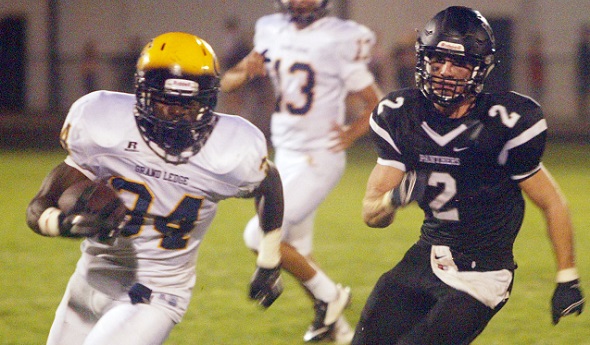
PHOTO: Grand Ledge’s 2-0 start included a 38-7 win over Holland West Ottawa in Week 2. (Click for more from HighSchoolSportsScene.com.)