

Program Builder Boyd Honored by Our Lady
October 12, 2016
By Keith Dunlap
Special for Second Half
WATERFORD – Mike Boyd always had a grand vision how his last home game as head coach at Waterford Our Lady of the Lakes would play out.
 As it got into the later stages of a nearly 50-year tenure as football coach, athletic director and so much more at the school, Boyd had one specific idea for how he wanted to go out.
“I always said that the last game I coached before I retired, I was going to play it here under the lights,” said Boyd, referring to the field at the school that doesn’t have permanent lights. “I didn’t get a chance.”
Boyd did not, since in April 2013 he decided to retire as football coach from WOLL after a 46 year-career in order to move full-time to Sarasota, Florida.
However, last Friday proved to be the next best thing for Boyd and the Our Lady of the Lakes community.
In a ceremony that was more than three years in the making after he made his retirement official, Boyd was brought back for the honor of having the entire athletic complex at Our Lady of the Lakes named after him.
To top it all off, the ceremony took place under portable lights in what doubled as the first night game ever at the school.
The game was against Royal Oak Shrine, which is not only the biggest rival for Our Lady of the Lakes, but coached by Boyd’s longtime best friend in coaching, John Goddard.
All anyone needs to do is look at MHSAA record book for evidence that it was a no-brainer for Our Lady of the Lakes to name the athletic complex after Boyd, one of the state’s all-time greatest prep athletic figures.
As football coach, Boyd won 357 games in his 46 years, which currently is good for fourth place on the all-time wins list for coaches in that sport.
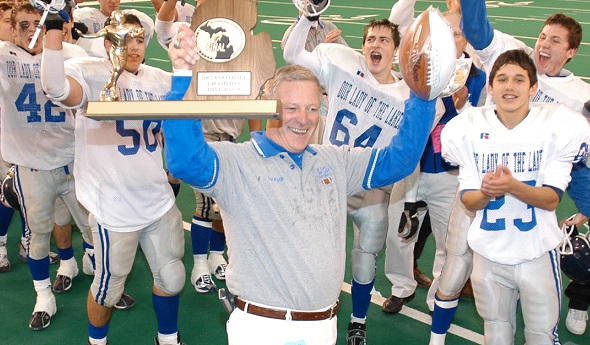
He led the Lakers to three appearances in MHSAA football championship games, with the zenith of his coaching career on the gridiron coming in 2002 when his Our Lady of the Lakes team won its only Finals title in school history with a 13-10 overtime win over Gaylord St. Mary in Division 8.
Facing a 4th-and-goal from the 1-yard line that day, Boyd didn’t hesitate in sending his offense out to go for the win on a do-or-die running play, and the decision paid off when running back Murray Percival broke the goal line to give Boyd his long-awaited title.
The jubilation was apparent on Boyd with how high he jumped over and over again in celebration following the handshake line.
While that was the only time Boyd celebrated an MHSAA championship in football, he did so plenty of times on the softball diamond.
Boyd led Our Lady of the Lakes to what remains a team state-record eight MHSAA championships in softball, going a perfect 8-for-8 in title game appearances and finishing with 703 career wins before retiring from that sport in 2007.
During his tenure, Boyd also coached two games for the hockey team, track & field and started the baseball program by coaching it for its first year of existence.
When not on a playing surface, Boyd was a principal, bus driver, the athletic director and overall face of not only what has become one of the state’s best small-school athletic programs, but the school as a whole.
One of Boyd’s big contributions was creating the home football field at Our Lady of the Lakes behind its school in stunningly quick fashion after some unexpected news.
Our Lady of the Lakes used to play home games at other high schools or middle schools in Waterford, but that changed suddenly in 2001 before a scheduled home game against Royal Oak Shrine.
“They got a new school board one year,” Boyd said. “We used to pay like $250 a game. They came back and said ‘We want $1,200 a game.’ The Dads club got together and put (the press box) up on one week and got the field ready.”
Indeed, in a matter of days a three-story press box was built (fully furnished later in the season) and space for a football field was created (the right side of it through the infield of the baseball diamond) to allow Our Lady of the Lakes to play games on its campus.
 It was fitting that the first home game in 2001 was against Shrine and that the ceremony last week was against Shrine, given his nearly 50-year friendship with Goddard.
The two had a nice chat on Shrine’s bench before the game last Friday, and one can only imagine the stories that were re-hashed.
In fact, when Boyd announced his retirement in 2013, he said how much he would miss playing against “that old turkey” in Goddard.
No doubt, Goddard misses competing against Boyd just as much.
“One year he had a kid that got hurt during practice during that week and he shows up at our place for a game, and after kickoff he comes out and starts running a single-wing,” Goddard said. “I go, ‘What the heck is this offense he is running?’ We beat them, but it took us half a game to figure what he was doing. He made it up on Saturday and we played on Sunday. He was a great coach.”
Boyd still follows the Our Lady of the Lakes program from Florida, watching film online and communicating regularly with current Our Lady of the Lakes head coach Josh Sawicki, a player on that 2002 title team – although Boyd was quick to point out he wants no part in decision-making with the Lakes team. “He’s his own coach,” Boyd said of Sawicki.
Boyd also returns to Michigan every August to help out with preseason practices for Lake Orion, which is coached by his son-in-law, Chris Bell, and he visits Sawicki at his preseason practices while in the area.
Before the game last Friday, Sawicki spoke about how little the topic of the ceremony came up with Boyd during conversations in the days leading up to the game.
“He was talking to me Wednesday or Thursday night, and there was not one question about (the ceremony),” Sawicki said. “It was all about the game plan. ‘What have you got? What have they got? What will you do if they do this? Watch out for Goddard because he likes to do this and likes to do that.’ Still to this day, that was all he was talking about.”
Sawicki said doing things without fanfare is who “Coach” has always been, and it’s a legacy that will be carried on in name now that the athletic complex is named after Boyd.
More importantly, it will also be carried on in spirit.
“He built that brand,” Sawicki said. “It’s the responsibility of the coaches and the players to continue that brand on. That is what we are focused on doing.”
PHOTOS: (Top) Our Lady of the Lakes football coach Mike Boyd hoists the Division 8 championship trophy in 2002 after his team defeated Gaylord St. Mary at the Pontiac Silverdome. (Middle) Boyd (left) receives a plaque from Rev. Lawrence Delonnay, Our Lady’s pastor, on Friday to recognize the naming of the school’s athletic complex in Boyd’s honor.

Michigan’s Football Numbers Game – Corrected
September 1, 2017
Today’s blog was written by MHSAA Second Half Editor Geoff Kimmerly
The demise of Michigan high school football has been greatly exaggerated – or, at least, recently misreported by one of the U.S.’s most recognizable newspapers that noted as part of a larger story on football decline that Michigan has seen a “net loss of 57 teams in the past five years.”
It’s easy to understand how this error took place – especially when a reporter is not familiar with the football landscape in our state – but that doesn’t make this statement any less misleading, or harmful considering the story since has been picked up by multiple large news organizations. So let’s quickly clear up the misinterpreted information:
-
The data that led to this error came from an annual participation report released by the National Federation of State High School Associations (NFHS). Every spring, state associations (like the MHSAA) from every state and Washington, D.C., tally up how many of their member schools have a sport and how many athletes play it.
-
For 2016-17, the MHSAA submitted to the NFHS a total of 580 schools with 11-player football – that number actually includes all schools that reported having at least one football player, including primary and secondary schools in co-ops. And yes, that 580 is 57 fewer than the 637 11-player schools the MHSAA submitted for 2012-13.
-
But saying Michigan has lost 57 football programs misses out on something incredibly significant – the MHSAA also submitted 60 schools with 8-player football last year, up from 16 in 2012-13, making that net decrease in football schools over five years 13 – far fewer than 57.
And with a few more brush strokes, the picture of football in our state actually shows a healthy landscape:
-
The 640 schools in Michigan with at least one football player for 2016-17, 11 and 8-player combined, is actually eight more than we reported to the NFHS four years ago and 10 more than three years ago.
-
A better picture of Michigan’s football consistency is shown by how many varsity programs are taking the field. This fall, that number is 616 – 555 11-player varsities and 61 8-player – and we also had 616 for most of the 2016 season, 616 in 2015 and 615 in 2014.
-
We’ve had programs bring back varsity teams this year, and in one case a school has a team on its own for the first time. Benzonia Benzie Central and Suttons Bay were unable to field varsities in 2016, but Benzie Central is back playing 11-player and Suttons Bay is back with an 8-player team. Brimley, an 8-player school going back to 2010, also is fielding a team again after being unable to do so last year. Mount Clemens played only two varsity games in 2016 and forfeited a third, but has seven scheduled for this fall and lost close in its opener last week. And Bear Lake, previously a secondary school in a co-op program, now has a team all its own for the first time and is playing at the 8-player level.
-
Yes, there has been a decrease in Michigan high school football participation when it comes to the number of players – for reasons we discuss frequently, including more extracurricular/entertainment options than ever for students, more who are specializing in other sports and safety fears that often are misplaced. But we’ve also seen a three percent drop in enrollment at MHSAA member schools over the last five years. And despite that trend, Michigan again had the sixth-highest 11-player football participation in the nation in 2016-17 (and seventh-highest in 8-player) while ranking 10th nationally in number of residents of high school age.
-
So yes, while a nine percent drop in the number of football players over the last five years in Michigan clearly is troubling, and something we’re working with the Michigan High School Football Coaches Association to reverse, let’s also put those numbers in perspective. At medium-sized to bigger schools, it could mean a roster of 40 might have only 36 players. A roster of 20 at an 8-player school might go down to 18. Neither would signal the need to eliminate a football program.
-
And that move by so many schools to 8-player? It definitely started as a way for low-participation programs to keep football (and has worked for most of them). While that still may be the driving force as schools move from 11 to 8, others have made the switch because most of their former opponents did and joining them makes scheduling easier and travel shorter. Michigan has a multitude of small towns, and you’ll find most of these 8-player programs in pockets in the thumb, southwest or northern Lower Peninsula, or Upper Peninsula. And keep in mind, only Class D teams remain eligible for the 8-player playoffs – and only two of 61 teams playing 8-player this fall are larger than Class D and its enrollment limit of 203 students for 2017-18.
The story behind “a decrease of 57 schools” clearly is a little complex to explain and explain away, but it’s necessary to do so.
Yes, Michigan’s total number of football players is down a few percent. But the sport’s prominence and importance in our schools and communities remains high.