

Program Builder Boyd Honored by Our Lady
October 12, 2016
By Keith Dunlap
Special for Second Half
WATERFORD – Mike Boyd always had a grand vision how his last home game as head coach at Waterford Our Lady of the Lakes would play out.
 As it got into the later stages of a nearly 50-year tenure as football coach, athletic director and so much more at the school, Boyd had one specific idea for how he wanted to go out.
“I always said that the last game I coached before I retired, I was going to play it here under the lights,” said Boyd, referring to the field at the school that doesn’t have permanent lights. “I didn’t get a chance.”
Boyd did not, since in April 2013 he decided to retire as football coach from WOLL after a 46 year-career in order to move full-time to Sarasota, Florida.
However, last Friday proved to be the next best thing for Boyd and the Our Lady of the Lakes community.
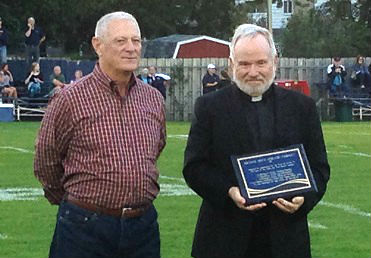
In a ceremony that was more than three years in the making after he made his retirement official, Boyd was brought back for the honor of having the entire athletic complex at Our Lady of the Lakes named after him.
To top it all off, the ceremony took place under portable lights in what doubled as the first night game ever at the school.
The game was against Royal Oak Shrine, which is not only the biggest rival for Our Lady of the Lakes, but coached by Boyd’s longtime best friend in coaching, John Goddard.
All anyone needs to do is look at MHSAA record book for evidence that it was a no-brainer for Our Lady of the Lakes to name the athletic complex after Boyd, one of the state’s all-time greatest prep athletic figures.
As football coach, Boyd won 357 games in his 46 years, which currently is good for fourth place on the all-time wins list for coaches in that sport.
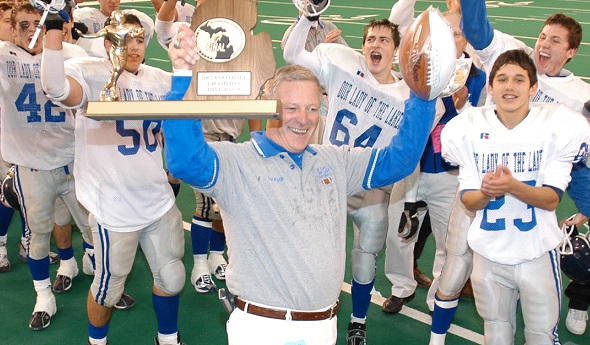
He led the Lakers to three appearances in MHSAA football championship games, with the zenith of his coaching career on the gridiron coming in 2002 when his Our Lady of the Lakes team won its only Finals title in school history with a 13-10 overtime win over Gaylord St. Mary in Division 8.
Facing a 4th-and-goal from the 1-yard line that day, Boyd didn’t hesitate in sending his offense out to go for the win on a do-or-die running play, and the decision paid off when running back Murray Percival broke the goal line to give Boyd his long-awaited title.
The jubilation was apparent on Boyd with how high he jumped over and over again in celebration following the handshake line.
While that was the only time Boyd celebrated an MHSAA championship in football, he did so plenty of times on the softball diamond.
Boyd led Our Lady of the Lakes to what remains a team state-record eight MHSAA championships in softball, going a perfect 8-for-8 in title game appearances and finishing with 703 career wins before retiring from that sport in 2007.
During his tenure, Boyd also coached two games for the hockey team, track & field and started the baseball program by coaching it for its first year of existence.
When not on a playing surface, Boyd was a principal, bus driver, the athletic director and overall face of not only what has become one of the state’s best small-school athletic programs, but the school as a whole.
One of Boyd’s big contributions was creating the home football field at Our Lady of the Lakes behind its school in stunningly quick fashion after some unexpected news.
Our Lady of the Lakes used to play home games at other high schools or middle schools in Waterford, but that changed suddenly in 2001 before a scheduled home game against Royal Oak Shrine.
“They got a new school board one year,” Boyd said. “We used to pay like $250 a game. They came back and said ‘We want $1,200 a game.’ The Dads club got together and put (the press box) up on one week and got the field ready.”
Indeed, in a matter of days a three-story press box was built (fully furnished later in the season) and space for a football field was created (the right side of it through the infield of the baseball diamond) to allow Our Lady of the Lakes to play games on its campus.
 It was fitting that the first home game in 2001 was against Shrine and that the ceremony last week was against Shrine, given his nearly 50-year friendship with Goddard.
The two had a nice chat on Shrine’s bench before the game last Friday, and one can only imagine the stories that were re-hashed.
In fact, when Boyd announced his retirement in 2013, he said how much he would miss playing against “that old turkey” in Goddard.
No doubt, Goddard misses competing against Boyd just as much.
“One year he had a kid that got hurt during practice during that week and he shows up at our place for a game, and after kickoff he comes out and starts running a single-wing,” Goddard said. “I go, ‘What the heck is this offense he is running?’ We beat them, but it took us half a game to figure what he was doing. He made it up on Saturday and we played on Sunday. He was a great coach.”
Boyd still follows the Our Lady of the Lakes program from Florida, watching film online and communicating regularly with current Our Lady of the Lakes head coach Josh Sawicki, a player on that 2002 title team – although Boyd was quick to point out he wants no part in decision-making with the Lakes team. “He’s his own coach,” Boyd said of Sawicki.
Boyd also returns to Michigan every August to help out with preseason practices for Lake Orion, which is coached by his son-in-law, Chris Bell, and he visits Sawicki at his preseason practices while in the area.
Before the game last Friday, Sawicki spoke about how little the topic of the ceremony came up with Boyd during conversations in the days leading up to the game.
“He was talking to me Wednesday or Thursday night, and there was not one question about (the ceremony),” Sawicki said. “It was all about the game plan. ‘What have you got? What have they got? What will you do if they do this? Watch out for Goddard because he likes to do this and likes to do that.’ Still to this day, that was all he was talking about.”
Sawicki said doing things without fanfare is who “Coach” has always been, and it’s a legacy that will be carried on in name now that the athletic complex is named after Boyd.
More importantly, it will also be carried on in spirit.
“He built that brand,” Sawicki said. “It’s the responsibility of the coaches and the players to continue that brand on. That is what we are focused on doing.”
PHOTOS: (Top) Our Lady of the Lakes football coach Mike Boyd hoists the Division 8 championship trophy in 2002 after his team defeated Gaylord St. Mary at the Pontiac Silverdome. (Middle) Boyd (left) receives a plaque from Rev. Lawrence Delonnay, Our Lady’s pastor, on Friday to recognize the naming of the school’s athletic complex in Boyd’s honor.
Drive for Detroit: Playoff R3 Preview
November 10, 2016
By Geoff Kimmerly
Second Half editor
The best have risen to the occasion this MHSAA Football Playoffs. But this weekend's 11-player Regional Finals and 8-player Semifinals are guaranteed to be the final stop for a handful of teams that haven't experienced a loss this fall.
Of 20 teams still undefeated, 12 will face each other in six games over five divisions, with two matchups coming in Division 8.
 Most of those matchups are among games highlighted in this week's "Drive for Detroit" preview powered by MI Student Aid. Read on for details on one game from each 11-player division and both 8-player matchups, and remember to visit MHSAA.com for the full schedule, scores this weekend as they come in and next week's matchups as they're determined.
Also, tune in for eight games this weekend, four tonight and four Saturday, either on FoxSportsDetroit.com or MHSAA.tv. Click for that schedule.
All games below are Friday unless noted.
Division 1
Detroit Cass Tech (11-0) at Saline (11-0)
This will be the third playoff collision in five seasons for these powers; Saline won the most recent, a 2014 Semifinal. The Hornets’ last three wins were over teams that finished a combined 25-7, and last week they hung on for a 37-31 victory over Canton despite giving up more than two touchdowns for the first time since Week 3. Cass Tech’s last three wins were over teams a combined 26-2, and its defense has been even more stifling allowing only a touchdown apiece to Dearborn and Dearborn Fordson the last two weeks and 8.8 points per game total this season.
Other Regional Finals: Romeo (8-3) at Clarkston (9-2), Southfield Arts & Technology (8-3) at Utica Eisenhower (11-0), Grandville (10-1) at Detroit Catholic Central (11-0) on Saturday.
Division 2
Grand Rapids Forest Hills Central (9-2) at Lowell (11-0)
Lowell doesn’t lose often; the Red Arrows haven’t had more than three defeats in a season since 1999. So Forest Hills Central had to be smarting for a while after letting a 17-point fourth-quarter lead disappear in its 41-37 loss to Lowell in Week 7. Lowell has cruised through back-to-back 42-17 wins the last two weeks over Greenville and Traverse City Central as it seeks to return to Ford Field for the second straight year, but no doubt expects a closer game with the Rangers seeking their first Regional title since 1995.
Other Regional Finals: Grosse Pointe South (8-3) at Birmingham Groves (10-1), Fenton (9-2) at Walled Lake Western (10-1) on Saturday, Temperance Bedford (9-2) at Detroit Martin Luther King (9-2) on Saturday.
Division 3
Edwardsburg (11-0) at Chelsea (11-0)
The Eddies are 66-11 over the last seven seasons and 32-3 over the last three but are coming into a Regional Final undefeated for the first time during this run. It’s hard to not point at an incredible defensive average of giving up only 5.2 points per game with five shutouts. But it’s also hard to imagine Chelsea being held scoreless; that would be a first since a 2014 Regional Final loss. The Bulldogs also can equal last season’s school record for wins by earning this one.
Other Regional Finals: Byron Center (10-1) at Muskegon (10-1), Orchard Lake St. Mary’s (7-4) at DeWitt (10-1), Dearborn Divine Child (9-2) at Allen Park (11-0).
Division 4
Lake Odessa Lakewood (10-1) vs. Hudsonville Unity Christian (9-2) at Jenison
It was fair to predict last week that neither of these teams would still be playing today, but they’ve certainly earned the opportunity. Lakewood downed Lansing Sexton by eight to advance and Unity Christian got past undefeated Benton Harbor in overtime, and both now can win a Regional title for the first time. Both also have set program records for wins this fall, and Lakewood’s Pre-District victory was its first ever in the playoffs.
Other Regional Finals: Adrian (7-4) at River Rouge (10-1), Escanaba (9-2) at Grand Rapids Catholic Central (10-1) on Saturday, Corunna (9-2) at Detroit Country Day (11-0) on Saturday.
Division 5
Menominee (10-1) at Reed City (11-0), Saturday
The Coyotes have been poised for a run like this for a while, with four 10-1 finishes over the last five seasons but this only the second Regional Final appearance in program history. A sterling average of 8.3 points given up per game was hurt only a little by Remus Chippewa Hills’ 28 last week. But Reed City’s defense has arguably its toughest challenge in the Maroons. Menominee has cleared 10 wins for the fifth straight season and saved its usually eye-popping offensive numbers for the last month – it has scored at least 50 points three of the last five weeks and put up 61 on Grayling in the District Final.
Other Regional Finals: Ida (10-1) at Algonac (10-1), Frankenmuth (10-1) at Ithaca (11-0) on Saturday, Grand Rapids West Catholic (9-2) at Berrien Springs (8-2) on Saturday.
Division 6
Detroit Central Collegiate (7-4) at Millington (10-1)
We’re used to seeing Detroit Public School League leaders Cass Tech and Martin Luther King this deep into the playoffs, and at times the former Crockett-now-East English as well. But Detroit Central has come back from a 1-4 start to reach a Regional Final for the first time since 2010. Millington, meanwhile, has 10 wins for the first time since 2011 and is looking for its first Regional title since 2010. The Cardinals will aim to continue a stifling defensive effort that has given up only 8.3 points per game.
Other Regional Finals: Maple City Glen Lake (9-2) at Calumet (10-1) on Saturday, Leroy Pine River (8-3) at Ravenna (9-2) on Saturday, Napoleon (9-2) at Jackson Lumen Christi (9-2) on Saturday.
Division 7
Pewamo-Westphalia (11-0) at Traverse City St. Francis (11-0), Saturday
This is familiar territory for both programs: St. Francis will play in its fourth Regional Final in six seasons, while P-W will play in its sixth straight this decade. We've talked about record-setting running back Jared Smith this week (click for more), but the Pirates will take advantage of a variety of offensive weapons to try to break through a Gladiators defense giving up only 5.6 points per game.
Other Regional Finals: Concord (9-2) vs. Cassopolis (10-1) at Decatur, Detroit Loyola (9-2) at Hudson (10-1), Ubly (11-0) vs. New Lothrop (10-1) at Chesaning on Saturday.
Division 8
Frankfort (11-0) at Muskegon Catholic Central (11-0), Saturday
Frankfort gets another chance to take down perennial power MCC after falling to the Crusaders 22-12 in the Regional Final in 2015. But this is a stronger Panthers team that has scored nearly 100 more points but also knows how to win close, as it has done twice including last week against Lincoln Alcona. Frankfort will need all of its expertise against the reigning three-time Division 8 champion, which is also putting up even better numbers than a year ago and hasn't let an opponent within two touchdowns this fall.
Other Regional Finals: Climax-Scotts (11-0) at Ottawa Lake Whiteford (11-0), Norway (9-2) at St. Ignace (10-1) on Saturday, Royal Oak Shrine (9-2) at Saginaw Michigan Lutheran Seminary (9-2) on Saturday.
8-Player
Pickford (10-1) at Powers North Central (11-0)
Pickford, in its second season of 8-player, has reached the Semifinals for the first time since 1991. The Panthers last week avenged their only loss this season by edging Engadine in a Regional Final, and now will attempt to hand reigning champion North Central its first loss also in two seasons of 8-player. This Jets team is reminiscent of last year's champion and also the back-to-back Class D boys basketball champions, mostly because it is led by senior quarterback Jason Whitens. He's thrown for 2,170 yards and 40 touchdowns and run for 15 more scores.
Wyoming Tri-unity Christian (11-0) at Deckerville (10-0), Saturday
Tri-unity's first playoff run is now only one more win from the championship game, and the Defenders have made it by following senior quarterback Brayden Sherrod (2,104 yards/37 touchdowns rushing, 1,610 yards/21 TDs passing.) Deckerville has owned the line of scrimmage and dominated as a result, running for nearly 3,000 yards and holding its opponents to 323 and only 44 points – 150 fewer points than at this point when it won the MHSAA title in 2012.
Second Half’s weekly “Drive for Detroit” previews are powered by MI Student Aid, a part of the Student Financial Services Bureau located within the Michigan Department of Treasury. MI Student Aid encourages students to pursue postsecondary education by providing access to student financial resources and information, including various student financial assistance programs to help make college more affordable for Michigan students. MI Student Aid administers the state’s 529 savings programs (MET/MESP) and eight additional aid programs within its Student Scholarships and Grants division. Click for more information and connect with MI Student Aid on Facebook and Twitter @mistudentaid.
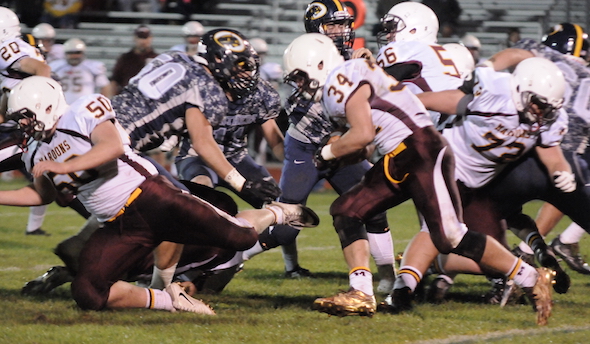
PHOTO: Menominee and DeWitt met in Week 8 (the Panthers won 48-14) and both will play in Regional Finals this weekend. (Click to see more from HighSchoolSportsScene.com.)