

Program Builder Boyd Honored by Our Lady
October 12, 2016
By Keith Dunlap
Special for Second Half
WATERFORD – Mike Boyd always had a grand vision how his last home game as head coach at Waterford Our Lady of the Lakes would play out.
 As it got into the later stages of a nearly 50-year tenure as football coach, athletic director and so much more at the school, Boyd had one specific idea for how he wanted to go out.
“I always said that the last game I coached before I retired, I was going to play it here under the lights,” said Boyd, referring to the field at the school that doesn’t have permanent lights. “I didn’t get a chance.”
Boyd did not, since in April 2013 he decided to retire as football coach from WOLL after a 46 year-career in order to move full-time to Sarasota, Florida.
However, last Friday proved to be the next best thing for Boyd and the Our Lady of the Lakes community.
In a ceremony that was more than three years in the making after he made his retirement official, Boyd was brought back for the honor of having the entire athletic complex at Our Lady of the Lakes named after him.
To top it all off, the ceremony took place under portable lights in what doubled as the first night game ever at the school.
The game was against Royal Oak Shrine, which is not only the biggest rival for Our Lady of the Lakes, but coached by Boyd’s longtime best friend in coaching, John Goddard.
All anyone needs to do is look at MHSAA record book for evidence that it was a no-brainer for Our Lady of the Lakes to name the athletic complex after Boyd, one of the state’s all-time greatest prep athletic figures.
As football coach, Boyd won 357 games in his 46 years, which currently is good for fourth place on the all-time wins list for coaches in that sport.
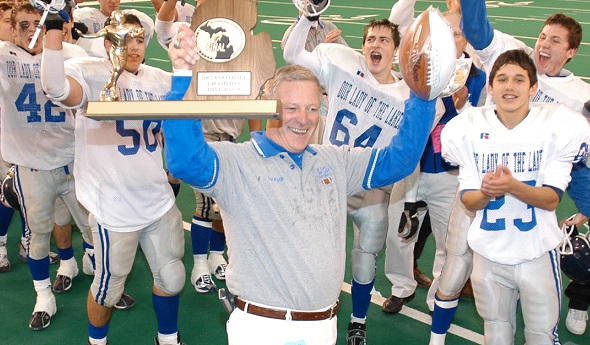
He led the Lakers to three appearances in MHSAA football championship games, with the zenith of his coaching career on the gridiron coming in 2002 when his Our Lady of the Lakes team won its only Finals title in school history with a 13-10 overtime win over Gaylord St. Mary in Division 8.
Facing a 4th-and-goal from the 1-yard line that day, Boyd didn’t hesitate in sending his offense out to go for the win on a do-or-die running play, and the decision paid off when running back Murray Percival broke the goal line to give Boyd his long-awaited title.
The jubilation was apparent on Boyd with how high he jumped over and over again in celebration following the handshake line.
While that was the only time Boyd celebrated an MHSAA championship in football, he did so plenty of times on the softball diamond.
Boyd led Our Lady of the Lakes to what remains a team state-record eight MHSAA championships in softball, going a perfect 8-for-8 in title game appearances and finishing with 703 career wins before retiring from that sport in 2007.
During his tenure, Boyd also coached two games for the hockey team, track & field and started the baseball program by coaching it for its first year of existence.
When not on a playing surface, Boyd was a principal, bus driver, the athletic director and overall face of not only what has become one of the state’s best small-school athletic programs, but the school as a whole.
One of Boyd’s big contributions was creating the home football field at Our Lady of the Lakes behind its school in stunningly quick fashion after some unexpected news.
Our Lady of the Lakes used to play home games at other high schools or middle schools in Waterford, but that changed suddenly in 2001 before a scheduled home game against Royal Oak Shrine.
“They got a new school board one year,” Boyd said. “We used to pay like $250 a game. They came back and said ‘We want $1,200 a game.’ The Dads club got together and put (the press box) up on one week and got the field ready.”
Indeed, in a matter of days a three-story press box was built (fully furnished later in the season) and space for a football field was created (the right side of it through the infield of the baseball diamond) to allow Our Lady of the Lakes to play games on its campus.
 It was fitting that the first home game in 2001 was against Shrine and that the ceremony last week was against Shrine, given his nearly 50-year friendship with Goddard.
The two had a nice chat on Shrine’s bench before the game last Friday, and one can only imagine the stories that were re-hashed.
In fact, when Boyd announced his retirement in 2013, he said how much he would miss playing against “that old turkey” in Goddard.
No doubt, Goddard misses competing against Boyd just as much.
“One year he had a kid that got hurt during practice during that week and he shows up at our place for a game, and after kickoff he comes out and starts running a single-wing,” Goddard said. “I go, ‘What the heck is this offense he is running?’ We beat them, but it took us half a game to figure what he was doing. He made it up on Saturday and we played on Sunday. He was a great coach.”
Boyd still follows the Our Lady of the Lakes program from Florida, watching film online and communicating regularly with current Our Lady of the Lakes head coach Josh Sawicki, a player on that 2002 title team – although Boyd was quick to point out he wants no part in decision-making with the Lakes team. “He’s his own coach,” Boyd said of Sawicki.
Boyd also returns to Michigan every August to help out with preseason practices for Lake Orion, which is coached by his son-in-law, Chris Bell, and he visits Sawicki at his preseason practices while in the area.
Before the game last Friday, Sawicki spoke about how little the topic of the ceremony came up with Boyd during conversations in the days leading up to the game.
“He was talking to me Wednesday or Thursday night, and there was not one question about (the ceremony),” Sawicki said. “It was all about the game plan. ‘What have you got? What have they got? What will you do if they do this? Watch out for Goddard because he likes to do this and likes to do that.’ Still to this day, that was all he was talking about.”
Sawicki said doing things without fanfare is who “Coach” has always been, and it’s a legacy that will be carried on in name now that the athletic complex is named after Boyd.
More importantly, it will also be carried on in spirit.
“He built that brand,” Sawicki said. “It’s the responsibility of the coaches and the players to continue that brand on. That is what we are focused on doing.”
PHOTOS: (Top) Our Lady of the Lakes football coach Mike Boyd hoists the Division 8 championship trophy in 2002 after his team defeated Gaylord St. Mary at the Pontiac Silverdome. (Middle) Boyd (left) receives a plaque from Rev. Lawrence Delonnay, Our Lady’s pastor, on Friday to recognize the naming of the school’s athletic complex in Boyd’s honor.
Drive for Detroit: Week 1 Preview
August 24, 2016
By Geoff Kimmerly
Second Half editor
Your wait is over. After nine months of anticipation, high school football will return to Michigan tonight.
 And we'll quickly kick off to a great start.
Over the last four seasons, the Second Half weekly preview of the state’s top games was titled “A Game for Every Fan.” Despite a name change this fall, the goal is the same – we’ll highlight a top game in all eight of our Second Half coverage zones, plus the best in 8-player, and suggest a few more as we truly believe there’s a game close by worth watching no matter where our football fans reside.
Drive for Detroit, powered by MI Student Aid, will publish the first varsity game day (generally Fridays) each week. Games are organized regionally by host team (or the Michigan team if it’s playing out of state); this week is a little tricky with a number of games hosted by University of Michigan and Wayne State University, so the top games from those showcases are listed below in the regions where those stadiums are located. All games are Thursday unless noted.
Visit the MHSAA.com Score Center tonight and all weekend for scores as they are reported and links to updated schedules and standings.
Bay & Thumb
Algonac (10-2) at Marine City (6-4)
Based on last season’s records alone, maybe this wouldn’t be considered the most intriguing game coming from this region. But the back stories bring these teams up front. Algonac was the story from the Thumb last season, enjoying its best finish ever after going 1-8 in 2014. The Muskrats opened by breaking a 15-game losing streak to Marine City, by the closest of margins winning 19-18, and a number of key contributors are back this fall. The Mariners did go on to extend their playoff streak to 18 straight seasons and shared the Macomb Area Conference Gold championship, but tallied their fewest wins since that last non-playoff season of 1997.
Others that caught my eye: Mount Pleasant (9-3) at Midland Dow (10-2), DeWitt (9-2) at Linden (8-3), New Lothrop (12-1) at Saginaw Nouvel (9-2), Saginaw Michigan Lutheran Seminary (10-2) at Almont (8-3).
Greater Detroit
Chelsea (12-2) vs. River Rouge (12-2), Saturday at Wayne State
Both of these teams finished last season at Ford Field, as both made appearance at the MHSAA Finals for the first time. Chelsea fell in Division 3 to Orchard Lake St. Mary’s but returns veteran quarterback Jack Bush to lead a number of new contributors. River Rouge just missed taking down Grand Rapids West Catholic in last season’s Division 5 championship game and graduated Finals star Antoine Burgess among others who played big roles, but is a combined 40-7 over the last four seasons.
Others that caught my eye: Orchard Lake St. Mary's (12-1) at Macomb Dakota (9-3), Birmingham Groves (10-1) at West Bloomfield (9-1), Livonia Franklin (9-4) at Livonia Stevenson (6-4), Detroit Martin Luther King (14-0) vs. Southfield Arts & Technology (former schools Southfield and Lathrup combined to go 13-8 last season) on Saturday at Wayne State.
Mid-Michigan
Monroe St. Mary Catholic Central (8-2) at Pewamo-Westphalia (13-1), Friday
This is arguably the best matchup of small schools anywhere in the state during opening weekend, with Pewamo-Westphalia coming off a runner-up finish in Division 7 and St. Mary coming off its 12th playoff berth in 13 seasons and only two removed from winning the Division 6 title. Most eyes will be on Pirates senior running back Jared Smith, who set the MHSAA single-season rushing record with 3,250 yards last fall and single-season rushing touchdown record with 53.
Others that caught my eye: Lansing Everett (4-5) at Howell (5-5), Mount Pleasant Sacred Heart (6-4) at Beal City (9-2) on Friday, Ithaca (14-0) at Clare (5-4) on Friday, St. Johns (8-4) at East Lansing (5-4) on Friday.
Northern Lower Peninsula
Gaylord (6-4) at Boyne City (10-2)
Rebuilt Gaylord found itself in the playoffs last season for the first time since 2007 and with its most wins since 2005 after successive seasons of 0-9, 1-8 and 5-4, respectively. The Blue Devils have replaced key players like most, but so too is Boyne City with running back Malik Smith now at Michigan State after helping the Ramblers to 22 wins against only three losses over the last two seasons. Boyne City does return quarterback Mason Gardner, however, and his presence could be good for a quicker start than many this weekend.
Others that caught my eye: Ada Forest Hills Eastern (11-2) at Petoskey (8-3), Cadillac (2-7) at Big Rapids (7-4), McBain (8-4) at Manistee (7-3), Kingsley (5-4) at Maple City Glen Lake (5-5) on Friday.
Southeast & Border
Grand Rapids West Catholic (12-2) at Jackson Lumen Christi (8-4), Friday
West Catholic will play its first game in a decade without coach Dan Rohn, who stepped down after last season’s fourth MHSAA championship in six seasons. Still, offensive stars Gaetano Vallone and David Fox should give the Falcons a good head start. Lumen Christi was among an impressive group of teams taken down last season during Clinton’s run to the Division 6 Final; the Titans were eliminated in the Regional Final. But they’re looking to add to an 18-season playoff streak – and add a second straight win in this series after downing West Catholic 22-21 on opening night a year ago.
Others that caught my eye: Manchester (9-2) at Clinton (13-1) on Friday, Coldwater (12-1) at Jackson (8-3) on Friday, Clarkston (7-3) at Lapeer (10-1) on Friday at University of Michigan, Muskegon (9-3) at Ann Arbor Pioneer (7-4) on Saturday at University of Michigan.
Southwest Corridor
Marshall (7-3) at Benton Harbor (6-5), Friday
Last season was one of dreams coming true for Benton Harbor, which gained national acclaim and made the playoffs for the first time (and won a playoff game too) after two straight 0-9 seasons and eight straight total with one or zero wins. This is a new season, but there should be plenty of enthusiasm as it kicks off immediately against a tough opponent. Marshall rebounded off two straight sub-.500 seasons last fall to finish a two-point loss shy of an undefeated run in the Interstate 8 Athletic Conference.
Others that caught my eye: Saugatuck (10-1) at Constantine (7-5), Vicksburg (8-3) at Dowagiac (6-4), Portage Central (8-2) at Mattawan (5-4) on Friday, Battle Creek Central (4-5) at Stevensville Lakeshore (6-4) on Friday.
West Michigan
East Grand Rapids (9-4) at Grand Rapids Catholic Central (9-2), Friday
Grand Rapids Catholic Central will host the first varsity football game at Cougar Stadium against the first of a slate of tough opponents again this season. East Grand Rapids has beaten the Cougars in three straight openers, last season 28-14, and is coming off its best season since also winning nine games in 2011 – the Pioneers were eight points from getting past eventual Division 3 champion Orchard Lake St. Mary’s in last season’s Semifinal. After last season’s loss, GRCC didn’t fall again until its Division 4 District Final.
Others that caught my eye: Grand Ledge (12-1) at Hudsonville (7-4), Muskegon Oakridge (7-3) at Muskegon Catholic Central (11-2), Warren DeLaSalle (6-4) at Lowell (12-2) on Friday, Saline (10-1) at Rockford (7-4) on Friday.
Upper Peninsula
Ishpeming (13-0) at Iron Mountain (7-4), Friday
Ishpeming is coming off its third MHSAA championship in four seasons after downing P-W in last fall’s Division 7 Final and defeated rival Iron Mountain twice in 2015 – 14-7 on opening night and then 24-14 in their District Final. The Hematites will try to extend a regular-season winning streak that goes back to Week 8 of 2012, as Iron Mountain seeks to beat them for the first time since 2011.
Others that caught my eye: Munising (7-3) at Iron River West Iron County (3-6), Houghton (4-5) at L'Anse (5-4) on Friday, Traverse City St. Francis (12-1) at Marquette (3-5) on Friday, Menominee (11-1) at Marinette, Wis. (2-7) on Saturday.
8-Player
Crystal Falls Forest Park (7-4 as 11-player) at Rapid River (7-4), Friday
One of the Upper Peninsula’s best rivalries in a number of sports will enjoy a new chapter with Forest Park’s move to 8-player football this fall. As an 11-player team, the Trojans enjoyed a string of 19 straight playoff appearances through last fall. The Forest Park and Rapid River football programs haven’t faced off since 1983, and the Rockets have built one of the top 8-player programs in Michigan since making the switch in 2011.
Others that caught my eye: Lawrence (8-3) at Mayville (5-4 as 11-player), Battle Creek St. Philip (12-1) at Kingston (5-4) on Friday.
Second Half’s weekly “Drive for Detroit” previews are powered by MI Student Aid, a part of the Student Financial Services Bureau located within the Michigan Department of Treasury. MI Student Aid encourages students to pursue postsecondary education by providing access to student financial resources and information, including various student financial assistance programs to help make college more affordable for Michigan students. MI Student Aid administers the state’s 529 savings programs (MET/MESP) and eight additional aid programs within its Student Scholarships and Grants division. Click for more information and connect with MI Student Aid on Facebook and Twitter @mistudentaid.
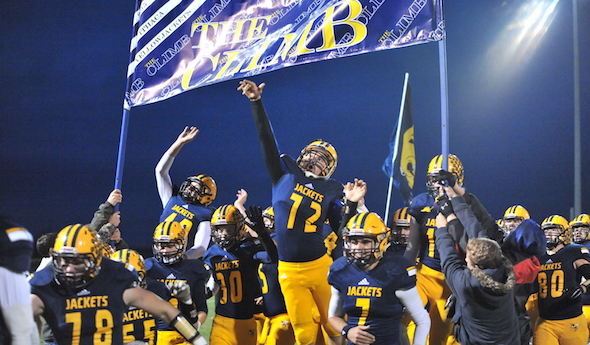
PHOTO: Ithaca players enter the field during a game last season. (Click to see more from HighSchoolSportsScene.com.)