

Program Builder Boyd Honored by Our Lady
October 12, 2016
By Keith Dunlap
Special for Second Half
WATERFORD – Mike Boyd always had a grand vision how his last home game as head coach at Waterford Our Lady of the Lakes would play out.
 As it got into the later stages of a nearly 50-year tenure as football coach, athletic director and so much more at the school, Boyd had one specific idea for how he wanted to go out.
“I always said that the last game I coached before I retired, I was going to play it here under the lights,” said Boyd, referring to the field at the school that doesn’t have permanent lights. “I didn’t get a chance.”
Boyd did not, since in April 2013 he decided to retire as football coach from WOLL after a 46 year-career in order to move full-time to Sarasota, Florida.
However, last Friday proved to be the next best thing for Boyd and the Our Lady of the Lakes community.
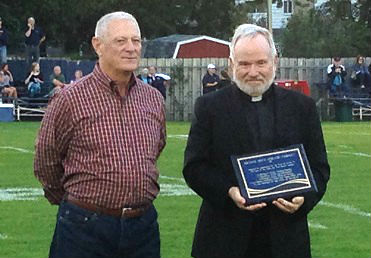
In a ceremony that was more than three years in the making after he made his retirement official, Boyd was brought back for the honor of having the entire athletic complex at Our Lady of the Lakes named after him.
To top it all off, the ceremony took place under portable lights in what doubled as the first night game ever at the school.
The game was against Royal Oak Shrine, which is not only the biggest rival for Our Lady of the Lakes, but coached by Boyd’s longtime best friend in coaching, John Goddard.
All anyone needs to do is look at MHSAA record book for evidence that it was a no-brainer for Our Lady of the Lakes to name the athletic complex after Boyd, one of the state’s all-time greatest prep athletic figures.
As football coach, Boyd won 357 games in his 46 years, which currently is good for fourth place on the all-time wins list for coaches in that sport.
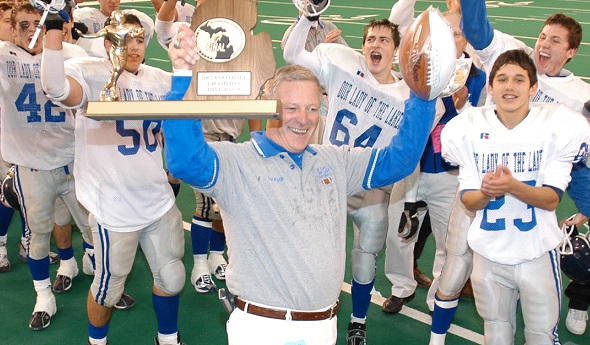
He led the Lakers to three appearances in MHSAA football championship games, with the zenith of his coaching career on the gridiron coming in 2002 when his Our Lady of the Lakes team won its only Finals title in school history with a 13-10 overtime win over Gaylord St. Mary in Division 8.
Facing a 4th-and-goal from the 1-yard line that day, Boyd didn’t hesitate in sending his offense out to go for the win on a do-or-die running play, and the decision paid off when running back Murray Percival broke the goal line to give Boyd his long-awaited title.
The jubilation was apparent on Boyd with how high he jumped over and over again in celebration following the handshake line.
While that was the only time Boyd celebrated an MHSAA championship in football, he did so plenty of times on the softball diamond.
Boyd led Our Lady of the Lakes to what remains a team state-record eight MHSAA championships in softball, going a perfect 8-for-8 in title game appearances and finishing with 703 career wins before retiring from that sport in 2007.
During his tenure, Boyd also coached two games for the hockey team, track & field and started the baseball program by coaching it for its first year of existence.
When not on a playing surface, Boyd was a principal, bus driver, the athletic director and overall face of not only what has become one of the state’s best small-school athletic programs, but the school as a whole.
One of Boyd’s big contributions was creating the home football field at Our Lady of the Lakes behind its school in stunningly quick fashion after some unexpected news.
Our Lady of the Lakes used to play home games at other high schools or middle schools in Waterford, but that changed suddenly in 2001 before a scheduled home game against Royal Oak Shrine.
“They got a new school board one year,” Boyd said. “We used to pay like $250 a game. They came back and said ‘We want $1,200 a game.’ The Dads club got together and put (the press box) up on one week and got the field ready.”
Indeed, in a matter of days a three-story press box was built (fully furnished later in the season) and space for a football field was created (the right side of it through the infield of the baseball diamond) to allow Our Lady of the Lakes to play games on its campus.
 It was fitting that the first home game in 2001 was against Shrine and that the ceremony last week was against Shrine, given his nearly 50-year friendship with Goddard.
The two had a nice chat on Shrine’s bench before the game last Friday, and one can only imagine the stories that were re-hashed.
In fact, when Boyd announced his retirement in 2013, he said how much he would miss playing against “that old turkey” in Goddard.
No doubt, Goddard misses competing against Boyd just as much.
“One year he had a kid that got hurt during practice during that week and he shows up at our place for a game, and after kickoff he comes out and starts running a single-wing,” Goddard said. “I go, ‘What the heck is this offense he is running?’ We beat them, but it took us half a game to figure what he was doing. He made it up on Saturday and we played on Sunday. He was a great coach.”
Boyd still follows the Our Lady of the Lakes program from Florida, watching film online and communicating regularly with current Our Lady of the Lakes head coach Josh Sawicki, a player on that 2002 title team – although Boyd was quick to point out he wants no part in decision-making with the Lakes team. “He’s his own coach,” Boyd said of Sawicki.
Boyd also returns to Michigan every August to help out with preseason practices for Lake Orion, which is coached by his son-in-law, Chris Bell, and he visits Sawicki at his preseason practices while in the area.
Before the game last Friday, Sawicki spoke about how little the topic of the ceremony came up with Boyd during conversations in the days leading up to the game.
“He was talking to me Wednesday or Thursday night, and there was not one question about (the ceremony),” Sawicki said. “It was all about the game plan. ‘What have you got? What have they got? What will you do if they do this? Watch out for Goddard because he likes to do this and likes to do that.’ Still to this day, that was all he was talking about.”
Sawicki said doing things without fanfare is who “Coach” has always been, and it’s a legacy that will be carried on in name now that the athletic complex is named after Boyd.
More importantly, it will also be carried on in spirit.
“He built that brand,” Sawicki said. “It’s the responsibility of the coaches and the players to continue that brand on. That is what we are focused on doing.”
PHOTOS: (Top) Our Lady of the Lakes football coach Mike Boyd hoists the Division 8 championship trophy in 2002 after his team defeated Gaylord St. Mary at the Pontiac Silverdome. (Middle) Boyd (left) receives a plaque from Rev. Lawrence Delonnay, Our Lady’s pastor, on Friday to recognize the naming of the school’s athletic complex in Boyd’s honor.
'Why I Cried After Losing a Football Game'
October 5, 2015
By Dallas Lintner
Owosso athletic director
Our varsity football team lost last Friday night to St. Johns High School 55-19. It was certainly a tough loss for our team. Often times, players, coaches, and fans may indicate they feel like crying after such a loss; occasionally they may literally shed a tear.
Let me share the story of what brought me to tears following our team’s loss. I will tell you, it was not the loss. … It was the story of two strangers, Logan Turner and Blake Thelen.
Owosso senior Logan Turner was diagnosed with leukemia over a year ago. While still a part of the Owosso football program, Logan’s condition prevents him from participation in football, or even attending school; yet each week, with permission from his medical team, Logan may occasionally attend OHS football activities. I will tell you that his attendance has been an uplift for our players and coaches nearly as much as seeing his classmates has been an uplift for Logan.
Logan has never met Blake Thelen, yet they share a remarkable bond. Blake Thelen is a member of St. Johns varsity football team. Last year while on spring break, Blake had read an online article about Owosso’s Logan and the struggles he was going through. He remarked several months ago to a few family members and friends that he would like to do something for this kid from Owosso.
Many times, our children will make remarks like this and forget the sentiment all together after a short time. Blake did not forget this sentiment. Several months later, Blake kept his word and offered support to a stranger … to a brother of the gridiron … to a friend he has never met. This is why I cried last Friday night.
On the Wednesday before our game with St. Johns, I received a phone call from Blake’s mother, Shannon. Shannon informed me about her son’s awareness of our Logan and his plan to offer support. Blake had mobilized students and parents to “pass the hat” in the stands and to place donation collection tubs at the concession stand area. Blake’s plan had been announced by the St. Johns public address announcer between the first and second quarters. From witnessing the event personally, this story of Logan and Blake had received as strong of an ovation from the spectators in attendance as the St. Johns Homecoming royalty did at halftime. What a display of character, integrity, and love. This is why I cried.
Logan was in attendance at the game and was on the sideline for a short time before the cold weather forced him to leave for home. Following the game, Blake, his mother, and a few other members of Blake’s group met me on the field immediately after the two teams shook hands. St. Johns’ athletic director Chris Ervin introduced me to Blake and his helpers and also to his mother Shannon, the woman I had met on the phone two days prior. Shannon was holding a gift bag filled with plastic food containers. As we greeted each other at midfield, there was an array of emotions. The Redwing players were elated, following a convincing victory; the Trojans were dejected following the defeat, and I was standing between the two groups smiling with tears running down my face as I tried to utter a few inspired works to Blake and his group expressing our gratitude, our surprise, and our awe for him and his generous deed.
I fear that I was only able to mumble a few incoherent syllables to that group. I spent most of the weekend attempting to determine how best to express today what I couldn’t express Friday night. This is why I cried.
When I returned home Friday evening, I sat in my chair with those plastic food containers and began to sort and count the donations from the evening. I was impressed that there was a great deal of pocket change in those canisters. Most likely from children who emptied their pockets into the tubs. At halftime, my own son purchased one less sucker at the concession stand so that he would have a quarter left over to donate to Logan. Shannon Thelen indicated that fans were flagging their people down in the stands with cash in hand. You wouldn’t believe the number of donations that came in denominations of 10 and 20 dollars, all for a stranger.
At the end of the night, I sat in my chair with $923.11 for Logan and his family. This is a remarkable sum that came from strangers … that came from Blake.
While the donations are very impressive, this is not what choked me up then and still. It is the notion that a student was moved by someone else’s story, took initiative, and gave a gift of far more value than $923.11. He gave friendship, he gave compassion, he gave love. School sports are often judged by scores, records, and stats. In this case, no score, record, or stat can do justice to this inspirational story.
It is these types of moments that inspire me to do what I do; to be associated with children who do amazing things. This high school football game transcended high school athletics and became a great human interest story on a very personal level.
This is why I cried after losing a football game.
God Bless you Blake.
God Bless you Logan.
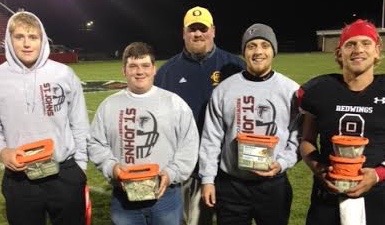
PHOTO: Owosso athletic director Dallas Lintner, middle, stands with (from left) Jake Dorn, Adam Webb, Tyler Luznak and Blake Thelen after Friday's football game between the teams. (Photo courtesy of St. Johns athletic department.)