

Saints Remember, Rally During Semifinal Run
November 20, 2015
By Dennis Grall
Special for Second Half
ST. IGNACE – Tradition and excellence are distinctive parts of the athletic program at LaSalle High School at this eastern tip of the Upper Peninsula.
 Located at the north end of the Mackinac Bridge, St. Ignace has won five MHSAA girls basketball championships since 1999, and the school's football team won the 1983 Class C title. The football team also is currently preparing for its third MHSAA Semifinal appearance since 2011.
When the Saints face two-time defending Division 8 champion Muskegon Catholic Central on Saturday at Thirlby Field in Traverse City, they will have an extra player in their huddle.
Mitchell Snyder, a three-year starter at center, was killed in a car accident following the school's homecoming in October when he was struck by an alleged drunk driver.
"Since his death, the team has really come together as a unit," said veteran St. Ignace News sportswriter Dave Latva.
Head coach Marty Spencer, in his 19th season at the helm, agreed. "This has been a rallying point for us," said Spencer, noting the Snyder family has become an integral part of every football game.
 "This has brought us closer; it has brought his family closer to us. We have rallied around him. He is with us. He is on our shoulders. He is in our huddle."
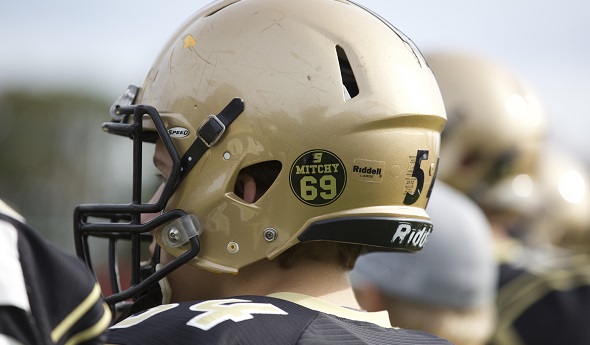
Snyder's father, Brent, wears his son's No. 69 jersey to every game, and the players reach out and touch the jersey as they leave the locker room for the field. His number also appears on the back of each player's helmet.
In the first game after the accident, against Ironwood and played in Gladstone, Brent Snyder asked the Saints what they thought Mitchell would want them to do. Snyder told them Mitchell loved to play football, and they should continue to play the game.
The Saints ran their opening two plays against Ironwood with just 10 players, in memory of their deceased teammate. "Mitchell was there blocking for us," said Spencer.
Spencer said the coaching staff and players talked extensively about the tragic accident. "It was tough that first week. We struggled," said Spencer. "We talked a lot trying to find answers, and you never can answer those questions.
"We had to do that for our well-being, for us to survive. As he helps us through each game, it gets better and better for us. Not just for us, for the whole community."
 Spencer has guided St. Ignace to an 11-1 record. Its only loss was 20-14 to unbeaten Ishpeming, which is in the Division 7 Semifinals for the fourth straight year. Last week the Saints beat perennial Division 8 power Crystal Falls Forest Park 22-8.
"Our kids are pretty resilient," said Spencer. "He (Mitchell Snyder) has been our backbone for this run. It could have destroyed us all. Mitchell's dad said there should be no more crying. Mitchell is not crying. He wants you to play football."
Because the Saints have played such powerful foes as Ishpeming and Forest Park, they will not be intimidated going up against a team the stature of Muskegon Catholic Central. "They are bigger than us, they have size and speed," said Spencer. "Our kids are confident. We have played some good teams (including also Fowler and Johannesburg-Lewiston). We are ready."
Leading the Saints is senior Gage Kreski, an all-state prospect in football and basketball and highly-sought college recruit in both sports. Kreski is the team's quarterback and was the Upper Peninsula's defensive player of the year (small school division, as voted by media) as a back. He also does the punting and returns punts.
"He does so much," said Spencer, noting Kreski had 11 interceptions as a sophomore and this year has scored off two of his three interceptions as offenses steer away from him. "He is a constant athlete who keeps working. He can play anywhere. He could be one heckuva wide receiver," said Spencer.
Kreski has rushed for 851 yards and added another 1,235 yards passing. He has solid backfield support from Mitchell Peterson, Andrew Goldthorpe and Dave LaVake, with linemen Cole Garen and Jared Helms setting the interior tempo for the two-time Ski Valley Conference champions.
 Spencer said the heavily balanced Saints have emphasized defense this year with a 52 alignment (five linemen, two linebackers). "Against the run, this is the best it has ever been," he said.
The narrow loss to Ishpeming provided a confidence boost for the Saints, who have a fully home-grown coaching staff under Spencer, a downstate native. Spencer coached nearly every assistant coach when they played and said having St. Ignace grads on the staff "helps continue the legacy that has been built."
Two of the aides are volunteers who moved back home this fall, Chase and Zach Pierson, the sons of legendary St. Ignace football standout and coach Barry Pierson.
"It is nice having people who know the tradition here, the ins and outs of what the program means to people," said Spencer.
 Denny Grall retired in 2012 after 39 years at the Escanaba Daily Press and four at the Green Bay Press-Gazette, plus 15 months for WLST radio in Escanaba; he served as the Daily Press sports editor from 1970-80 and again from 1984-2012. Grall was inducted into the Upper Peninsula Sports Hall of Fame in 2002 and serves as its executive secretary. E-mail him at [email protected] with story ideas for the Upper Peninsula.
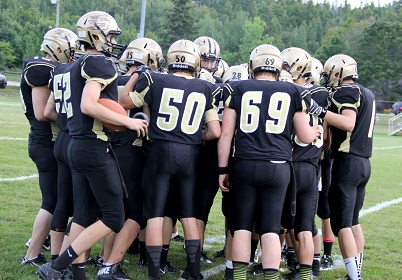
PHOTOS: (Top) St. Ignace players all wear a decal on their helmets in memory of late teammate Mitchell Snyder. (Middle) A Saints defender stacks up an Indian River Inland Lakes ball-carrier earlier this season. (Below) St. Ignace huddles during a break in play. (Photos courtesy of Kristi Gustafson.)
Drive for Detroit: Week 6 in Review
October 6, 2014
By Geoff Kimmerly
Second Half editor
Less than a month remains in the MHSAA football regular season, and 21 percent of the 11-player playoff field is filled after 53 teams earned qualifying wins during Week 6.
A number of others must turn their attention solely to the postseason after the whittling over the weekend of many league races to only a few remaining favorites.
See below for some of the most significant stories we watched unfold during Week 6:
Greater Detroit
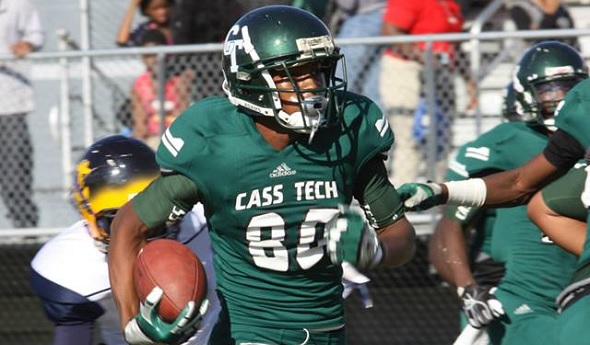
Detroit Cass Tech 21, Detroit East English 16
Usually it’s the Cass Tech offense that gets the headlines. But in its toughest Detroit Public School League game of this season to date, the team’s defenders were the eventual heroes after the Technicians (6-0) went up two touchdowns early. East English (4-2) held Cass Tech to a season-low in points and scored the most the Technicians had given up since Oak Park put up 26 on opening night, but the Technicians held strong late to remain tied for first. Click for more from MLive-Detroit.
Also noted:
Walled Lake Central 38, Waterford Mott 20 – After two seasons of sub-.500 records, Walled Lake Central claimed a share of the Kensington Lakes Activities Association North title for the first time since 2010 while dropping second-place Mott to 4-2.
Birmingham Brother Rice 28, Orchard Lake St. Mary's 20 – The Warriors (6-0) claimed a share of their third straight Detroit Catholic League Central title in handing St. Mary’s (5-1) its lone loss.
Canton 40, Livonia Churchill 35 – Canton (5-1) claimed a share of its second straight KLAA South championship by dealing 2012 champ Churchill (5-1) its first loss.
Clinton 28, Morenci 26 – Clinton (6-0) stopped a 2-point conversion attempt during the final minute to extend its 24-game regular-season winning streak and deal Morenci (5-1) its first loss after its best start since 1997.
Upper Peninsula
Ishpeming 20, Beal City 0
These Ford Field regulars have played in different divisions in recent trips, but met in Gaylord for one of the most intriguing games of 2014. The good news for Beal City is the Aggies held Ishpeming (6-0) to its fewest points since 2012. But the Hematites also notched their second straight shutout, holding Beal City (5-1) scoreless for the first time since 2010. Ishpeming’s winning streak is up to 27 straight. Click for more from the Mount Pleasant Morning Sun.
Also noted:
Iron River West Iron County 40, Calumet 26 – West Iron (6-0) pulled within a win of a second-straight West Peninsula Athletic Conference title by escaping improved Calumet (3-3), which is tied for second place.
Crystal Falls Forest Park 36, Felch North Dickinson 14 – This rivalry game was a little less fierce than usual, as the Trojans (4-1) made it three straight over the Nordics (3-3).
Marquette 13, Kingsford 8 – The Redmen (5-1) kept pace in the Great Northern U.P. Conference to set up a Week 9 championship game with undefeated Menominee.
Sault Ste. Marie 28, Gladstone 22 – The Blue Devils (3-3) have stormed back from an 0-3 start, while Gladstone (3-3) has gone the opposite after starting 3-0.
Mid-Michigan
DeWitt 16, St. Johns 10
The Panthers’ run of 32 straight league wins (dating to 2008) was on the line midway through the fourth quarter as DeWitt trailed by a point. But back-up quarterback Chase McPhee – in for injured starter and Division I college prospect Jacob Johnson – led the Panthers (6-0) on a go-ahead touchdown drive that helped them clinch a share of the Capital Area Activities Conference Red title while handing the rival Redwings (5-1) their lone loss. Click for more from the Lansing State Journal.
Also noted:
Olivet 69, Stockbridge 48 – The Eagles (5-1) are at least partial owners of the inaugural Greater Lansing Activities Conference championship, with second-place Stockbridge (4-2) now needing help from Maple Valley to gather a share.
Jackson Lumen Christi 35, Coldwater 24 – Lumen Christi (6-0) pulled within a win of claiming the inaugural Interstate 8 Athletic Conference title while dropping Coldwater (5-1) into a tie for second place.
Clare 43, Gladwin 36 (OT) – Clare (4-2) hasn’t had too many scares in winning seven straight Jack Pine Conference championships, but survived one from the Flying G’s (4-2) to hold on to a tie for first.
Stanton Central Montcalm 28, Remus Chippewa Hills 27 – The Hornets (4-2) broke open the Central State Activities Association Gold race by handing formerly first-place Chippewa Hills (5-1) its first loss.
Southwest and Border
Three Rivers 25, Vicksburg 12
The Wildcats’ 0-2 start is becoming a distant memory as they work deeper into the Wolverine B Conference East schedule. Three Rivers (4-2) has won four straight and set itself up to play Plainwell this week to possibly decide the eventual league champion. Vicksburg (4-2), meanwhile, was one of the hottest teams in the state to start the season and beat Three Rivers in 2013, but has now lost two straight. Click for more from the Kalamazoo Gazette.
Also noted:
Berrien Springs 26, Paw Paw 8 – The Shamrocks (4-2) suddenly are in the Wolverine B West conversation, having now won more games this fall than in each of the last two and with this impressive victory over Paw Paw (3-3).
Portage Central 35, Niles 13 – Reigning champion Portage Central (4-1) remains in striking distance in the Southwestern Michigan Athletic Conference West if first-place Stevensville Lakeshore falters, while Niles (4-2) remains in position to make the playoffs with a couple solid wins down the stretch.
Stevensville Lakeshore 21, Portage Northern 13 – This was key for the Lancers (5-1), who fell to Northern (4-2) by two points last season.
Union City 18, Jonesville 16 – The Chargers (6-0) have bounced back nicely from last season’s 3-6 finish and are tied for first in the Big 8 Conference.
Lower Up North
Cadillac 21, Gaylord 20
The Big North Conference race opened up a bit last week (see next result below), but nearly got a lot more interesting with Gaylord (4-2) continuing to push the traditional favorites. Reigning champion and first-place Cadillac hadn’t had alcall this close (except, perhaps, needing a goalline stand in 2013 against Traverse City Central) over its two-season run atop the standings. Click for more from the Cadillac News.
Also noted:
Petoskey 16, Traverse City Central 13 – The Northmen (5-1) now get Gaylord, but look best to benefit in the Big North if Cadillac falters; Central (4-2) also is tied for second and gets Cadillac in Week 9.
Boyne City 50, Maple City Glen Lake 0 – Boyne City (6-0) looks good to not only win the inaugural Northern Michigan Football Conference Leaders title, but also finish the regular season perfect for the first time since 2001.
Oscoda 21, Lincoln Alcona 16 – The Owls (3-3) are in position for their best finish since at least 2000 after delivering Alcona (3-3) its third straight loss.
Whittemore-Prescott 26, Tawas 16 – Although not a league game, this was a good measuring stick locally for the Cardinals (6-0), who continued their surge against solid Tawas (4-2).
West Michigan
Holland West Ottawa 28, East Kentwood 21
While solid, these two haven’t been much in the Ottawa-Kent Conference Red title discussion in a while – but West Ottawa (5-1) has earned the opportunity to match favorite Rockford for the championship in Week 9 if it can survive Grandville and Hudsonville over the next few weeks. East Kentwood (5-1), still off to its best start since 2004, has a similarly tough road as it seeks a sixth win for the first time since that season. Click for more from the Grand Rapids Press.
Also noted:
Hudsonville 27, Grand Haven 24 – After two straight one-point losses, Hudsonville (4-2) got on the positive end of a close finish and handed Grand Haven (3-3) its third straight defeat.
Grand Rapids Forest Hills Northern 44, Greenville 36 – Forest Hills Northern (6-0) earned the opportunity to face league co-leader Cedar Springs this week by dispatching another O-K Bronze contender in Greenville (4-2).
Hopkins 35, Grandville Calvin Christian 27 – Hopkins (5-1) paid back Calvin Christian (2-4) for a one-point loss in 2013 to remain in line for a fifth-straight O-K Silver title.
Lowell 20, Grand Rapids Christian 12 – The Red Arrows (6-0) continued to impress by claiming a close one over another O-K White power in Grand Rapids Christian (4-2).
Bay and Thumb
Saginaw Swan Valley 14, Freeland 7
In what was and remains likely to be Swan Valley’s toughest regular-season game, the Vikings (6-0) showed plenty of mettle. The defense continues to rank among the most stellar in Michigan this season after giving up only one score to push this fall’s total points allowed to a mere 29 (Freeland, now 5-1, hadn’t scored fewer than 42). And of course standout running back Alex Grace showed, with 261 yards rushing and both of his team’s touchdowns. Click for more from The Saginaw News.
Also noted:
Burton Bendle 41, Flint Hamady 36 – The Tigers (3-3) have bounced back nicely from a 1-3 start, although Hamady (4-2) – itself impressive after going 0-8 a year ago – didn’t make this easy.
Frankenmuth 21, Birch Run 14 – The Eagles (5-1) likely now need help from Birch Run (5-1) against first-place Millington if the three are to share the Tri-Valley Conference East title.
Fenton 41, Clio 20 – The Tigers (6-0) remain tied for first in the Flint Metro League despite a challenge from much-improved Clio (3-3), which hadn’t won a game since 2009 before opening night.
Davison 34, Bay City Western 28 (OT) – The Cardinals kept their playoff hopes alive and also sit just a win back in the Saginaw Valley Association Blue standings.
8-player
Rapid River 20, Cedarville 19
These two have built quite a rivalry in the Bridge Alliance Conference – Rapid River handed Cedarville its only regular season loss last season, beat Cedarville during the 2012 playoffs after losing to the Trojans by 60 five weeks earlier, and suffered their only regular-season loss to Cedarville during the 2011 season. Add this to the classics. Click for more from the Escanaba Daily Press.
Also noted:
Lawrence 52, Deckerville 20 – Lawrence (6-0) is again looking like a strong possibility to drive to at least the MHSAA Semifinals; Deckerville (5-1) also had entered undefeated.
Engadine 28, Posen 26 – The Eagles (3-3) got a needed boost, especially with undefeated Bellaire up next.
PHOTO: Detroit Cass Tech improved to 6-0 with a 21-16 win over Detroit East English in Detroit Public School League play. (Photo courtesy of the Detroit PSL.)