

Saints Remember, Rally During Semifinal Run
November 20, 2015
By Dennis Grall
Special for Second Half
ST. IGNACE – Tradition and excellence are distinctive parts of the athletic program at LaSalle High School at this eastern tip of the Upper Peninsula.
 Located at the north end of the Mackinac Bridge, St. Ignace has won five MHSAA girls basketball championships since 1999, and the school's football team won the 1983 Class C title. The football team also is currently preparing for its third MHSAA Semifinal appearance since 2011.
When the Saints face two-time defending Division 8 champion Muskegon Catholic Central on Saturday at Thirlby Field in Traverse City, they will have an extra player in their huddle.
Mitchell Snyder, a three-year starter at center, was killed in a car accident following the school's homecoming in October when he was struck by an alleged drunk driver.
"Since his death, the team has really come together as a unit," said veteran St. Ignace News sportswriter Dave Latva.
Head coach Marty Spencer, in his 19th season at the helm, agreed. "This has been a rallying point for us," said Spencer, noting the Snyder family has become an integral part of every football game.
 "This has brought us closer; it has brought his family closer to us. We have rallied around him. He is with us. He is on our shoulders. He is in our huddle."
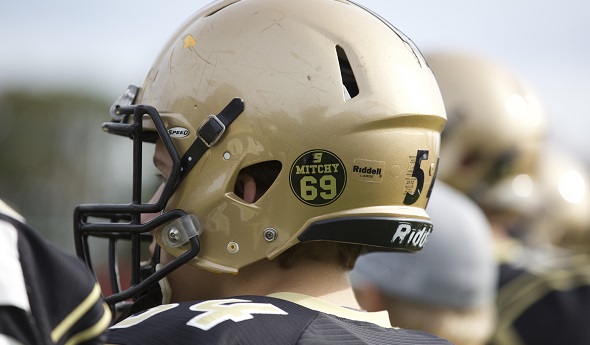
Snyder's father, Brent, wears his son's No. 69 jersey to every game, and the players reach out and touch the jersey as they leave the locker room for the field. His number also appears on the back of each player's helmet.
In the first game after the accident, against Ironwood and played in Gladstone, Brent Snyder asked the Saints what they thought Mitchell would want them to do. Snyder told them Mitchell loved to play football, and they should continue to play the game.
The Saints ran their opening two plays against Ironwood with just 10 players, in memory of their deceased teammate. "Mitchell was there blocking for us," said Spencer.
Spencer said the coaching staff and players talked extensively about the tragic accident. "It was tough that first week. We struggled," said Spencer. "We talked a lot trying to find answers, and you never can answer those questions.
"We had to do that for our well-being, for us to survive. As he helps us through each game, it gets better and better for us. Not just for us, for the whole community."
 Spencer has guided St. Ignace to an 11-1 record. Its only loss was 20-14 to unbeaten Ishpeming, which is in the Division 7 Semifinals for the fourth straight year. Last week the Saints beat perennial Division 8 power Crystal Falls Forest Park 22-8.
"Our kids are pretty resilient," said Spencer. "He (Mitchell Snyder) has been our backbone for this run. It could have destroyed us all. Mitchell's dad said there should be no more crying. Mitchell is not crying. He wants you to play football."
Because the Saints have played such powerful foes as Ishpeming and Forest Park, they will not be intimidated going up against a team the stature of Muskegon Catholic Central. "They are bigger than us, they have size and speed," said Spencer. "Our kids are confident. We have played some good teams (including also Fowler and Johannesburg-Lewiston). We are ready."
Leading the Saints is senior Gage Kreski, an all-state prospect in football and basketball and highly-sought college recruit in both sports. Kreski is the team's quarterback and was the Upper Peninsula's defensive player of the year (small school division, as voted by media) as a back. He also does the punting and returns punts.
"He does so much," said Spencer, noting Kreski had 11 interceptions as a sophomore and this year has scored off two of his three interceptions as offenses steer away from him. "He is a constant athlete who keeps working. He can play anywhere. He could be one heckuva wide receiver," said Spencer.
Kreski has rushed for 851 yards and added another 1,235 yards passing. He has solid backfield support from Mitchell Peterson, Andrew Goldthorpe and Dave LaVake, with linemen Cole Garen and Jared Helms setting the interior tempo for the two-time Ski Valley Conference champions.
 Spencer said the heavily balanced Saints have emphasized defense this year with a 52 alignment (five linemen, two linebackers). "Against the run, this is the best it has ever been," he said.
The narrow loss to Ishpeming provided a confidence boost for the Saints, who have a fully home-grown coaching staff under Spencer, a downstate native. Spencer coached nearly every assistant coach when they played and said having St. Ignace grads on the staff "helps continue the legacy that has been built."
Two of the aides are volunteers who moved back home this fall, Chase and Zach Pierson, the sons of legendary St. Ignace football standout and coach Barry Pierson.
"It is nice having people who know the tradition here, the ins and outs of what the program means to people," said Spencer.
 Denny Grall retired in 2012 after 39 years at the Escanaba Daily Press and four at the Green Bay Press-Gazette, plus 15 months for WLST radio in Escanaba; he served as the Daily Press sports editor from 1970-80 and again from 1984-2012. Grall was inducted into the Upper Peninsula Sports Hall of Fame in 2002 and serves as its executive secretary. E-mail him at [email protected] with story ideas for the Upper Peninsula.
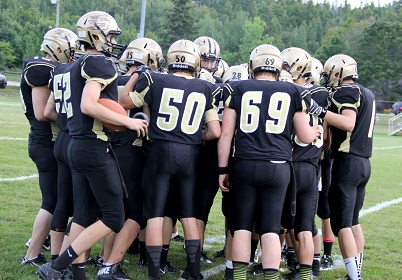
PHOTOS: (Top) St. Ignace players all wear a decal on their helmets in memory of late teammate Mitchell Snyder. (Middle) A Saints defender stacks up an Indian River Inland Lakes ball-carrier earlier this season. (Below) St. Ignace huddles during a break in play. (Photos courtesy of Kristi Gustafson.)
Thank Roosevelt for Football Weekends
December 20, 2013
By Rob Kaminski
MHSAA benchmarks editor
The next time you find yourself immersed in a tense crosstown football rivalry on a Friday night followed by a Saturday pilgrimage to the nearest college campus and a Sunday afternoon with a remote and your favorite snacks and beverages, take a moment to consider what the weekend would be like if it weren’t for Teddy Roosevelt.
The man who became our 26th President shortly after the turn of the 20th Century following the assassination of William McKinley in 1901 was a football fan like you. Maybe more so.
Today’s game of football has reached a critical crossroads. Player size and speed have increased across the board. Savage use of equipment as weapons rather than protective gear has been glorified on television networks and social media. Leaders of the game at all levels have recognized the need for change, employing new rules and widespread educational efforts to aid in preserving the sport.
History, as they say, is repeating itself.
In an ironic twist, it was Roosevelt who saved the then-brutally violent game of football from itself more than 100 years ago. Yes, the same “Rough and Ready Teddy” who led the charge up San Juan Hill during the Spanish-American War and often sparred in the boxing ring while in office from 1901-09 opined that football was becoming so gruesome that he delivered an ultimatum: clean up the game or it would be outlawed.
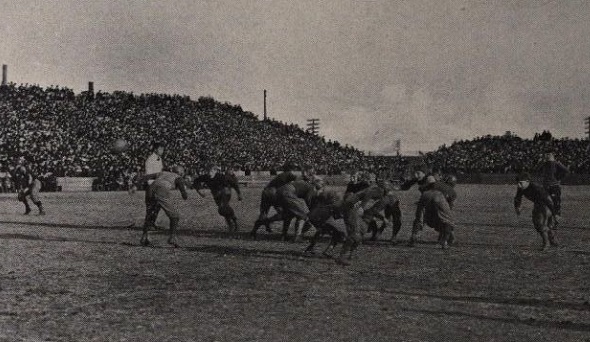
The Chicago Tribune reported that in 1904 alone, there were 18 football deaths and 159 serious injuries, mostly among prep school players. Football deaths suffered by younger players were reported on a nearly weekly basis, as outraged citizens called on colleges and high schools to banish football outright.
In stepped Roosevelt, who called head coaches and representatives from Harvard, Yale and Princeton – college powers at the time – to the White House in 1905 urging them to eliminate excessive violence and set an example of fair play for the rest of the country. When the casualties actually rose by one during the ensuing season, Roosevelt reacted with greater resolve and convened leading football authorities for the purpose of authoring drastic rules changes. What emerged was an intercollegiate conference which was the predecessor of the NCAA.
Among the most effective changes for the 1906 season were the legalization of the forward pass, the elimination of mass formations, and the creation of a neutral zone. Football fatalities fell to 11 in each of the next two seasons, and severe injuries fell drastically.
Thanks to the introduction of protective equipment and ever-evolving rules changes, football during the 100-plus years to follow has become an exponentially safer game. Yet, the game’s leaders always will need to adjust and react to scrutiny that comes with the territory.
So, as the game once again undergoes rules modifications in the name of safety, give a tip of the cap to President Roosevelt while you enjoy college bowl season and the NFL playoffs and begin to think ahead to the first high school practice of 2014.