

Saints Remember, Rally During Semifinal Run
November 20, 2015
By Dennis Grall
Special for Second Half
ST. IGNACE – Tradition and excellence are distinctive parts of the athletic program at LaSalle High School at this eastern tip of the Upper Peninsula.
 Located at the north end of the Mackinac Bridge, St. Ignace has won five MHSAA girls basketball championships since 1999, and the school's football team won the 1983 Class C title. The football team also is currently preparing for its third MHSAA Semifinal appearance since 2011.
When the Saints face two-time defending Division 8 champion Muskegon Catholic Central on Saturday at Thirlby Field in Traverse City, they will have an extra player in their huddle.
Mitchell Snyder, a three-year starter at center, was killed in a car accident following the school's homecoming in October when he was struck by an alleged drunk driver.
"Since his death, the team has really come together as a unit," said veteran St. Ignace News sportswriter Dave Latva.
Head coach Marty Spencer, in his 19th season at the helm, agreed. "This has been a rallying point for us," said Spencer, noting the Snyder family has become an integral part of every football game.
 "This has brought us closer; it has brought his family closer to us. We have rallied around him. He is with us. He is on our shoulders. He is in our huddle."
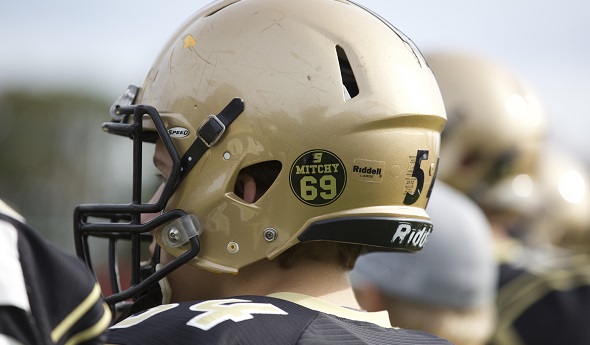
Snyder's father, Brent, wears his son's No. 69 jersey to every game, and the players reach out and touch the jersey as they leave the locker room for the field. His number also appears on the back of each player's helmet.
In the first game after the accident, against Ironwood and played in Gladstone, Brent Snyder asked the Saints what they thought Mitchell would want them to do. Snyder told them Mitchell loved to play football, and they should continue to play the game.
The Saints ran their opening two plays against Ironwood with just 10 players, in memory of their deceased teammate. "Mitchell was there blocking for us," said Spencer.
Spencer said the coaching staff and players talked extensively about the tragic accident. "It was tough that first week. We struggled," said Spencer. "We talked a lot trying to find answers, and you never can answer those questions.
"We had to do that for our well-being, for us to survive. As he helps us through each game, it gets better and better for us. Not just for us, for the whole community."
 Spencer has guided St. Ignace to an 11-1 record. Its only loss was 20-14 to unbeaten Ishpeming, which is in the Division 7 Semifinals for the fourth straight year. Last week the Saints beat perennial Division 8 power Crystal Falls Forest Park 22-8.
"Our kids are pretty resilient," said Spencer. "He (Mitchell Snyder) has been our backbone for this run. It could have destroyed us all. Mitchell's dad said there should be no more crying. Mitchell is not crying. He wants you to play football."
Because the Saints have played such powerful foes as Ishpeming and Forest Park, they will not be intimidated going up against a team the stature of Muskegon Catholic Central. "They are bigger than us, they have size and speed," said Spencer. "Our kids are confident. We have played some good teams (including also Fowler and Johannesburg-Lewiston). We are ready."
Leading the Saints is senior Gage Kreski, an all-state prospect in football and basketball and highly-sought college recruit in both sports. Kreski is the team's quarterback and was the Upper Peninsula's defensive player of the year (small school division, as voted by media) as a back. He also does the punting and returns punts.
"He does so much," said Spencer, noting Kreski had 11 interceptions as a sophomore and this year has scored off two of his three interceptions as offenses steer away from him. "He is a constant athlete who keeps working. He can play anywhere. He could be one heckuva wide receiver," said Spencer.
Kreski has rushed for 851 yards and added another 1,235 yards passing. He has solid backfield support from Mitchell Peterson, Andrew Goldthorpe and Dave LaVake, with linemen Cole Garen and Jared Helms setting the interior tempo for the two-time Ski Valley Conference champions.
 Spencer said the heavily balanced Saints have emphasized defense this year with a 52 alignment (five linemen, two linebackers). "Against the run, this is the best it has ever been," he said.
The narrow loss to Ishpeming provided a confidence boost for the Saints, who have a fully home-grown coaching staff under Spencer, a downstate native. Spencer coached nearly every assistant coach when they played and said having St. Ignace grads on the staff "helps continue the legacy that has been built."
Two of the aides are volunteers who moved back home this fall, Chase and Zach Pierson, the sons of legendary St. Ignace football standout and coach Barry Pierson.
"It is nice having people who know the tradition here, the ins and outs of what the program means to people," said Spencer.
 Denny Grall retired in 2012 after 39 years at the Escanaba Daily Press and four at the Green Bay Press-Gazette, plus 15 months for WLST radio in Escanaba; he served as the Daily Press sports editor from 1970-80 and again from 1984-2012. Grall was inducted into the Upper Peninsula Sports Hall of Fame in 2002 and serves as its executive secretary. E-mail him at [email protected] with story ideas for the Upper Peninsula.
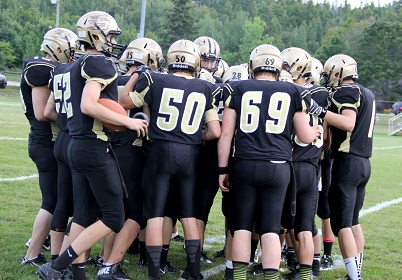
PHOTOS: (Top) St. Ignace players all wear a decal on their helmets in memory of late teammate Mitchell Snyder. (Middle) A Saints defender stacks up an Indian River Inland Lakes ball-carrier earlier this season. (Below) St. Ignace huddles during a break in play. (Photos courtesy of Kristi Gustafson.)
Drive for Detroit: Week 4 in Review
September 19, 2016
By Geoff Kimmerly
Second Half editor
A pair of game-winning field goals. Gutsy calls to go for two. Three significant streaks broken and a pair of MHSAA records set, and on top of it all a scene to draw a tear from even the most macho fan.
What more could we ask for from one weekend of high school football?
Our Week 4 review touches on a lot of these stories and more. But also check out this Observer & Eccentric piece how two teams came together to make a special night for Novi's "hydration engineer" and his mother, who is fighting cancer for the second time. A piece by WXYZ-TV also is at the bottom of this report.
Bay & Thumb
Freeland 12, Alma 6
The Falcons (4-0) added to a 16-game regular-season winning streak and kept hold on their lead in the Tri-Valley Conference Central, but just barely thanks to a defense that locked down an Alma offense that averaged 36 points per game over its first three. Freeland had three interceptions to stay ahead of the Panthers, who have given up only 26 points on the year. Click for more from the Midland Daily News.
Also noted:
Croswell-Lexington 48, Almont 28 – The Pioneers (3-1) are a three-point loss to Richmond from perfection, but are keeping themselves in the Blue Water Area Conference conversation thanks to this win over Almont (2-2).
Flint Carman-Ainsworth 41, Flint Powers Catholic 7 – A tough opening schedule made it tough to gauge the Cavaliers (2-2), but downing Powers (2-2) said plenty and kept them undefeated in the Saginaw Valley League Blue.
Midland 31, Mount Pleasant 28 – Gavin Archbold drilled a 40-yard field goal as the final seconds ticked off the clock to give Midland (3-1) the edge over the Oilers (1-3) in a series that has seen the last five games decided by eight points or fewer.
Montrose 29, Flint Beecher 15 – What’s generally a three-team race in the Genesee Area Conference Red now has two favorites with Montrose (3-1) and Lake Fenton both downing Beecher (2-2) over the last two weeks.
Greater Detroit
Farmington Hills Harrison 28, West Bloomfield 0
Harrison (3-1) avenged last season’s Week 9 loss by dealing West Bloomfield (2-2) its first shutout since 2010. Both could emerge as eventual league champions; Harrison is 2-0 in the Oakland Activities Association White, and the Lakers have two strong opening wins in the OAA Red. Click for more from the Detroit Free Press.
Also noted:
Birmingham Brother Rice 13, Warren DeLaSalle 3 – The Warriors (3-1) are back after their first sub-.500 season in 30 years, with this win over DeLaSalle (2-2) giving them more victories than in all of 2015.
Oak Park 44, Rochester Adams 43 (OT) – The Knights (2-2) went for the two-point conversion in overtime and made it five straight over Adams (3-1) and stay in the mix in the OAA White.
Detroit Catholic Central 28, Cleveland St. Ignatius, Ohio, 21 (OT) – This was the first close game for both teams, with the Shamrocks (4-0) emerging as the still-undefeated by winning overtime.
Warren Fitzgerald 24, St. Clair Shores South Lake – The Spartans (4-0) are in a slightly more comfortable position in the Macomb Area Conference Silver thanks to this win and an earlier victory by South Lake (3-1) over 2015 champion Madison Heights Madison.
Mid-Michigan
Portland 36, Lansing Catholic 35
The Lansing area’s most anticipated game was as good as expected, coming down to a made two-point conversion with 25 seconds to play that kept Portland (4-0) atop the Capital Area Activities Conference White. Lansing Catholic (3-1), which beat Portland in a Division 5 District Final last season after losing their regular-season matchup, led the entire game until that go-ahead score. Click for more from the Lansing State Journal.
Also noted:
Stockbridge 70, Leslie 32 – This wasn’t just another 100-point game involving Stockbridge (3-1); Mason Gee-Montgomery threw eight touchdown passes, reportedly breaking the MHSAA career record in the category after entering this season needing 21 to do so.
Greenville 35, Grand Rapids Forest Hills Central 34 – The Yellow Jackets (3-1) now have one more win than all of last season after handing Forest Hills Central (3-1 also after going 2-7 a year ago) its first loss.
Ithaca 45, Pinconning 0 – The Yellowjackets’ third straight shutout also put them at 4-0 and 97-3 over their last 100 games, the best 100-game winning percentage in MHSAA history.
DeWitt 47, Mason 0 – The Panthers (3-1) finish with a couple tough nonleague matchups, but beating Mason (3-1) this well makes it look like they won’t have many more challenges in the CAAC Red.
Northern Lower Peninsula
Traverse City Central 38, Portage Central 22
Storms pushed the end of this one past midnight Friday, but Traverse City Central left its home field with a big-time statement win against one of the southwest corner's top teams. The Trojans finished on a 21-7 second-half run to remain undefeated at 4-0 and hand the Mustangs (3-1) their first loss while scoring the most points Portage Central has given up since a 2013 Division 2 Semifinal. Click for more from the Traverse City Record-Eagle.
Also noted:
Johannesburg-Lewiston 47, Central Lake 14 – The Cardinals’ five-year playoff streak looked to be in jeopardy, but getting to 2-2 with this win over Central Lake (1-3) will help significantly with a tough slate ahead.
Lincoln Alcona 58, AuGres-Sims 20 – Alcona (3-1) is all alone atop the North Star League standings with the second-place Wolverines (3-1) now needing some help and two others only a win back.
Maple City Glen Lake 42, Onekama 7 – The Lakers (3-1) kept pace in the Northern Michigan Football Conference Leaders division and are the only team to beat the Portagers (3-1) during the last two regular seasons, having done so last year as well.
Roscommon 20, Beaverton 14 – Another week, another important win for upstart Jack Pine Conference co-leader Roscommon (4-0), which dealt the Beavers (2-2) a second straight loss.
Southeast & Border
Saline 26, Temperance Bedford 24
There’s a chance this season’s Southeastern Conference Red championship will come down to the field goal kicked by Vinnie Patteri with three seconds to play against Bedford (3-1) after he missed an extra point earlier in the game and was injured the week before when Saline (4-0) also won on a late field goal. Click for more from MLive-Detroit.
Also noted:
Sand Creek 38, Morenci 36 – The Aggies are continuing to enjoy their best start since 2006, making themselves a Tri-County Conference contender by beating a Morenci team (2-2) that has been the last two seasons.
Ann Arbor Skyline 35, Monroe 22 – After a tough start, Skyline (1-3) lost to Saline by only three last week and now has its first win over a Monroe team that while 2-2 has made the playoffs four of the last five seasons.
Ida 58, Brooklyn Columbia Central 34 – The matchup of last season’s top two in the Lenawee County Athletic Association went Ida’s way again, with the Bluestreaks (4-0) now tied atop the league with Dundee and Columbia Central (2-2) needing to chase.
New Boston Huron 7, Monroe St. Mary Catholic Central 6 – The Chiefs (3-1) may be a win behind in the Huron League standings but kept themselves in the conversation – with much more to celebrate – by beating the Falcons (2-2) for the first time since 1986.
Southwest Corridor
Cassopolis 28, Berrien Springs 21
The Rangers secured their first 4-0 start since 2009 in avenging a 7-0 loss from a year ago. Cassopolis mounted the winning the drive with three minutes to play and handed the Shamrocks (1-2) their second defeat by seven or fewer points this fall. Both won nine games a year ago. Click for more from the Niles Daily Star.
Also noted:
Comstock 26, Bronson 16 – The Colts’ 40-game losing streak is history as they won for the first time since 2011 to go to 1-3 this fall.
Vicksburg 24, Plainwell 8 – The Bulldogs (3-1) will need some help in the Wolverine Conference after falling to favorite Edwardsburg two weeks ago, but getting past perennial playoff team Plainwell (1-3) was big for postseason hopes.
Stevensville Lakeshore 31, St. Joseph 12 – A week after a big loss to Portage Central, Lakeshore (3-1) bounced back quickly and well in handing the Bears (3-1) their first defeat.
Portage Northern 24, Niles 21 – Portage Northern (2-2) got a needed victory as it hopes to get back to the playoffs after missing last fall; it’s worth noting that the Vikings (3-1) do have one more win already than all of last season.
Upper Peninsula
Negaunee 35, Iron Mountain 13
The Mid-Peninsula Athletic Conference title is hardly wrapped up, but Negaunee (4-0) has now handed the only losses this season to two teams – Iron Mountain and Calumet – and has to feel pretty confident with nemesis Ishpeming coming up in three weeks. Iron Mountain (3-1) handed the Hematites their lone loss this fall and now will be rooting for them. Click for more from the Iron Mountain Daily News.
Also noted:
St. Ignace 46, East Jordan 8 – This meeting of early contenders in the NMFC Legacy didn’t stay close for long, as St. Ignace (3-1) kept its spot among favorites by handing East Jordan (3-1) a first defeat.
Newberry 22, Felch North Dickinson (20) – The Indians (4-0) stood up to their first challenge of the season to remain atop the Mid-Eastern Conference with North Dickinson (2-2) falling into a tie for third.
Gwinn 28, Bark River-Harris 14 – Save for a Week 2 loss to Iron Mountain, Gwinn (3-1) already has had a memorable fall with as many wins as in any season since going 4-5 in 2001 – and now a victory over last season’s Mid-Eastern Conference co-champion Broncos (2-2).
Kingsford 36, Sault Ste. Marie 14 – The Flivvers (3-1) lined themselves up nicely for this week’s matchup against Great Northern Conference power Menominee, while dropping first-year league member Sault Ste. Marie to 1-3 overall.
West Michigan
Hudsonville Unity Christian 24, Zeeland West 22 (OT)
Unity Christian (4-0) has strung together a pair of nice finishes over the last two seasons, but both included big regular-season losses to West including 52-6 in Week 9 last season. However, the Crusaders looked like they might have figured out the Dux (3-1) a bit, falling only 28-21 in a Division 4 Regional Final a few weeks later – and this time handed the reigning Division 4 champion its first regular season loss since Week 2 of 2013. Click for more from the Grand Rapids Press.
Also noted:
Grand Rapids Forest Hills Northern 24, East Kentwood 23 – The Huskies (2-2) squeaked past what’s been considered one of the contenders in the Ottawa-Kent Conference Red; East Kentwood’s two losses the last two weeks were by a combined eight points.
Grandville Calvin Christian 36, Grand Rapids NorthPointe Christian 33 – The Squires (2-2) have come back from opening losses to bigger teams with a pair of wins against O-K Silver opponents, this one over a NorthPointe team (3-1) that played in MHSAA Semifinals the last two years.
Grandville 36, Hudsonville 6 – The Bulldogs (4-0) now look like the clear favorites in the O-K Red with a combined 185-28 score on their four opponents including an Eagles team (3-1) that looked like the other likely contender.
Muskegon Reeths-Puffer 39, Muskegon Mona Shores 34 – Reeths-Puffer (3-1) had lost to Mona Shores by a combined score of 97-18 over the last two seasons, but this time dealt the Sailors (1-3) their third straight defeat of the fall.
8-Player
Deckerville 38, Peck 0
These were two of the top three in the North Central Thumb 8-Man League, but Deckerville stands alone and impressively – the Eagles have given up 20 points this season and no more than eight in any game. Click for more from the Port Huron Times Herald.
Also noted:
Rapid River 48, Ontonagon 36 – One of the closer games statewide in 8-player saw Rapid River win its third straight to move to 3-1, with Ontonagon 2-2 after two straight losses to top Western Eight Conference teams.
New Haven Merritt 36, Hale 32 – The Mustangs are off to their first 4-0 start in their five-year program's history but only after just surviving an Eagles team that at 3-1 has as many wins this season as the last three combined.
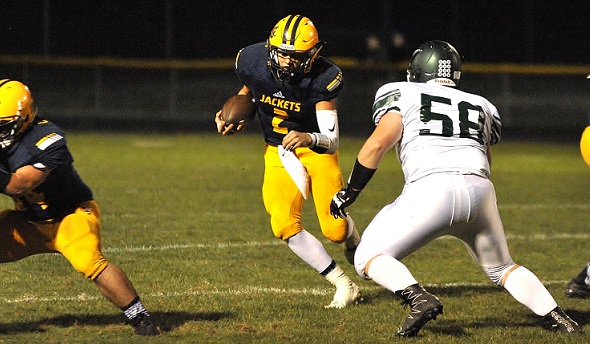
PHOTO: Ithaca improved to 97-3 over its last 100 games with a win over Pinconning. (Click to see more from HighSchoolSportsScene.com.)