

Second Half Starts Your Football Drive
August 31, 2014
By Geoff Kimmerly
Second Half editor
Just like that, the first weekend of MHSAA football season 2014 is in the books.
But we've got three more months of exciting stories to follow as September kicks off Monday.
Here's a brief breakdown of regular features to come this season on Second Half:
- A Game for Every Fan: Weekly looks each Friday at the best games to be played in every corner of the state.
- Drive for Detroit: Weekly reviews each Tuesday at the most significant results from the weekend across both peninsulas.
- Be the Referee: Weekly series from our director of officiating, Mark Uyl, that will include a number of football topics during the fall.
- This Week on MHSAA.TV: We'll fill you in on all the games available on-demand on MHSAA.TV from the week before and let you know which coming up can be watched live on a subscription basis.
- Inside Selection Sunday: Our annual explanation of how playoff pairings are chosen and some of our toughest decisions when building brackets in October.
- Live from the Finals: We'll cover all nine MHSAA Finals, beginning with the 8-Player championship game and through two days of 11-player title contests during Thanksgiving weekend.
- Records Report: Each week we'll fill you in on our latest additions to the MHSAA record books, including for football, which has our largest set of listings.
- All the scores, schedules and standings: Keep an eye on "Scores & Schedules" on MHSAA.com for scores every weekend as we receive them, and visit your favorite team's page for all results from this fall plus league standings, the rest of the schedule to come and playoff point averages.
A Game for Every Fan: Week 1
August 28, 2013
By Geoff Kimmerly
Second Half editor
It's opening night of another MHSAA football season. Not much more needs to be said to describe why athletes, coaches and communities are stepping a little higher with the first varsity kickoffs only a few hours away.
Every game and every team has a story. And each week Second Half will bring you the best game in each of seven regions around the state, plus another five from each that should be worth following for even casual fans.
Make sure to visit MHSAA.com tonight and all weekend for a complete statewide scoreboard, and return to Second Half on Monday as we wrap up the most significant results from another opening night.
(Team records that follow are from 2012, and all games are tonight unless noted. Games are designated by region based on home team. Visit the MHSAA Score Center for a complete schedule.)
Greater Detroit
Oak Park (9-3) vs. Orchard Lake St. Mary’s (11-3), Friday at Wayne State University
When last we left Oak Park, the Knights were celebrating a team record for wins, their first playoff appearance since 2005 plus league and District championships. They can kick off 2013 by giving proof they’ll be contenders again; St. Mary’s is coming off an overtime loss to Grand Rapids Christian in a memorable MHSAA Final and always is in the hunt.
Others that caught my eye: Rockford (10-3) at Utica Eisenhower (8-3) on Friday, Detroit Cass Tech (12-2) at Southfield (7-4) on Friday, Pontiac Notre Dame (9-2) at Dearborn Heights Robichaud (9-2), Macomb Dakota (10-2) at Dearborn Fordson (7-3), Zeeland West (7-4) at Detroit Country Day (11-1).
Bay and Thumb
Saginaw Nouvel (9-3) at Saginaw Swan Valley (10-3)
This is a rare matchup between Saginaw powers, but one with interesting history nonetheless. The teams have met only three times – most recently in 2001, when Nouvel beat the Vikings 30-0 in a Division 5 District Final. Nouvel also shut Swan Valley out in season openers in 1984 and 1985. But 2,000-yard rusher Alex Grace and teammates also back from last season’s MHSAA Semifinal run should find the end zone this time regardless of the final score.
Others that caught my eye: Reese (10-1) at Montrose (10-2), Hemlock (9-2) at Frankenmuth (10-1), Marine City (8-2) at Richmond (7-4), Armada (5-4) at Flint Powers Catholic (11-1), Clare (9-3) at Freeland (6-4).
Lower Up North
Big Rapids (8-2) at Reed City (10-1)
Reed City eventually finished first and Big Rapids second in the Central State Activities Association in 2012 after Reed City edged the Cardinals 14-6 on opening night. The Coyotes went on to win 10 straight before falling in their District Final. This matchup should set the tone again in one of the few league races that begins on opening night.
Others that caught my eye: Boyne City (8-2) at Maple City Glen Lake (9-2), Roscommon (6-4) at Grayling (9-1), Elk Rapids (4-5) at Mancelona (10-1), Carrollton (8-2) at Standish-Sterling (7-4), New Lothrop (10-1) at Traverse City St. Francis (4-5).
West Michigan
Grand Rapids Christian (13-1) at Grand Rapids South Christian (11-3)
Three months after continuing their annual opening-night game in 2012, Grand Rapids Christian won the MHSAA Division 3 championship a day after South Christian won the Division 4 title. The Eagles will have a significantly different look at least on offense this time after graduating most of their skill players and losing record-setting receiver Drake Harris for reportedly a month with a leg injury. South Christian quarterback Jon Wassink won’t be familiar to those who watched last season’s Finals – he was injured during the run and didn’t play in the championship game. But he’s back to lead another strong effort.
Others that caught my eye: Grand Rapids Catholic Central (10-1) at East Grand Rapids (4-5), River Rouge (11-1) at Lowell (8-3), Muskegon Oakridge (10-1) at Grand Rapids West Catholic (10-4), Byron Center (5-4) at Grand Rapids Northview (7-3), Holland Christian (5-5) at Zeeland East (9-1).
Mid-Michigan
Williamston (7-4) at Ithaca (14-0)
The Yellowjackets have won 42 straight games including the last three MHSAA Division 6 Finals, and are led by senior all-state quarterback Travis Smith. A win would tie Ithaca with 1977-82 Cheboygan for the longest winning streak in MHSAA history falling fully during the playoff era (Morenci won 44 straight before playoffs were added, and Hudson’s 72-game victory streak ended during the first year of the playoffs in 1975.) Williamston hasn’t given the Yellowjackets much of a scare during the first two years of their opening-night series, but could be the best bet as stopper until playoff time.
Others that caught my eye: Lansing Catholic (8-2) at Pewamo-Westphalia (9-4), Lansing Waverly (6-4) at Lansing Everett (9-1), Haslett (4-5) at East Lansing (7-4), Dundee (6-4) at Grass Lake (10-2), Beal City (13-1) at Mount Pleasant Sacred Heart (9-2) on Friday.
Southwest and Border
Battle Creek Harper Creek (10-3) at Mattawan (10-2)
Harper Creek kicks off its quest for a third straight season of double-digit wins against a Mattawan team coming off a school record for wins and 18 total over the last two seasons. They last met in a 2005 playoff opener. It will be a strong opening test for teams with league title aspirations again; Harper Creek won the Southwest Michigan Athletic Conference East last season, and Mattawan finished second in the SMAC West.
Others that caught my eye: Portage Central (7-4) at Sturgis (5-4), Marshall (6-4) at Stevensville Lakeshore (11-1), Otsego (6-4) at Edwardsburg (6-4), Fowler (9-2) at Mendon (11-1), Ottawa Lake Whiteford (8-2) at Blissfield (6-5).
Upper Peninsula
Manistique (6-4) at Negaunee (10-2) on Friday
Negaunee has had only one losing season over the last 23 and won the Mid-Peninsula Athletic Conference title last year ahead of eventual MHSAA Division 7 champion Ishpeming. Manistique finished with a winning record for the first time in four years despite opening with losses to Negaunee and Ishpeming, and could be in the title hunt in the MPAC.
Others that caught my eye: Traverse City Central (4-5) at Marquette (5-4), Iron Mountain (5-5) at Ishpeming (13-1), Stephenson (8-3) at Ishpeming Westwood (3-6) on Friday, Hancock (3-6) at Bessemer (6-3) on Saturday, Brimley (2-6) at Eben Junction Superior Central (6-3).
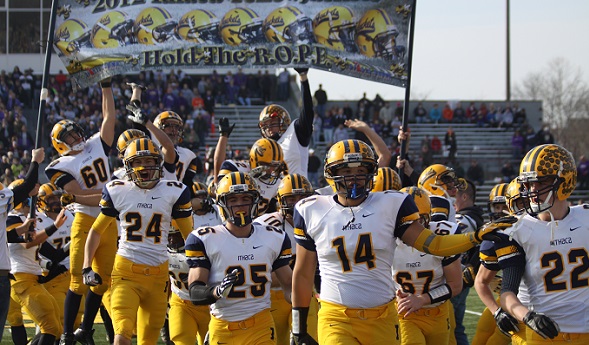
PHOTO: Ithaca takes the field for its MHSAA Semifinal last season at Saginaw Valley State University. The Yellowjackets have won 42 straight games. (Click for more from HighSchoolSportsScene.com.)