

Talking Practice: Texas, Illinois Revise Policies
December 20, 2013
By Rob Kaminski
MHSAA benchmarks editor
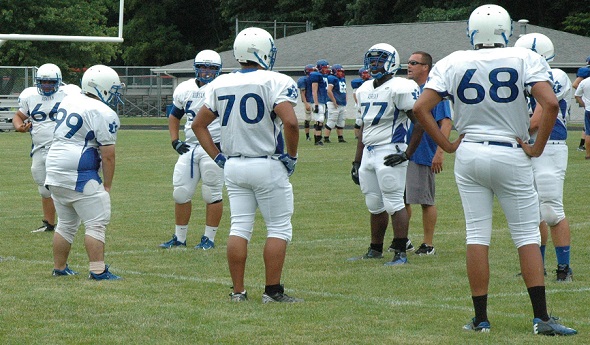
Coaches and players in Texas and Illinois adapted to new football practice limitations this fall, with the Texas policy focusing on contact, and the Illinois regulation emphasizing length of preseason practices.
Following are the main changes those states put in place heading into the 2013-14 season:
The University Interscholastic League, which governs school sports in Texas, put into writing that, “During the regular season and postseason, no football player is allowed to participate in more than ninety (90) minutes of full contact practice per week,” effective with the first day of practice this fall.
The complete policy follows:
For the purposes of the of rule, "full contact" is defined as football drills or live game simulations where "live action" occurs. Live action, as defined by USA Football, is contact at game speed where players execute full tackles at a competitive pace taking players to the ground. A team may continue to dress in full pads for practice, but may only participate in live action drills and game time simulations no more than ninety minutes per athlete per week. It is assumed that when players are in shells (shorts, shoulder pads, and helmets) no live action drills or simulations will occur. This rule is intended to limit live action drills and simulations and not the number of practices a team may participate in full pads. A team may participate in "air," "bags," "wrap," and "thud" drills and simulations at any point. These contact levels are defined below:
• Air - Players should run unopposed without bags or any opposition
• Bags - activity is executed against a bag, shield or pad to allow for a soft-contact surface, with or without the resistance of a teammate or coach standing behind the bag.
• Wrap - Drills run at full speed until contact, which is above the waist with the players remaining on their feet.
• Thud - Same as wrap but tempo is competitive with no pre-determined winner and the players are not tackling to the ground.
 The rule came to the UIL Legislative Council as a recommendation from the UIL Medical Advisory Committee, a permanent advisory committee to the Legislative Council which meets twice each year to discuss and review safety policies for UIL participants. The committee, which is made up of leading medical professionals in various specialties and includes representatives from the Texas High School Coaches Association, the Texas Girls Coaches Association, and the Texas State Athletic Trainer Association, unanimously recommended this limitation in full-contact football practice.
The rule formulates into a formal policy the existing actions of the majority of coaches across Texas, and most coaches have had to make few adjustments, if any. In fact, according to a story on statesman.com, the proposal caused more of an uproar on social media than from coaches.
“It’s not going to affect us in anyway,” Vandegrift HS coach Drew Sanders said in the story. “Most good coaches were way below that 90-minute amount already. Prior to legislation we still monitored it ourselves – the only change is now we have to keep up a log more publicly.”
Illinois put standards in place for its first 14 days of football practices, known as the state’s Preseason Football Acclimatization Practice Period. At the core of the policy is a three-hour practice limit for the first five days, during which teams can also conduct a one-hour walk-through.
 Teams must observe a minimum two hours rest between the practices and walk-throughs. Players may wear helmets only on the first two days, then helmets and shoulder pads for the next three. From days seven through 14 of the acclimatization period, schools may practice for a maximum of five hours per day, as long as that day is followed by a three-hour day, or an off day. During the five-hour days, no session can last more than three hours and must include a two-hour break between practices. Full pads may be worn for the final seven dates leading up to the first contest.
“This policy was the result of a collaborative effort between the IHSA Sports Medicine Advisory Committee and the Football Advisory Committee,” said SMAC committee member and University of Illinois Associate Professor of Orthopedic Surgery Dr. Preston M. Wolin. “The guidelines are based on the most recent scientific evidence, as well as the expertise of the coaches who will help implement them. Both committees believe the guidelines represent a significant positive contribution to the health of our athletes.”
“This new policy undoubtedly changes the way we, as coaches, approach preseason practice,” said Metamora HS coach Pat Ryan, who is a member of the FAC and a past President of the Illinois High School Football Coaches Association. “Coaches have to get more creative with when and how they schedule practices, as well what they do with their time. The proposals were strongly supported by both committees. It is a crucial final step to the process of being able to effectively prepare our teams in a safe manner. Change is always difficult, but the game is changing and we need to adapt to continue to put the safety of our players first.”
The IHSA offered multiple interactive online webinar meetings for high school coaches leading up to the start of practice where questions were answered, along with further clarifications on the policy and the science behind it.
“I think most coaches understood that changes were on the horizon,” said IHSA Executive Director Marty Hickman. “We wanted to be in a position to give our coaches as much information as possible to make sure they are comfortable with the new policy. Their input will be critical moving forward as we develop educational materials, like a best practices presentation. I commend our committees on a policy that is supported by medical experts, football coaches and school administrators.”
Dock Putting Dad's Coaching Lessons to Work as Middleville TK Continues Climb
By
Steve Vedder
Special for MHSAA.com
November 3, 2025
MIDDLEVILLE – Denny Dock can't pinpoint the exact moment he thought his football-loving son would follow him into coaching, but the signs were there all along.
 For starters, there were the countless hours spent tossing a football around the backyard. Or when his young son, Jeff – not even old enough for middle school at the time – eagerly joined other Stevensville Lakeshore coaches watching film on weekends.
Maybe it was all those Friday nights spent trekking along the sideline as a ball boy for Lancers teams. Another clue might have been the Saturday afternoons the two spent together watching college football, or taking in the NFL on Sundays.
When Jeff got older, it may have been how he readily absorbed tips that helped him become a better quarterback in high school and then at Grand Valley State. It could have even been an early, uncanny ability to grasp the importance of fundamentals.
Put it all together, and it seemed inevitable coaching football loomed in Jeff Dock's future.
"That's very fair to say," said Denny Dock, who is 19th on the state's list of all-time winningest football coaches while also the winningest high school softball coach in the country. "The younger years in football were really positive for Jeff, and that doesn't happen all the time. There are negative things that can happen."
While there might have been multiple signs the younger Dock would one day join the coaching ranks, he admits it was far from a done deal. There were thoughts of becoming a biology teacher, a pastor or maybe even an orthopedic surgeon.
But coaching? Even with his father as a classic example of the positive impact a good coach could spread, Dock said it took years for him to eventually land in coaching.
"It dawned on me that there were a lot of all three of those things in being a coach," he said. "Growing up in sports is what I knew, and I ended up developing a passion for it."
That passion is actually the highest it's been in years as his Middleville Thornapple Kellogg football team this past weekend improved to 7-3, continuing the program's first winning season since 2020 and the best fall since the Trojans went 7-3 in 2018. The Trojans defeated Hastings 28-20 in a Division 2 playoff opener, and a win this Friday at Lowell would give Middleville its first District championship since 2001.
Denny Dock coached football at Hartford from 1981-83, Dowagiac from 1984-87, and then Lakeshore from 1988-2013, returning to lead the Lancers for one more season in 2020 and all together totaling a 270-79 career record, 15 league titles and five runner-up MHSAA Finals finishes.
He has kept his hand in football in aiding his son's Trojans program. He's at all the games to add support, critique, advice, strategy, tips on how practices can best be organized and long talks discussing how continual improvement can be furthered.
It's a two-way street as an old football coach who never had a losing season, and is a member of the Michigan High School Football Coaches Association Hall of Fame, can remain invested in the game while his son benefits from three decades worth of experience.
Jeff Dock said his father's real value is his ability to spot from the stands the little things that less experienced coaches may miss.
 "Play calling, how players are used, maybe a little bit about strategy," Dock said.
After playing for his father, Dock said there's no doubt he's transferred the best of what he learned into his own coaching. The older Dock was not only a highly successful football coach, he's compiled a 1,319-345-2 record in softball with eight Finals titles.
Whether it's about football or the philosophy Dock stresses in his softball program, the advice accepted from his father – who still attends softball clinics for tips on improving the Lakeshore program – is virtually across the board. It begins, however, with how a coach should treat his players.
"I was a manager growing up, and I saw his intensity and a love of his players," Dock said. "He never pushed me in any direction, but he told me about education. He always let me figure it out. One of the coolest things my parents did in raising me was to allow me to figure things out."
As far as the Xs and Os of coaching, Dock said his father prizes an organized practice. In fact, it could even be argued that both Docks enjoy a spirited and productive practice session over the microscope of Friday Night Lights.
"He never had a losing season, and it was ingrained in us just to go back to work and that that work never stops," he said. "He loves practices and being organized. Rule No. 1 with him was to make sure the players are prepared, and that you have to communicate with them. Dad would never belittle us or cuss us out.
"I saw the work he put in, how he'd wake up every Saturday thinking about the game. I saw the nitty gritty of coaching and how it was going to take work."
It was that seemingly endless work, in fact, that Denny Dock made sure his young son understood. Denny had no illusions over the pitfalls of coaching, and the pros and the cons. But before he could teach that to his son the coach, he made sure his son the quarterback understood how athletics worked.
There were challenges as a player and now for his son as a coach.
"He was always a quarterback because I think he liked the ball in his hands," Denny Dock said. "I think he liked the leadership part of the game, understanding the team part, and knowing what he had to do. That always challenged him."
While the challenge of playing is long gone for the younger Dock, the next challenge is building a program which is annually competitive. To do that, Jeff Dock said he accepts what his father knew 30 years ago.
"I'm willing to learn anything from anyone at any time," he said. "I know my dad has always thought about what he can do to become a little better every year. I'm always looking for ways to communicate and do things better. It can always be done better, but how can you get there? How can we do the little things better. That's what I learned."
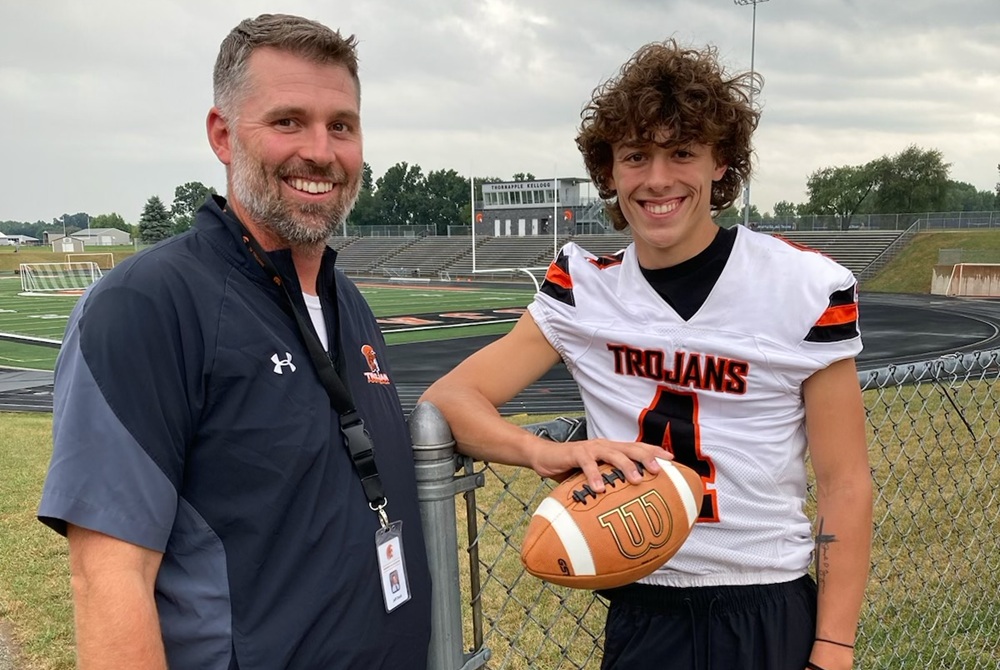
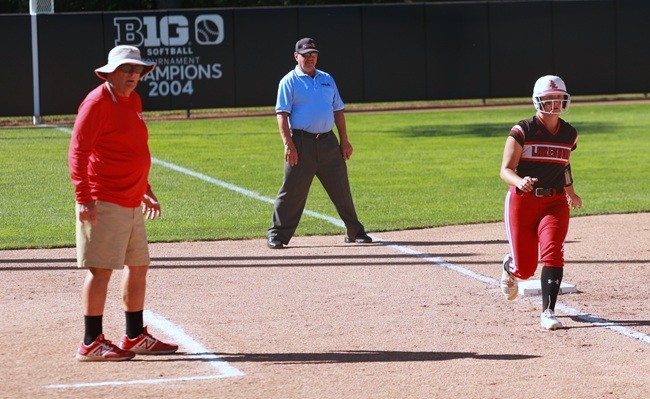
PHOTOS (Top) Jeff Dock, left, and son Micah – Middleville Thornapple Kellogg’s quarterback this season – stand for a photo at their home field. (Middle) Denny Dock, far left, coaches a base runner during Stevensville Lakeshore’s 2022 Semifinal win. (Top photo by Steve Vedder.)