


#TBT: 600-plus Teams Ready for Kickoff
August 27, 2015
By Geoff Kimmerly
Second Half editor
Football teams have represented Michigan high schools for more than a century, beginning long before the MHSAA was formed during the winter of 1924-25.
This weekend, nearly all of the 614 varsity teams scheduled to play this fall will kick off their seasons – and for a fortunate 18, start a journey that will last more than three months through the MHSAA Finals.
This will be the 40th season of the MHSAA football playoffs, which were first played with a much smaller field of teams in 1975. The field expanded to its current 256 11-player teams in 1999, and an 8-player tournament was added in 2011.
The above photo was taking during a 23-0 Muskegon victory over Escanaba during the 1989 Class A playoffs (senior Marcus Longmire celebrates scoring his team's second touchdown). The Big Reds advanced from this Pre-Regional game to face Midland, then Lansing Sexton, and finally Detroit Martin Luther King in the Class A Final – which Muskegon won 16-13.
The Big Reds have won five MHSAA titles total, and also made Finals the last three seasons, finishing runner-up in Division 2 in 2012 and 2013 and last season in Division 3 after falling 7-0 to Orchard Lake St. Mary's.
Drive for Detroit: Week 4 Preview
September 19, 2019
By Geoff Kimmerly
Second Half editor
As we cruise into Week 4 of this high school football season, be ready for a few curveballs and change-ups.
 For starters: Something just doesn't feel right about not featuring the latest meetings between Detroit Martin Luther King and Cass Tech and Traverse City West and Central, like we have almost every season since beginning these previews in 2012. But other games from those parts of the state are potentially bigger this time around.
Read on for more on many of the matchups that especially stuck out from this week's schedule. Be sure as well to check out this week's MHSAA.tv schedule featuring 25 games including seven mentioned below.
And because those two games mentioned above are still going to mean a lot, potentially, here are a few quick notes: The King/Cass winner will move to 2-2 and the loser to 1-3, with the teams likely to meet again in the league playoffs and the loser of that rematch very possibly missing the MHSAA postseason. Both got to 1-2 after playing some of the toughest opening competition of any teams statewide. Meanwhile, the West/Central “Patriot Game” will draw more than 10,000 fans downtown tonight, and the winner will be a frontrunner to win the Big North Conference title. West was the champ and Central second last season thanks to West's 21-14 win of the Trojans.
"Drive for Detroit" is sponsored by MI Student Aid.
Bay & Thumb
Frankenmuth (3-0) at Freeland (3-0)
These two have met six times over the last four seasons, four in nonleague contests and twice in the playoffs, with Freeland holding a 4-2 edge. The realigned Tri-Valley Conference East has them both in the same league this fall and as the only unbeaten teams overall after three weeks (Saginaw Swan Valley also is 2-0 in league play, 2-1 overall). Freeland has pulled out a couple of close games this fall against tough opponents, while the Eagles have won all of their games (against a less imposing group) by at least 29 points – but fell to the Falcons in last year’s Week 9 matchup 15-8.
Keep an eye on these: FRIDAY New Lothrop (3-0) at Montrose (3-0), Davison (3-0) at Flint Powers Catholic (3-0), Richmond (3-0) at Croswell-Lexington (2-1), Alma (1-2) at Saginaw Swan Valley (2-1).
Greater Detroit
Brighton (3-0) at Plymouth (3-0)
The Wildcats took a nice step last fall after posting sub-.500 records in 2016 and 2017, finishing 6-4. Taking down reigning league champion Brighton to move into first alone in the Kensington Lakes Activities Association West would be another jump. Plymouth broke a three-year losing streak against rival Canton with a 15-13 win last week, while the Bulldogs are riding an 11-game regular-season winning streak that includes a 24-7 win over Plymouth last season.
Keep an eye on these: FRIDAY Orchard Lake St. Mary's (3-0) at Walled Lake Western (3-0), Detroit Cass Tech (1-2) at Detroit Martin Luther King (1-2), Birmingham Groves (3-0) at Oak Park (2-1), Clarkston (1-2) at West Bloomfield (2-1), Brownstown Woodhaven (3-0) at Wyandotte Roosevelt (3-0).
Mid-Michigan
DeWitt (2-1) at Holt (2-1)
The Rams’ rejuvenation has brought relevance to this matchup after the first meeting between these teams ended with a 49-7 Panthers victory a year ago. With solid wins over Caledonia and Hudsonville and a close loss last week to Traverse City West, Holt is projecting early to earn its first playoff berth since 2013. But DeWitt represents a fourth straight tough opponent to start the season, and also a major measuring stick locally as the reigning Capital Area Activities Conference Blue champion and winningest team in the Lansing area since the start of the century.
Keep an eye on these: FRIDAY Evart (3-0) at Beal City (3-0), Fowler (3-0) at Laingsburg (3-0), Portage Northern (3-0) at East Lansing (2-1), Williamston (2-1) at St. Johns (2-1).
Northern Lower Peninsula
Traverse City St. Francis (2-1) at Kingsley (3-0)
This rivalry has been one-sided this decade, with St. Francis winning seven of eight meetings including last year’s during the regular season (43-8) and playoffs (41-20). But there are a few reasons to believe this rematch will be much more competitive. First, last year’s games saw Kingsley break a four-year shutout streak against the Gladiators on the way to finishing 10-2 – after going only 1-8 in 2017. The Stags have won all of their games this fall by at least 27 points. And St. Francis did suffer only its second regular-season loss of the last five seasons, in Week 2 to Maple City Glen Lake – although the defeat is looking better every week as the Lakers remain unbeaten.
Keep an eye on these: FRIDAY Traverse City Central (2-1) at Traverse City West (2-1), Frankfort (2-1) at Maple City Glen Lake (3-0), St. Ignace (2-1) at Johannesburg-Lewiston (3-0), McBain (1-2) at Lake City (1-2).
Southeast & Border
Sand Creek (3-0) at Clinton (3-0)
Clinton has emerged as the early favorite in the Tri-County Conference with recent power Ottawa Lake Whiteford off to a 1-2 start and the Redskins putting up at least 41 points in all three of their games so far. But Sand Creek has gone over 50 twice, and more impressively pulled out a 31-28 Week 2 win over otherwise unscored-upon Adrian Lenawee Christian. The last three games between these two were decided by seven points or fewer. Clinton won the last two including last fall 28-27.
Keep an eye on these: FRIDAY Blissfield (2-1) at Brooklyn Columbia Central (3-0), Onsted (2-1) at Hillsdale (3-0), Michigan Center (1-2) at Addison (2-1), Waterford Our Lady of the Lakes (1-2) at Pittsford (2-1).
Southwest Corridor
Edwardsburg (3-0) at Vicksburg (3-0)
The reigning Division 4 champion Eddies have run their winning streak to 17 and given up all of eight points this season, those to Dowagiac in Week 1. This is all familiar of course – Edwardsburg has lost only two regular-season games over the last seven years, although the first defeat came to Vicksburg in 2014. Despite finishing just 3-6 a year ago, the Bulldogs did give the Eddies their second-closest game of the entire 2018 season including playoffs with a 38-22 defeat in Week 8 (only Grand Rapids Catholic Central in a two-point Semifinal loss came closer).
Keep an eye on these: FRIDAY Lawton (3-0) at Delton Kellogg (3-0), Paw Paw (3-0) at Dowagiac (2-1), Stevensville Lakeshore (2-1) at St. Joseph (3-0), Kalamazoo Central (1-2) at Kalamazoo Loy Norrix (0-3).
Upper Peninsula
West Iron County (3-0) at Calumet (3-0)
Coming off what surely will be one of its toughest league games of this season against Ishpeming Westwood, Calumet next gets what should be a strong nonleague challenge in West Iron – even considering the Copper Kings won the same matchup under similar circumstances 43-6 a year ago. The Wykons did go on to finish 8-3, its only other losses both to Ishpeming. A win tonight would give them not only a great measuring stick as they look to match up with another undefeated Hematites team in league play, but also would put West Iron at 4-0 for the first time since 2014.
Keep an eye on these: FRIDAY Marquette (1-2) at Escanaba (3-0), Ishpeming Westwood (1-2) at Ishpeming (3-0), Kingsford (1-2) at Gladstone (2-1), Petoskey (0-3) at Sault Ste. Marie (2-1).
West Michigan
Rockford (3-0) at Muskegon Mona Shores (3-0)
Even with some of their opponents’ struggles, it’s always going to be impressive how Rockford has opened with wins over Grand Rapids Christian, Lowell and Holland West Ottawa. Mona Shores actually was even better this time against early opponents East Kentwood, Bay City Central and Reeths-Puffer than a year ago, when the Sailors also started 3-0 and then went on to beat Rockford 33-14 in Week 4 and eventually finish 12-2 and Division 2 runner-up. The Rams have some added motivation, as reportedly longtime and legendary coach Ralph Munger is slated to return to the sideline for the first time this fall after undergoing heart surgery just before practice began.
Keep an eye on these: FRIDAY Holland Christian (2-1) at Byron Center (3-0), Sparta (3-0) at Grand Rapids Catholic Central (2-1), Zeeland West (3-1) at Lowell (2-1), Grand Rapids Forest Hills Central (2-1) at Grand Rapids Forest Hills Northern (1-2).
8-Player
Climax-Scotts (3-0) at Camden-Frontier (3-0)
While the Panthers’ early run during their inaugural season of 8-player has been impressive, Camden-Frontier might present a next-level challenge. The Redskins have made the playoffs all three seasons they’ve played 8-player, and this fall they’ve sandwiched a nice eight-point win over Burr Oak between 50+ scoring weeks. The last time these teams played, Climax-Scotts won 60-0 in a 2015 11-player game – but it’s a good assumption the move to 8-player for both will prove to be a bit of an equalizer as they meet again.
Keep an eye on these: FRIDAY Suttons Bay (3-0) at Onekama (3-0), Rudyard (2-1) at Brimley (3-0), Colon (3-0) at Burr Oak (2-1). SATURDAY Pickford (2-1) at Eben Junction Superior Central (2-1).
Second Half’s weekly “Drive for Detroit” previews are powered by MI Student Aid, a part of the Office of Postsecondary Financial Planning located within the Michigan Department of Treasury. MI Student Aid encourages students to pursue postsecondary education by providing access to student financial resources and information. MI Student Aid administers the state’s 529 college savings programs (MET/MESP), as well as scholarship and grant programs that help make college Accessible, Affordable and Attainable for you. Connect with MI Student Aid at www.michigan.gov/mistudentaid and find more information on Facebook and Twitter @mistudentaid.
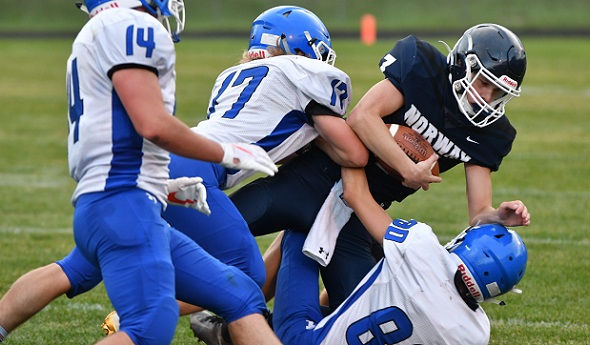
PHOTO: Norway quarterback Nathan Paulitch (7) gains several yards during the second quarter of last week's game against Ishpeming before Hematites Ben Pruett (14), Dawson Delongchamp (17) and Tanner Romback (80) catch up to him. (Photo by Cara Kamps.)