

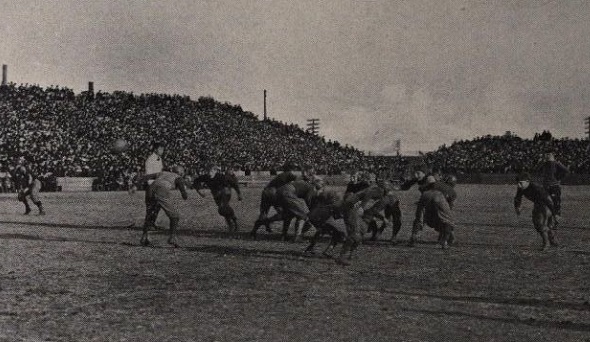
Thank Roosevelt for Football Weekends
December 20, 2013
By Rob Kaminski
MHSAA benchmarks editor
The next time you find yourself immersed in a tense crosstown football rivalry on a Friday night followed by a Saturday pilgrimage to the nearest college campus and a Sunday afternoon with a remote and your favorite snacks and beverages, take a moment to consider what the weekend would be like if it weren’t for Teddy Roosevelt.
The man who became our 26th President shortly after the turn of the 20th Century following the assassination of William McKinley in 1901 was a football fan like you. Maybe more so.
Today’s game of football has reached a critical crossroads. Player size and speed have increased across the board. Savage use of equipment as weapons rather than protective gear has been glorified on television networks and social media. Leaders of the game at all levels have recognized the need for change, employing new rules and widespread educational efforts to aid in preserving the sport.
History, as they say, is repeating itself.
In an ironic twist, it was Roosevelt who saved the then-brutally violent game of football from itself more than 100 years ago. Yes, the same “Rough and Ready Teddy” who led the charge up San Juan Hill during the Spanish-American War and often sparred in the boxing ring while in office from 1901-09 opined that football was becoming so gruesome that he delivered an ultimatum: clean up the game or it would be outlawed.
The Chicago Tribune reported that in 1904 alone, there were 18 football deaths and 159 serious injuries, mostly among prep school players. Football deaths suffered by younger players were reported on a nearly weekly basis, as outraged citizens called on colleges and high schools to banish football outright.
In stepped Roosevelt, who called head coaches and representatives from Harvard, Yale and Princeton – college powers at the time – to the White House in 1905 urging them to eliminate excessive violence and set an example of fair play for the rest of the country. When the casualties actually rose by one during the ensuing season, Roosevelt reacted with greater resolve and convened leading football authorities for the purpose of authoring drastic rules changes. What emerged was an intercollegiate conference which was the predecessor of the NCAA.
Among the most effective changes for the 1906 season were the legalization of the forward pass, the elimination of mass formations, and the creation of a neutral zone. Football fatalities fell to 11 in each of the next two seasons, and severe injuries fell drastically.
Thanks to the introduction of protective equipment and ever-evolving rules changes, football during the 100-plus years to follow has become an exponentially safer game. Yet, the game’s leaders always will need to adjust and react to scrutiny that comes with the territory.
So, as the game once again undergoes rules modifications in the name of safety, give a tip of the cap to President Roosevelt while you enjoy college bowl season and the NFL playoffs and begin to think ahead to the first high school practice of 2014.
Sadler Primed for Big Finish to Championship-Filled Cass Tech Career
By
Keith Dunlap
Special for MHSAA.com
August 22, 2025
DETROIT — For C.J. Sadler, it all started with a token of generosity from a neighbor he calls “Mr. Johnson” when Sadler was just 7 years old.
 Sadler recalls how Mr. Johnson – the grandfather of childhood friend Jalen Johnson, who went on to star at Belleville – paid for his for his initial registration for Detroit’s Police Athletic League.
Sadler said the elder Johnson noticed his aggressiveness while out playing with an older kid in the neighborhood, and saw something in Sadler that made him believe he was ready to give football a try.
So Mr. Johnson forked over $250 to help get Sadler enrolled in the youth football league.
“I’ll never, ever forget that,” Sadler said of Mr. Johnson, who has since passed away. “He’s the reason I’m doing this now.”
What Sadler is doing right now is establishing himself as one of the elite high school players in the Midwest.
A senior wideout/defensive back for 2024 Division 1 champion Detroit Cass Tech, Sadler is widely considered the state’s best player going into this season.
On Friday, he committed to play next for Bill Belichick at North Carolina, primarily because the Tar Heels will give him the opportunity to play on both sides of the ball in college.
“I definitely can pull it off,” Sadler said. “I know it’s college, and it’s the next level. But I told coaches I want to play both sides, and that’s what I want to do. Whatever I’ve got to do to do it, I’m going to do it.”
Anyone who watched Sadler during last season’s 42-20 win over Hudsonville in the Division 1 championship game sure knows what he can do on the field.
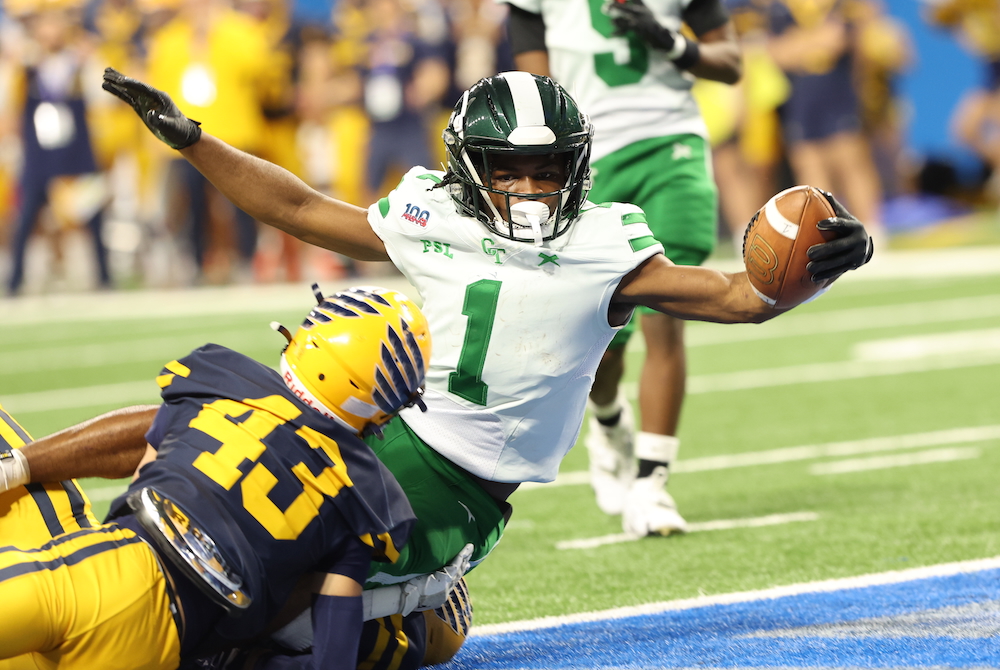
Sadler caught six passes for 47 yards and two touchdowns, finishing off a season that saw him catch 51 passes for 1,043 yards and 14 touchdowns total.
Defensively, he had three solo tackles and played his usual lockdown pass coverage in the secondary.
Sadler is entering this fall as a four-year varsity player, but he spent the first two years playing a lot of quarterback for the Technicians.
 But when current quarterback Donald Tabron came into the fold as a freshman last year, Sadler approached Cass Tech coach Marvin Rushing with an idea.
“He was one of the gentlemen who approached us and said, ‘Hey, I think the team may actually flow better if Don is in the lead,’” Rushing said. “We had the opportunity to be more dynamic with him out on the edge. Obviously preparing for the next stage and college football, it was less wear and tear on him. He was fundamental and paramount in being able to transition because if your players resist, it’s hard to have that growth in the program.”
Before last season, Sadler made it a point to take the promising Tabron under his wing and help him get adjusted to varsity football and the tradition-rich program that is Cass Tech.
“He knows a lot about the game of football, and he knows a lot about Cass Tech football,” Tabron said. “He was just giving small tidbits when I need it and giving me small pieces of information to learn.”
After some initial growing pains, Tabron matured enough to help Cass Tech win another Division 1 title.
With the quarterback now a year older and more comfortable as a sophomore, Tabron to Sadler figures to be one of the most lethal passing combinations in the state.
Rushing said the biggest emphasis for Sadler has been taking care of his body and getting it ready for the next level, focusing on his flexibility, nutrition and hydration, which only enhances an incredible appetite to win.
“He despises losing, and it becomes contagious,” Rushing said. “Weight room, basketball, football. You could be playing video games with the guy. He doesn’t want to lose.”
Sadler actually has two state championship rings at Cass Tech, as he was a reserve as a freshman on Cass Tech’s basketball team that won the Division 1 title in 2023. He said he still communicates with the star of that team, Darius Acuff, who will be a freshman at Arkansas this year.
“That’s my brother,” Sadler said. “I just talk to him about his college life right now, and he’s telling me.”
A big senior season, a collegiate career and maybe even a professional opportunity down the road all are on the table for Sadler’s future.
No doubt, Mr. Johnson is above smiling and proud of it all.
 Keith Dunlap has served in Detroit-area sports media for more than two decades, including as a sportswriter at the Oakland Press from 2001-16 primarily covering high school sports but also college and professional teams. His bylines also have appeared in USA Today, the Washington Post, the Detroit Free Press, the Houston Chronicle and the Boston Globe. He served as the administrator for the Oakland Activities Association’s website from 2017-2020. Contact him at [email protected] with story ideas for Oakland, Macomb and Wayne counties.
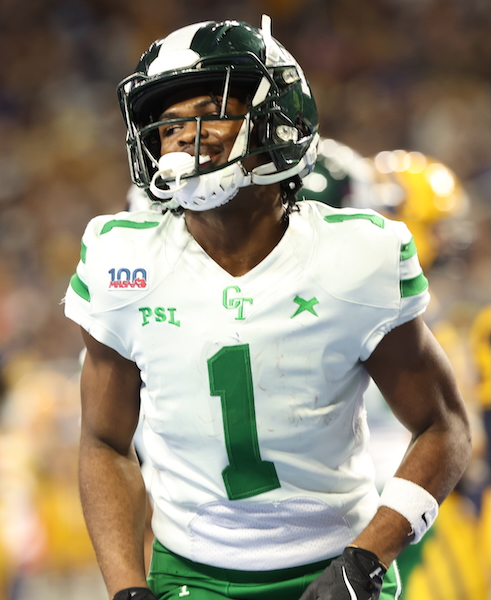
PHOTOS (Top) Detroit Cass Tech’s C.J. Sadler (1) stretches into the end zone for a touchdown during last year’s Division 1 Final at Ford Field. (Middle) Sadler has recently committed to continue at North Carolina.