

Thank Roosevelt for Football Weekends
December 20, 2013
By Rob Kaminski
MHSAA benchmarks editor
The next time you find yourself immersed in a tense crosstown football rivalry on a Friday night followed by a Saturday pilgrimage to the nearest college campus and a Sunday afternoon with a remote and your favorite snacks and beverages, take a moment to consider what the weekend would be like if it weren’t for Teddy Roosevelt.
The man who became our 26th President shortly after the turn of the 20th Century following the assassination of William McKinley in 1901 was a football fan like you. Maybe more so.
Today’s game of football has reached a critical crossroads. Player size and speed have increased across the board. Savage use of equipment as weapons rather than protective gear has been glorified on television networks and social media. Leaders of the game at all levels have recognized the need for change, employing new rules and widespread educational efforts to aid in preserving the sport.
History, as they say, is repeating itself.
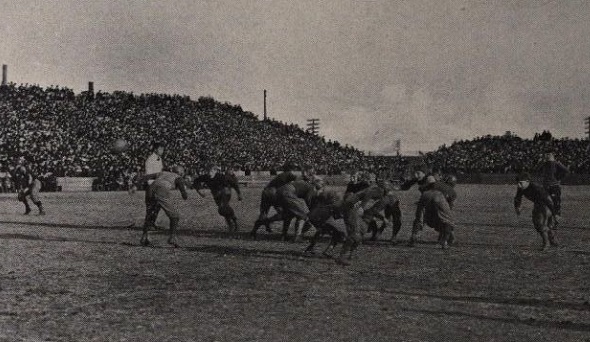
In an ironic twist, it was Roosevelt who saved the then-brutally violent game of football from itself more than 100 years ago. Yes, the same “Rough and Ready Teddy” who led the charge up San Juan Hill during the Spanish-American War and often sparred in the boxing ring while in office from 1901-09 opined that football was becoming so gruesome that he delivered an ultimatum: clean up the game or it would be outlawed.
The Chicago Tribune reported that in 1904 alone, there were 18 football deaths and 159 serious injuries, mostly among prep school players. Football deaths suffered by younger players were reported on a nearly weekly basis, as outraged citizens called on colleges and high schools to banish football outright.
In stepped Roosevelt, who called head coaches and representatives from Harvard, Yale and Princeton – college powers at the time – to the White House in 1905 urging them to eliminate excessive violence and set an example of fair play for the rest of the country. When the casualties actually rose by one during the ensuing season, Roosevelt reacted with greater resolve and convened leading football authorities for the purpose of authoring drastic rules changes. What emerged was an intercollegiate conference which was the predecessor of the NCAA.
Among the most effective changes for the 1906 season were the legalization of the forward pass, the elimination of mass formations, and the creation of a neutral zone. Football fatalities fell to 11 in each of the next two seasons, and severe injuries fell drastically.
Thanks to the introduction of protective equipment and ever-evolving rules changes, football during the 100-plus years to follow has become an exponentially safer game. Yet, the game’s leaders always will need to adjust and react to scrutiny that comes with the territory.
So, as the game once again undergoes rules modifications in the name of safety, give a tip of the cap to President Roosevelt while you enjoy college bowl season and the NFL playoffs and begin to think ahead to the first high school practice of 2014.
Heston Football Celebrates 1st League Title as Seniors Cap Extraordinary Rise
By
Tom Spencer
Special for MHSAA.com
November 5, 2025
St. Helen Charlton Heston Academy finished this football season with a five-game winning streak and in possession of a trophy representing the school’s first North Star League Big Dipper championship in any sport.
 The feat is especially incredible considering where the Patriots’ football program stood just four years ago.
Those Patriots welcomed a new assistant coach who would soon take over the program, but also five freshmen – Dylan Chichowski, Owen Romancky, Corbin Greenless, Desyln Klumpp and Tiernan Hinmon – in the starting lineup.
“If you rewind the clock, and go back to, like 2022, we went four straight games without even scoring a point,” said third-year head coach Matt Whelchel, who joined the staff that fall. “So to come from that and fast forward to this year, those (five) have been assistant coaches almost to me. They've really led this program to where it is right now.”
Those five seniors were part of a team than snapped a 43-game program losing streak as sophomores. They then led the Patriots to a 4-5 finish last year and 6-2 overall record this fall – with an undefeated run through league play. Heston was not eligible for the MHSAA Playoffs in 8-player because its enrollment exceeds the 215-student maximum to compete in the postseason. But Whelchel noted that the school remains ecstatic about what the team accomplished.
 Before turning the program around last year, the Patriots found wearing jerseys to school on game days more than a little difficult.
“We would not get made fun of, but when we talked about having a football game or had our jerseys on and we were in that losing situation, it wasn't a very prideful thing,” noted Klumpp, the team’s kicker, running back and receiver. “You're wearing a football jersey, and everyone else thinks that you're just a joke because we never win.
“And being able to turn that around, people, you know, just mentioning how fun the football games have been to watch. It's also been something we had to fight through.”
Klumpp, Greenless, Romancky and Chichowski also experienced a winless season as eighth-graders as Whelchel served the school as the middle school head coach and varsity assistant. Whelchel took over the varsity program in 2023.
The players credit Whelchel with instilling an offseason work ethic. The focus on studying film, spending time in the weight room and dedication to maintaining mental and physical health were also among keys to the Patriots’ turnaround.
“Our senior class had it extra hard starting out from middle school,” said Romancky, who played on both the offensive and defensive lines. “I think after our freshman year, once we lost every game, the drive to win the first one just became very apparent and we really took that step forward.”
Whelchel is quick to point out the school had had a good deal of talent over its 11 years of football history. Dedication, though, is at an all-time high for the Patriots.
 “I have no doubts in my mind that we had players in the past that wanted to win, but you've got to have more than that,” said Whelchel, who also serves as an elementary physical education teacher. “We had talent sometimes – we just didn't have the drive. You've got to have more than the will to win. You got to spend time in the weight room and keep grades up – and it takes a lot of dedication.”
Whelchel also credits his coaching staff for much of the Patriots’ success. The assistant coaches are Jory Klumpp, Graham Church, Liam McKeage and Nathaniel Snyder.
Heston always has found community support for football, but things are a little different nowadays. The varsity players are often asked for autographs from youth football kids.
“The community has always had our back — even last year, coming into some of our home games without a winning season — we always had our stands full and stuff,” said Chichowski, the team’s quarterback. “And this year, as I work out of school during the day, everybody who comes in is asking about the game, when it starts, and just telling us that they're going to be there and stuff. It's awesome.”
Chichowski racked up 1,076 passing yards and threw 12 touchdown passes. He also had four rushing TDs and 308 yards rushing for 1,384 total offensive yards. He was named to the Big Dipper’s all-conference team, as was Klumpp, Romancky, Tiernan Hinmon and Corbin Greenless.
Greenless, a senior lineman, led team in tackles with 114 plus six sacks. He added defensive touchdowns via a blocked punt and an interception.
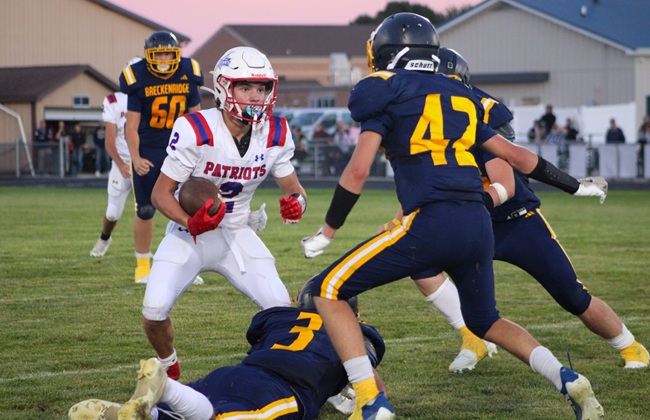
Hinmon, also a senior, led the team in touchdowns scored with 18. Twelve were on the ground, where he compiled 780 rushing yards. He also came through with a pick six against Au Gres-Sims in the fourth quarter of Heston’s 43-6 season-concluding victory.
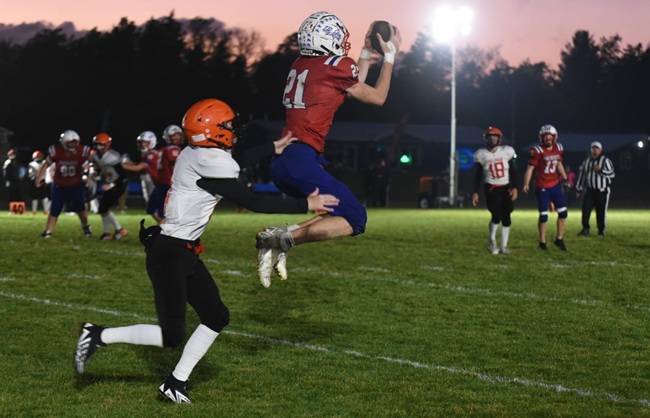 Romancky, who also had interception return touchdowns against Hillman and Whittemore-Prescott, admitted losing wore on the Patriots.
“I think all the losing left a bad taste in the mouth, and we just wanted to like clear it out and get that winning feeling,” he said. “All the losses that piled up fueled the drive to win.”
The Patriots had eight seniors this fall, but Whelchel is not at all thinking about a rebuilding year in 2026.
“We're going to lose a lot of talent for sure. But we had some really talented sophomores this year, and the only reason they didn't see the field a lot is because we had a lot of those guys playing ahead of them,” Whelchel said. “The seniors obviously had talent on the field, but they're leaders off the field too. And so they've set an example for next year’s seniors and juniors. I think we'll pick up – maybe not exactly where we left off – it might take some growing pains.”
Hinmon believes these seniors have paved the way for future Patriots football players to keep the winning tradition alive.
“Everybody used to call us the pity-party Patriots,” Hinmon indicated. “They never thought we were good, and now this season, we really proved ourselves. We worked hard. I think our next season, the younger ones are going to have a great season.”
“I think it's a thing of standards,” Klumpp added. “It just sets at the bar even higher for everyone else that's going to go through this program.”
 Tom Spencer is a longtime MHSAA-registered basketball and soccer official, and former softball and baseball official, and he also has coached in the northern Lower Peninsula area. He previously has written for the Saginaw News, Bay County Sports Page and Midland Daily News. He can be reached at [email protected] with story ideas for Manistee, Wexford, Missaukee, Roscommon, Ogemaw, Iosco, Alcona, Oscoda, Crawford, Kalkaska, Grand Traverse, Benzie, Leelanau, Antrim, Otsego, Montmorency, Alpena, Presque Isle, Cheboygan, Charlevoix and Emmet counties.
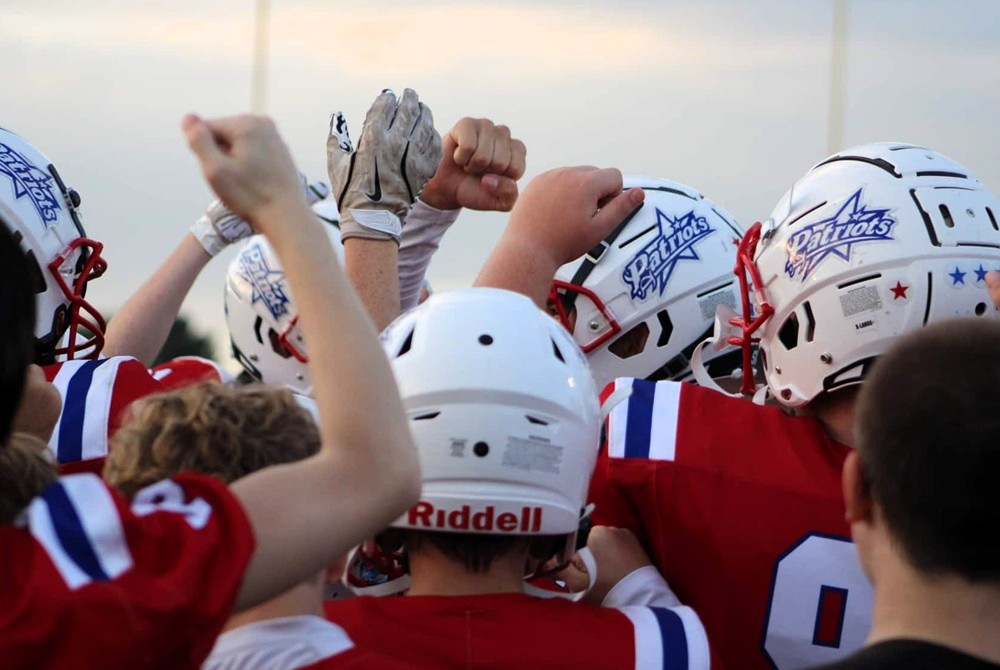
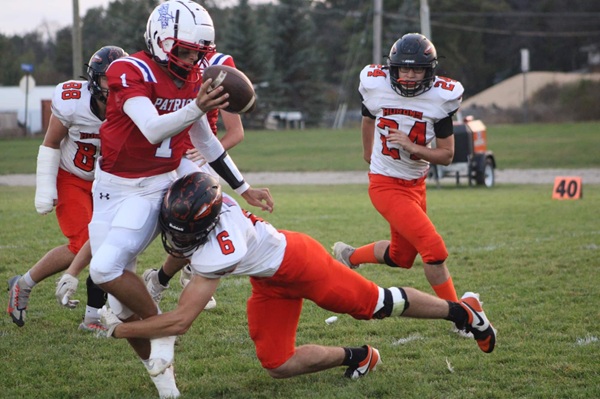
PHOTOS (Top) St. Helen Charlton Heston players huddle on a game day this season. (2) Patriots quarterback Dylan Chichowski works to elude a Rogers City defender. (3) Owen Romancky (21) leaps to haul in a pass against Hillman. (4) Tiernan Hinmon sets up to make his move while carrying the ball against Breckenridge. (Owen Romancky photo by Ashley Patti/Houghton Lake Resorter. All other photos submitted by Jessica Romancky.)