

'Wakers' Continue Marching Together
November 5, 2019
By Geoff Kimmerly
Second Half editor
First the local media picked it up, which made sense – it was a great story, and easy to appreciate whether you’ve heard of Maple City or could find Fife Lake on the map.
In what was still perhaps surprising but a logical next step, The Associated Press and then Detroit Free Press and MLive took the story statewide. But then CNN and NPR told the rest of the U.S. – which was followed by interest from The Kelly Clarkson Show and a Skype interview with one of Ellen DeGeneres’ representatives.
There is no way Maple City Glen Lake athletic director Mark Mattson could’ve foreseen any of that publicity as he prepped for his football team’s home game Sept. 27. All he knew was that his high school didn’t have a marching band, and Fife Lake Forest Area – at least this season – didn’t have a varsity football team.
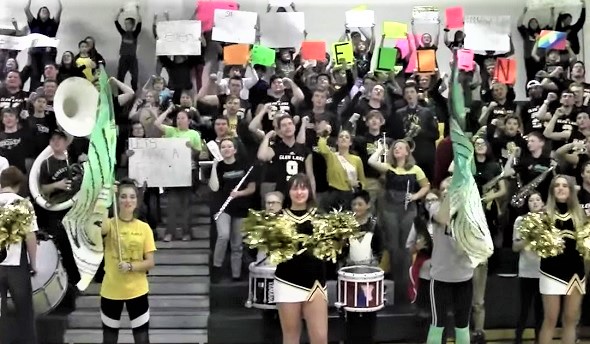
If you pay attention to high school sports in general or statewide news casually, you’ve probably heard some of the rest of this story. Mattson invited Forest Area director Brandon Deike and his band to play at Glen Lake’s game that night against Gladstone. A week later, after their story had been told all over the country, the schools combined for a “Marching for Ellen” spirit video hoping to land on the show.
Things have quieted back down substantially for the two small northern Lower Peninsula communities. But their march together continues.
“We don’t want it to end,” Mattson said. “Sometimes you see these initiatives begin, and it’s really cool, and they fizzle out. We want to work with our kids and their kids and Brandon over there to make cool things happen as we support each other – and at the end of the day to make his program grow and make our program grow over here.”
Glen Lake's athletic director said the Warrior marching band is welcome back anytime.https://t.co/RPXSNueHIx
— upnorthlive.com (@upnorthlive) September 29, 2019
A little background: Forest Area’s high school and Glen Lake’s are 45 miles away, or about an hour’s drive whether traveling through or around Traverse City. Glen Lake has nearly 250 students in its high school, and Forest Area has about 175.
Glen Lake’s football team is 9-1 and hosts Harrison on Friday in a Division 6 District Final. Forest Area started this fall playing 8-player football, and won its first game against Brethren 64-44. But the Warriors had started with a small roster that got smaller as the season got going – and by Week 3 didn’t have enough players to finish the season, so they canceled the rest of their games.
Meanwhile, Forest Area’s band has rebuilt mightily since the school’s music program was cut in 2011 – while Glen Lake’s band began this school year with one high schooler playing with a 10-member middle school group. In fact, Mattson asked his school’s football players and cheerleaders the last time they were at a home game where there was a band – and they couldn’t remember one.
So the Sept. 27 game happens, and all of the feel-good fanfare that came with it. With a few weeks, the statewide and national attention slowed way down – but the relationship between the schools was just beginning to grow.
A week later after the Gladstone game, Glen Lake hosted Elk Rapids on the night that was supposed to be Forest Area Homecoming – so during that school day, a group of Glen Lake football players and cheerleaders went over for Forest Area’s pep assembly, at first to be part of the “Marching for Ellen” video but then sticking around to take part in the Warriors’ festivities.
Then on a Monday night, Oct. 14, Mattson took a group of students to Traverse City to support Forest Area during the area’s band expo at Thirlby Field. There was some hope the schools might unite their forces again for Glen Lake’s final regular-season home game Oct. 25. But although that didn’t completely pan out, Forest Area did sent over 20 members of its band, who sat in bleachers on the track with Glen Lake’s student section, band and choir – and cheered on the now growing Glen Lake band, which included Mattson on the saxophone he’d stopped playing in sixth grade.
“One of the Forest Area kids called over from the bleachers, ‘Mr. Mattson, come here. I think we need to call our schools ‘Wakers,’” Mattson said (with the student referring to a combination of the mascot names Warriors and Lakers). “It really had gone from literally about zero to what we’ve got, and it’s a really collaborative partnership here."
“This isn’t their band director or myself making it happen. This is by and large kid driven. Our kids keep asking, ‘Are they coming for the game Friday night?’ Or their kids talk to Mr. Deike and say, ‘Can they come to our pep assembly?’ They know they’re welcome back to play with us any time.”
Mattson has recently taken over as administrator as well of Glen Lake’s fine arts department, and rebuilding the school’s band is a high priority. Glen Lake has brought in retired Traverse City West band directors Pat Brumbaugh and Flournoy Humphreys as “artists in residence” to revive the program. They’re teaching a two-day-a-week Intro to Band class, and Mattson said there are about 35 fifth and sixth-graders signed up.
Mattson also noted how the Forest Area band has opened up the perspective of his school’s football players, who have gained a real appreciation for all of the groups – cheerleaders and band especially – who join the players on the field in making for a great football night.
“What started from one simple gesture to help a school out and vice versa turned into, and I think Brandon would echo it, turned into valuable lessons for our society about teamwork and collaboration, and that kindness matters,” Mattson said. “When it’s driven by young people and really executed by our young people, how does it get better than that? They’re the next generation of leaders. To take it from simply, ‘Yeah, that sounds cool,’ to go and play at Glen Lake, to what it’s become, it’s a great lesson for all of us. That when these kids take the initiative and make it their own, special things happen – and that has happened.”
Performance of the Week: DeWitt's Traverse Moore
December 5, 2025
 Traverse Moore ♦ DeWitt
Senior ♦ Football
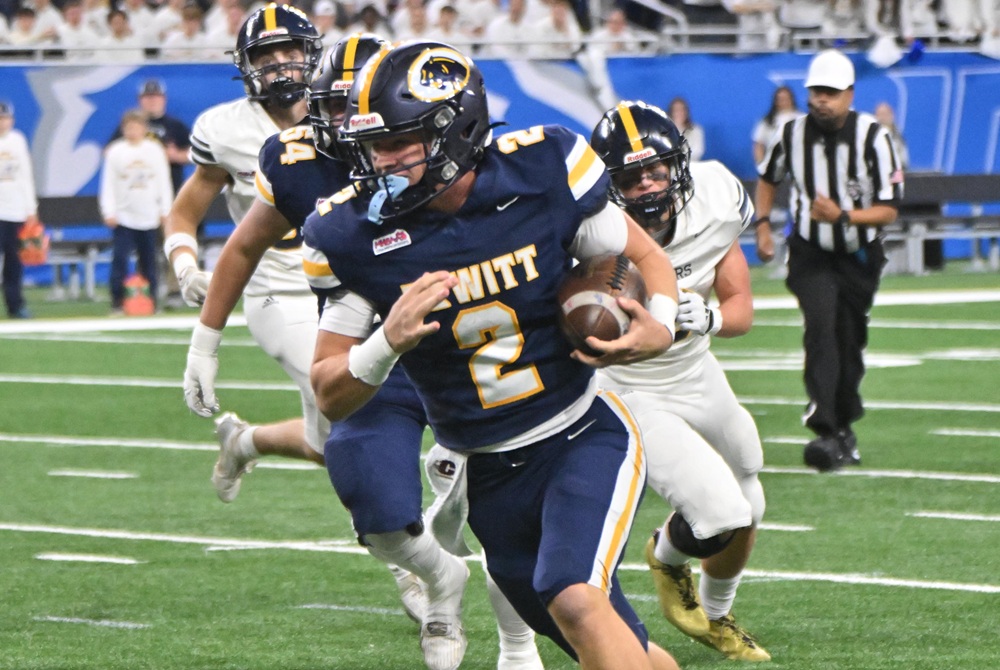
Moore ran 32 times for an MHSAA Finals-record 397 yards and four touchdowns as DeWitt defeated Mount Pleasant 54-20 in the Division 3 championship game Sunday at Ford Field to finish this season 14-0. He put his name in the record book that day seven times total, with his three first-quarter touchdowns tying the all-time high for one quarter and his 461 total yards ranking second on that list.
The Finals performance gave Moore – the team’s quarterback and main ball carrier in its single wing-heavy running attack – a total of 2,512 yards and 33 touchdowns rushing and 734 yards and 13 TDs passing this fall. The rushing yards and touchdowns will be added to single-season record book lists. Moore played on the DeWitt varsity all four years and signed this week to continue at Central Michigan University. He also plays baseball for the Panthers.
@mhsaasports 🏈POW: Traverse Moore #football #Dewitt #highschoolsports #performanceoftheweek #MHSAA ♬ Bright and fun upbeat pops, Kids, Animals, Pets, Fun, Cute, Happy, Playful, Upbeat(1465232) - SAKUMAMATATA
@mhsaasports 🏈POW: Traverse Moore #funfacts #tiktalk #performanceoftheweek #highschoolsports #MHSAA ♬ Girly and cute synth pop - SAKUMAMATATA
Follow the MHSAA on TikTok.
MHSAA.com's "Performance of the Week" features are powered by MI Student Aid, a division within the Department of Lifelong Education, Advancement, and Potential (MiLEAP). MI Student Aid encourages students to pursue postsecondary education by providing access to student financial resources and information. MI Student Aid administers the state’s 529 college savings programs (MET/MESP), as well as scholarship and grant programs that help make college Accessible, Affordable and Attainable for you. Connect with MI Student Aid at www.michigan.gov/mistudentaid and find more information on Facebook and Twitter @mistudentaid.
Previous 2025-26 honorees
Nov. 28: Elizabeth Eichbrecht, West Bloomfield swimming - Report
Nov. 20: Brady Kieff, Blanchard Montabella football - Report
Nov. 13: Ella Laupp, Battle Creek Harper Creek swimming - Report
Nov. 7: Hunter Eaton, Charlevoix cross country - Report
Oct. 31: Stephen Gollapalli, Lansing Christian tennis - Report
Oct. 23: Talya Schreiber, Pickford cross country - Report
Oct. 16: Avery Manning, Dexter golf - Report
Oct. 9: Brady Van Laecke, Hudsonville football - Report
Oct. 2: Sarah Giroux, Flat Rock volleyball - Report
Sept. 25: Sam Schumacher, Portage Central tennis - Report
Sept. 18: Kaylee Mitzel, Saline field hockey - Report
Sept. 11: Natasza Dudek, Ann Arbor Pioneer cross country - Report
Sept. 4: Kate Posey, Big Rapids golf - Report
(Headshot courtesy of TCP-Photography.)