

Warriors Continue Fight Against Cancer
September 26, 2014
By Geoff Kimmerly
Second Half editor
An exemplary effort that has raised more than $200,000 for cancer research and awareness will continue tonight at Walled Lake Western when the Warriors take on Waterford Mott in its annual “Warriors for Warriors” game.
This is the fourth season Western has hosted the event, which benefits the Susan G. Komen Detroit Race for the Cure, St. Baldrick’s Foundation for Pediatric Cancer and the American Cancer Society. Fans will be wearing pink shirts designed for the event, with more than 1,000 sold as of two weeks ago.
Last fall, “Warriors for Warriors” was recognized by the NFL and featured in a 30-second commercial shown during NFL football games, and the team was hosted and honored by the Detroit Lions (see below).
“We continue to be grateful for the selfless dedication of parents, staff members, community members and all of the countless volunteers who support the fourth annual Pink Out effort,” Walled Lake superintendent Kenneth Gutman said. “Breast cancer and all cancers continue to challenge thousands of people, and we will continue to work together to eradicate it.”
A “Warriors’ Survivors Parade” will kick off the event at 6 p.m. and include patients, survivors and others who wish to honor those who are fighting or have died after battling cancer of any form. The parade will continue into the stadium.
Prior to the 7:30 p.m. kickoff, Western’s players, wearing pink jerseys sponsored in honor of those who have fought the disease, will line the field from end zone to end zone with jersey honorees and their families. More than 170 people have been honored during the first three years of the event.
The game’s honorary captain is Commerce Elementary fifth-grader Sydney Balzer, who has fought leukemia twice and founded a community service project, Colors for Cancer Kids.
For information, click for the Warriors for Warriors website and follow the effort on Twitter @WLW_W4W.
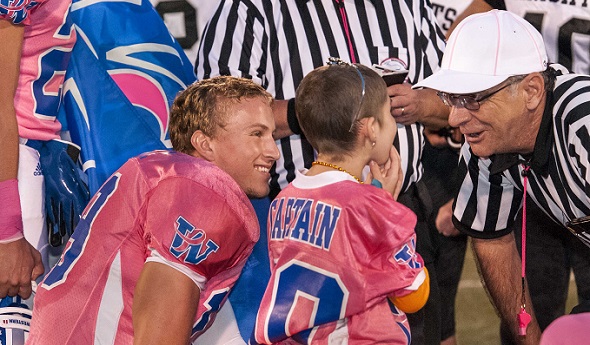
PHOTO: Walled Lake Western’s Kyle Bambard and 7-year-old Akayla Hodgins call the coin flip during the 2013 Warriors for Warriors game.

Summer Safety
August 28, 2012
As we have been considering changes for in-season football practice rules that are more in step with recent recommendations of the National Athletic Trainers Association, the American Academy of Pediatrics and the National Federation of State High School Associations, as well as the actions of several of our counterpart state organizations across the U.S., we have also been looking at the rules that apply out of season to assure they do not work against the preparation of students for a safe experience.
Except during the school’s designated summer dead period of at least seven consecutive days, football coaches may interact with any number of players in voluntary weight training and conditioning sessions as frequently as they desire. Introduce footballs and helmets, and the coach can still work with any number of students on the sideline and up to seven players at a time for any number of days. Add competition, and the coach can still work with up to seven players at a time for a maximum of seven days. In addition, football coaches may participate for a maximum of ten days at bona fide football camps where any number of their players are participating.
Plenty of time for coaches to teach, and even more time for players to train. During this time, the rules permit students to wear helmets, which protect against accidental collisions during drills; but the rules prohibit other pads that would allow activities to escalate to the point where contact is expected, leading to increased blows to the head at a time when the objective from the pros to Pop Warner is to reduce blows to the head.
When the brief preseason down time begins Aug. 1, the coach continues to be able to work with any number of players in conditioning and weight training. The down time prohibits those activities that could be a disguise for practice prior to the earliest allowed practice date – open gyms, camps, clinics and competition. The down time puts the emphasis where it’s most needed for a healthy student experience when practice actually begins: that’s weight training and conditioning.
Some critics may focus on what they can’t do in the summer; but clearly, there’s much they can do, and it’s all designed to help players improve and excel in a safe environment.