

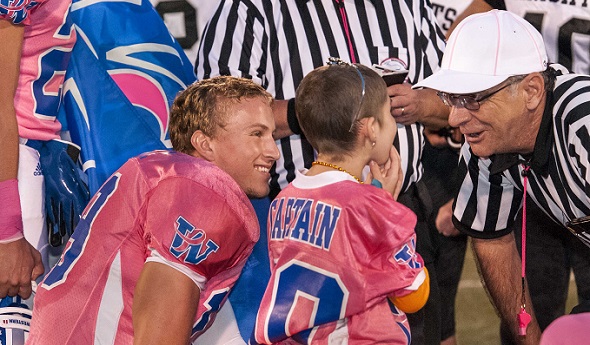
Warriors Continue Fight Against Cancer
September 26, 2014
By Geoff Kimmerly
Second Half editor
An exemplary effort that has raised more than $200,000 for cancer research and awareness will continue tonight at Walled Lake Western when the Warriors take on Waterford Mott in its annual “Warriors for Warriors” game.
This is the fourth season Western has hosted the event, which benefits the Susan G. Komen Detroit Race for the Cure, St. Baldrick’s Foundation for Pediatric Cancer and the American Cancer Society. Fans will be wearing pink shirts designed for the event, with more than 1,000 sold as of two weeks ago.
Last fall, “Warriors for Warriors” was recognized by the NFL and featured in a 30-second commercial shown during NFL football games, and the team was hosted and honored by the Detroit Lions (see below).
“We continue to be grateful for the selfless dedication of parents, staff members, community members and all of the countless volunteers who support the fourth annual Pink Out effort,” Walled Lake superintendent Kenneth Gutman said. “Breast cancer and all cancers continue to challenge thousands of people, and we will continue to work together to eradicate it.”
A “Warriors’ Survivors Parade” will kick off the event at 6 p.m. and include patients, survivors and others who wish to honor those who are fighting or have died after battling cancer of any form. The parade will continue into the stadium.
Prior to the 7:30 p.m. kickoff, Western’s players, wearing pink jerseys sponsored in honor of those who have fought the disease, will line the field from end zone to end zone with jersey honorees and their families. More than 170 people have been honored during the first three years of the event.
The game’s honorary captain is Commerce Elementary fifth-grader Sydney Balzer, who has fought leukemia twice and founded a community service project, Colors for Cancer Kids.
For information, click for the Warriors for Warriors website and follow the effort on Twitter @WLW_W4W.
PHOTO: Walled Lake Western’s Kyle Bambard and 7-year-old Akayla Hodgins call the coin flip during the 2013 Warriors for Warriors game.

Heads and Heat
August 16, 2012
We are engaged in very serious discussions. They’re not only complicated, with unintended negative consequences possible from what are thought to be positive actions; they’re also a matter of life and death.
The topic is football – the high school sport under most scrutiny today and suffering from the most criticism it’s seen since the 1970s when catastrophic neck injuries spiked, liability awards soared, many insurers balked, and most helmet manufacturers abandoned the business altogether.
During recent years we have learned about the devastating long-term effects of repeated blows to the head; and we’re trying to reduce such hits. We’ve learned that 70 percent of concussions in football result from helmet-to-helmet contact, and we’re trying to have coaches teach blocking and tackling differently and have officials penalize “high hits” consistently and rigorously.
During the past several years we’ve learned that serious heat illness and heat-related deaths are 100 percent preventable, yet nationwide there were 35 heat-related deaths in high school football alone from 1995 to 2010; and we’re promoting practices that acclimatize athletes more gradually than “old school” traditionalists might advocate.
As we simultaneously address issues of heads and heat in football, some coaches may think we’re being overbearing, while many in medical fields say we’re out of date, citing higher standards of the American Academy of Pediatrics, National Athletic Trainers Association and National Federation of State High School Associations, as well as many of our counterpart organizations across the country.
As we consider in-season changes to improve athlete acclimatization and reduce blows to the head, we should be open to making out-of-season changes that work toward rather than in opposition to those objectives. There can be no sacred cows. The topic is too serious.
Ultimately, if we err in the outcome of this year’s discussions about heads and heat in football, it must be on the side of safety, on minimizing risks for student participants. They deserve it and, once again, the sport of football needs it.