

Warriors Continue Fight Against Cancer
September 26, 2014
By Geoff Kimmerly
Second Half editor
An exemplary effort that has raised more than $200,000 for cancer research and awareness will continue tonight at Walled Lake Western when the Warriors take on Waterford Mott in its annual “Warriors for Warriors” game.
This is the fourth season Western has hosted the event, which benefits the Susan G. Komen Detroit Race for the Cure, St. Baldrick’s Foundation for Pediatric Cancer and the American Cancer Society. Fans will be wearing pink shirts designed for the event, with more than 1,000 sold as of two weeks ago.
Last fall, “Warriors for Warriors” was recognized by the NFL and featured in a 30-second commercial shown during NFL football games, and the team was hosted and honored by the Detroit Lions (see below).
“We continue to be grateful for the selfless dedication of parents, staff members, community members and all of the countless volunteers who support the fourth annual Pink Out effort,” Walled Lake superintendent Kenneth Gutman said. “Breast cancer and all cancers continue to challenge thousands of people, and we will continue to work together to eradicate it.”
A “Warriors’ Survivors Parade” will kick off the event at 6 p.m. and include patients, survivors and others who wish to honor those who are fighting or have died after battling cancer of any form. The parade will continue into the stadium.
Prior to the 7:30 p.m. kickoff, Western’s players, wearing pink jerseys sponsored in honor of those who have fought the disease, will line the field from end zone to end zone with jersey honorees and their families. More than 170 people have been honored during the first three years of the event.
The game’s honorary captain is Commerce Elementary fifth-grader Sydney Balzer, who has fought leukemia twice and founded a community service project, Colors for Cancer Kids.
For information, click for the Warriors for Warriors website and follow the effort on Twitter @WLW_W4W.
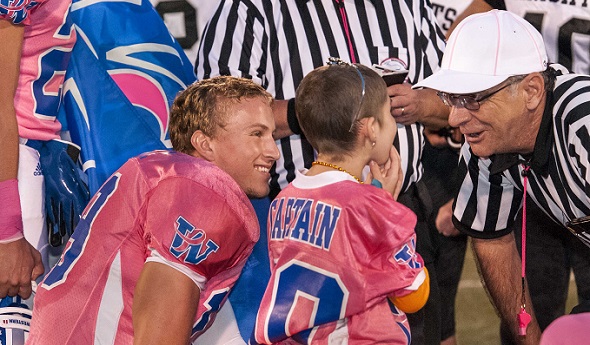
PHOTO: Walled Lake Western’s Kyle Bambard and 7-year-old Akayla Hodgins call the coin flip during the 2013 Warriors for Warriors game.

Summer Football Safety
July 23, 2018
(This blog first appeared on MHSAA.com on June 23, 2017.)
Across the U.S. this summer, school-age football players are flocking to camps conducted by colleges and commercial interests. They get outfitted in full gear and launch themselves into drills and skills work.
Unlike the start of the interscholastic football season, the players usually do this without several days of acclimatization to avoid heat illness, and without limits on player-to-player contact to reduce head injuries.
Required precautions of the school season are generally ignored at non-school summer camps.
One notable exception to this foolish behavior is found in Michigan where the Michigan High School Athletic Association prohibits member schools’ student-athletes from using full equipment and participating in full-contact activities outside the high school football season. This is not a recent change; it’s been the MHSAA’s explicit policy for more than four decades.
And it’s a policy that has never been more in style and in favor than it is today.