


We’ve Got This Right
March 1, 2013
This year's Super Bowl was an occasion for an unusual amount of commentary on the state of football safety, especially concussions.
One group called on state high school associations and football coaches associations to eliminate contact outside the defined interscholastic season. That would mean spring football practice, and during summer leagues and camps, and at all-star games.
Michigan is one of a large majority of states where schools do not allow spring football practice. Michigan is one of a minority of states where schools do not allow contact at summer camps, for which we are often criticized by out-of-state camp promoters. And Michigan is one of a smaller minority of states where schools prohibit students, coaches, officials and administrators from being involved in all-star games involving undergraduates.
While we are well ahead of the curve on out-of-season contact policies, we are in the mainstream of state high school associations studying what the appropriate limits should be on contact during early season football practice and throughout the remainder of the season. We have a task force that appears headed toward recommending that the Representative Council prescribe only one contact session per day during early season practice and only two contact practices per week after games begin.
There will be other ideas percolating and then simmering with these before any are proposed to the MHSAA Football Committee and Representative Council.
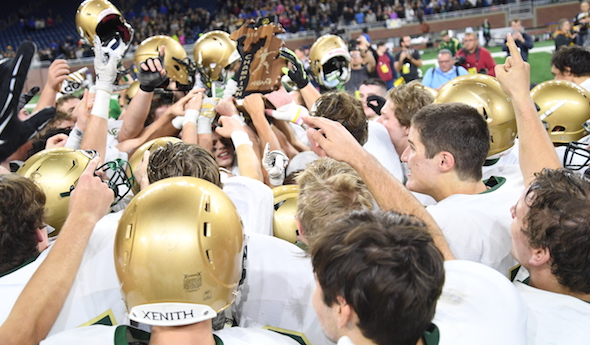
Lumen Christi Grinds, then Rises in D6
November 25, 2016
By Geoff Kimmerly
Second Half editor
DETROIT – The low was never that low, given the circumstances Jackson Lumen Christi played through during a 1-2 start this season.
But the high was definitely up there Friday as the Titans reached a peak they hadn’t visited since 2009.
Reminiscent of the teams that won three MHSAA championships during the first decade of this century, Lumen Christi’s latest contender rattled off 11 straight wins this fall, eliminated two top-three ranked favorites during the playoffs and finished with a workmanlike 26-14 win over Maple City Glen Lake in the Division 6 Final.
The title was the prize, of course, but the journey is worth celebrating as well. The Titans opened this season with a 17-point loss to Grand Rapids West Catholic, which will play for the Division 5 title Saturday. Two weeks later, Lumen fell to another eventual playoff team in Battle Creek Harper Creek. But the ensuing win streak included a run through the rest of the competitive Interstate 8 Athletic Conference and playoff wins over No. 2 Schoolcraft and No. 3 Millington before the fifth-ranked Titans took down the No. 6 Lakers.
“We were just so determined to get to this point, and we did,” Lumen junior fullback/linebacker Kyle Minder said. “After starting off 1-2, we were kinda down. We still had faith that we were going to make the playoffs. We had some tough games coming up; it was going to be a battle just to get into the playoffs.
"(But) we were on a roll, and it just never stopped.”
The Titans ran for 298 yards and held the Lakers to a mere four on the ground, overpowering them at times on the line and pounding with Minder on both sides of the ball while senior Bo Bell rattled off one of the busiest rushing games in MHSAA Finals history.
Bell ran 40 times for 238 yards – 11th-most for a championship game – to finish this fall unofficially with 2,666 yards, 16th most in MHSAA history for one season. His 340 carries ranked seventh, and he ran for a touchdown as well to give him 33 total, which is tied for 21st on that single-season list.
“I like putting the team on my back, but I can’t do this on my own,” said Bell, as he pointed out the contributions of his offensive line, Minder and junior quarterback Troy Kutcha. “All the hard work’s worth it; that’s all I can say,” Bell added.
Lumen Christi had 13 seniors on its roster. Although all but a couple were starters or second string by the end of the season, only about half had seen the field at the beginning – and the Titans also started three sophomores and a freshman.
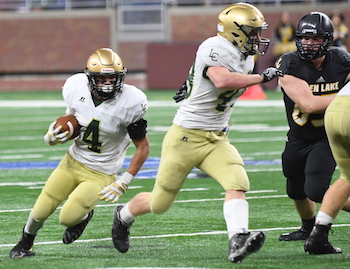 But the 24-14 Harper Creek loss left longtime coach Herb Brogan optimistic.
“I said to the coaches, ‘I’m not down, because we really competed hard against a good football team, and we’re going to get better,’” said Brogan, who has led Lumen Christi to 331 wins – fifth all-time – and seven of its nine championships since taking over the program in 1980. “The next two games, we pulled out games that were critical games going in.
“The kids, they really like each other, and not every team likes each other. It’s difficult when you have a small senior group. … When you get a mix of young kids in there, you have to have a special senior group to make that thing jell. That’s what I give a lot of credit to our seniors for; they gave us the leadership we needed.”
Minder, who ran for 66 yards on 21 carries, chugged in for his first of three touchdowns to start the scoring with 4:36 left in the first quarter. He added his second score 4:31 into the second, and picked up the third with 10 seconds left in the first half to make the score 20-7.
Along the way, Glen Lake junior quarterback Cade Peterson found junior Nick Rice for a 57-yard touchdown strike down the right side, and his 9-yard scoring pass to junior Nick Apsey brought the Lakers to within 26-13 with 9:47 to play.
But as a team that runs well is able to do, Lumen Christi (12-2) ground 8:04 off the clock going only 50 yards but on 17 plays, leaving Glen Lake little time to attempt a final rally.
The Lakers (11-3) were playing their first MHSAA Final since 1996 and after also eliminating top-eight teams in Calumet and Roscommon along the way.
“We didn’t get it done on two 4th-and-1s, or 4th-and-inches, which really was the surprising part,” Glen Lake coach Jerry Angers said. “And of course, they rushed the ball well. We blew some assignments. We made a couple big mistakes and didn’t get our run fits correctly, and it opened up the door for those guys.”
Peterson completed 15 of 20 passes for 254 yards, especially impressive because of Glen Lake’s troubles balancing things on the ground. Rice caught five passes for 116 yards.
Apsey, senior linebacker Tony Duperon and senior safety Jared Jackson had 11 tackles apiece for the Lakers.
“I’m just so grateful that we came down here with our team. A lot of people didn’t really expect this out of us,” Peterson said. “Obviously, we proved them wrong and we gave these guys a good fight.
“I’m going to miss these seniors a lot. They’re a great group of guys. But we’re coming back next year.”
The MHSAA Football Finals are sponsored by the Michigan National Guard.
PHOTOS: (Top) Jackson Lumen Christi players hoist the championship trophy after winning Division 6 on Friday. (Middle) Titans running back Bo Bell follows the blocking of teammate Kyle Minder.