


We’ve Got This Right
March 1, 2013
This year's Super Bowl was an occasion for an unusual amount of commentary on the state of football safety, especially concussions.
One group called on state high school associations and football coaches associations to eliminate contact outside the defined interscholastic season. That would mean spring football practice, and during summer leagues and camps, and at all-star games.
Michigan is one of a large majority of states where schools do not allow spring football practice. Michigan is one of a minority of states where schools do not allow contact at summer camps, for which we are often criticized by out-of-state camp promoters. And Michigan is one of a smaller minority of states where schools prohibit students, coaches, officials and administrators from being involved in all-star games involving undergraduates.
While we are well ahead of the curve on out-of-season contact policies, we are in the mainstream of state high school associations studying what the appropriate limits should be on contact during early season football practice and throughout the remainder of the season. We have a task force that appears headed toward recommending that the Representative Council prescribe only one contact session per day during early season practice and only two contact practices per week after games begin.
There will be other ideas percolating and then simmering with these before any are proposed to the MHSAA Football Committee and Representative Council.
Drive for Detroit: Playoff Week 3 Preview
November 9, 2017
By Geoff Kimmerly
Second Half editor
We’ve reached the third week of the 2017 Football Playoffs, and we’re going to switch up our “Drive for Detroit” format just a bit to kick off this week’s preview with a closer look at the “March to Marquette."
 Eight teams will play Semifinals this weekend to reach the first two-division 8-Player Finals to be hosted Nov. 18 by the Superior Dome at Northern Michigan University.
So we’ll glance at those four games first, followed by one person’s opinion of the most intriguing Regional Finals in all eight 11-player divisions. Six games will be broadcast this weekend either on Prep Zone by FOX Sports Detroit or MHSAA.tv, and the MHSAA playoff scoreboard page remains home to results and next week’s games as they’re determined. The MHSAA Playoffs are sponsored by the Michigan Army National Guard, and “Drive for Detroit” is sponsored by MI Student Aid.
8-Player Division 1
Stephenson (9-2) at Central Lake (11-0), Saturday
The move to 8-player clearly has been to Central Lake’s liking after the Trojans went only 2-7 a year ago in its final season with 11 on the field. This Semifinal will be a program first and has come after playoff wins over two other first-year 8-player programs. Stephenson also is playing in its first Semifinal, and the Eagles also have been considered among the best in 8-player most of the season. The only disappointments have been a two-point loss to Rapid River and 12-pointer to reigning champion Powers North Central, two more eventual playoff qualifiers.
Bellevue (10-1) at Deckerville (10-1), Saturday
Bellevue has shined in uncharted territory, reaching 10 wins and the Semifinals for the first time as a first-year 8-player program. Junior Gino Costello (1,756 yards, 21 TDs passing) quaterbacks a balanced attack. Deckerville, the reigning MHSAA runner-up, avenged its lone loss of the season last week in a big win over Morrice. The Eagles are averaging 341 total yards per game with junior Cruz Ibarra and senior Kenton Bowerman combining for more than 1,885 yards and 25 touchdowns rushing.
8-Player Division 2
Crystal Falls Forest Park (8-2) at Pickford (11-0), Friday
Pickford fell in last year’s Semifinal to reigning and also eventual champion Powers North Central, but has stormed back giving up only 184 yards per game. Four runners have at least 580 yards on the ground, and senior quarterback Jonah Bailey has thrown for 1,020 yards and 15 touchdowns. Former 11-player Semifinal regular Forest Park will make its first 8-player appearance at this stage of the playoffs in its second year since making the format switch, with a defense that’s giving up nearly three points fewer per game than a year ago.
Kinde-North Huron (10-1) at Portland St. Patrick (10-1), Saturday
Huron, in its second Semifinal in five seasons but with its most wins ever, has ridden a rushing attack led by senior Mike Craig. He’s run for 1,694 yards – 10.9 per carry – and 25 touchdowns as the Warriors have continued a turnaround from 2-7 a year ago. Portland St. Patrick has had a winning record every season since switching to 8-player in 2012, and this will be the Shamrocks’ first Semifinal since that fall as they look to play in a championship game for the first time since 1997.
11-Player Division 1
Detroit Cass Tech (8-2) at Clinton Township Chippewa Valley (10-1), Friday
This looks like a measuring stick game for both teams. Most years, reigning Division 1 champion Cass Tech would be an automatic favorite to win the whole thing again – but with two losses this fall, the Technicians have found themselves traveling the last two weeks. That said, those defeats came to reigning Division 2 champ Martin Luther King by 10 points and by only three points to Pickerington Central, which is 10-1 heading into the second round of the Ohio playoffs. Beating Cass Tech immediately lends respect to that opponent, which Chippewa Valley would deserve it if it lands a first Regional title since 2003. The Big Reds’ only loss was by seven in Week 4 to Utica Eisenhower, the Semifinal opponent if both succeed this weekend.
Other Regional Finals: FRIDAY Detroit Catholic Central (7-4) at Canton (10-1), West Bloomfield (9-2) at Utica Eisenhower (11-0), SATURDAY Clarkston (9-2) at Holland West Ottawa (10-1).
11-Player Division 2
Oak Park (9-2) vs. Warren DeLaSalle (9-2) at Wayne State University, Friday
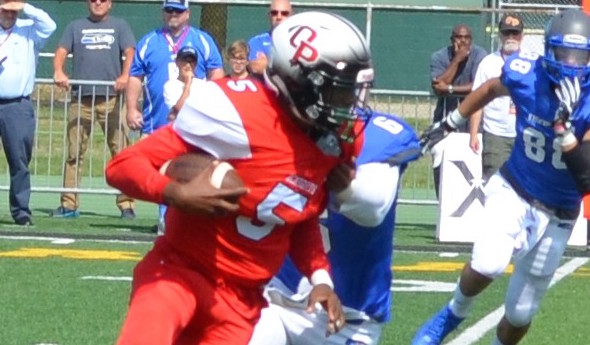
Oak Park is another program that could find itself more in the statewide spotlight with a successful weekend. The Knights have played in a Regional Final only once before, in 2012, and are seeking to make the Semifinals for the first time. Their only losses are to teams still alive – Eisenhower, again, in Division 1, and Division 3 semifinalist Farmington Hills Harrison. The Pilots are notable obstacles, of course. The Detroit Catholic League Central champs outscored their first two playoff opponents by a combined 96-0, and are only three years removed from winning the Division 2 title in 2014.
Other Regional Finals: FRIDAY Traverse City Central (8-3) at Grand Rapids Forest Hills Central (11-0), Flushing (9-2) at Livonia Franklin (9-2), Ypsilanti Lincoln (9-2) at Detroit Martin Luther King (10-1).
11-Player Division 3
DeWitt (10-1) vs. Muskegon (11-0) at Grand Haven, Saturday
On one sideline will be the Panthers, emerging from arguably the strongest District in the state in any division – DeWitt rose from a field including East Grand Rapids, Cedar Springs and Grand Rapids Christian. The Panthers haven’t lost since opening night to Christian and avenged that loss two weeks ago – and they still won’t be considered favorites against the reigning Division 3 runner-up Big Reds. Muskegon has topped 600 points for the second straight season and is down to giving up only 7.1 points per game this fall. Muskegon quarterback La’Darius Jefferson is coming off what’s become a typical 240 yards rushing with four touchdowns with another touchdown pass as well against Zeeland West.
Other Regional Finals: FRIDAY East Lansing (9-2) at Battle Creek Harper Creek (11-0), Riverview (10-1) at Dearborn Divine Child (10-1), Farmington Hills Harrison (8-3) at Linden (9-2).
11-Player Division 4
Lansing Sexton (8-3) at Edwardsburg (10-1), Saturday
As has been the case in the past, we’re seeing a powerful Sexton in the playoffs after the Big Reds spent most of the regular season facing larger opponents including postseason qualifiers in Divisions 1 and 3. The Big Reds cruised against previously one-loss Lake Odessa Lakewood two weeks ago before edging Plainwell last week by three – intriguing because Plainwell was one of three runners-up in the Wolverine Conference won by the Eddies. Edwardsburg avenged its lone defeat of this fall, to Three Rivers, last week with an 18-point win. The Eddies can call on some experience from last season’s Semifinal run, its second of the last four years.
Other Regional Finals: FRIDAY Williamston (7-4) at Escanaba (9-2), Belding (9-2) at Grand Rapids Catholic Central (11-0), SATURDAY River Rouge (9-2) at Bloomfield Hills Cranbrook Kingswood (10-1).
11-Player Division 5
Grand Rapids West Catholic (9-2) at Portland (10-1), Friday
This will be the fifth playoff meeting over seven seasons between these perennial powers, with the Raiders’ lone win in the recent series coming when they faced each other in the 2012 Division 5 championship game. The Falcons have won the last four titles, last year after escaping with a 10-7 win over Portland in the District Final, and they are three-point losses to Grand Rapids Catholic Central and Jackson Lumen Christi from perfection this fall. Portland, with three straight shutouts and four over their last five games, likely will be West Catholic’s toughest test so far in the playoffs.
Other Regional Finals: SATURDAY Menominee (8-3) at Reed City (10-1), Muskegon Oakridge (9-2) at Saginaw Swan Valley (10-1), Algonac 10-1) at Frankenmuth (11-0).
11-Player Division 6
Ithaca (11-0) at Montague (11-0), Saturday
The players are likely too young to remember there is some history between these powerhouse programs. Montague in a 2009 Semifinal was the last team to beat Ithaca before the Yellowjackets reeled off 69 straight wins from 2010 through the 2014 Semifinals. This meeting has that kind of weight to it; more than a few would call these the two best teams in Division 6 as Montague has faced one single-digit challenge to its perfect run this year and Ithaca has won all of its games by at least 24 points.
Other Regional Finals: FRIDAY Traverse City St. Francis (10-1) at Millington (10-1), Blissfield (7-4) at Warren Michigan Collegiate (11-0), SATURDAY Jackson Lumen Christi (9-1) at Watervliet (11-0).
11-Player Division 7
Monroe St. Mary Catholic Central (7-4) at Madison Heights Madison (11-0), Saturday
Maybe this seems like an odd pick as the intriguing game from this division, given St. Mary qualified for the playoffs as an additional qualifier and Madison hasn’t given up a point in the postseason while enjoying a perfect run. But it’s worth noting that the Falcons are the only team this fall to give a loss to reigning champion Pewamo-Westphalia – which remains alive on the other side of the bracket – and have beaten two league champions over the last two weeks. Madison’s work has been truly impressive, however. The Eagles are playing to make their first Semifinal since 2007 and have survived three games decided by four points or fewer this fall while, like SMCC, playing a schedule loaded with larger opponents.
Other Regional Finals: FRIDAY Saugatuck (8-3) at Cassopolis (10-1), SATURDAY Breckenridge (10-1) at Lake City (11-0), Pewamo-Westphalia (10-1) at Elkton-Pigeon-Bay Port Laker (10-1).
11-Player Division 8
Lincoln Alcona (9-2) at Saginaw Nouvel (11-0), Friday
Many expecting a Nouvel/Muskegon Catholic Central championship game in three weeks got a shock when reigning champ MCC fell to Mendon in the District Final. Now Lincoln Alcona, coming off its first District title in this sport, is looking to continue the demolition on its side of the bracket. Nouvel is trying to get to the Semifinals for the first time since winning Division 7 in 2011, and the Panthers have had only a few scares this fall – but the latest came last week in a one-point win over Harbor Beach. The Tigers are five points over two losses from a perfect record, and a Regional title would make those close losses easy to forget.
Other Regional Finals: SATURDAY Frankfort (8-2) at Iron River West Iron County (10-1), Climax-Scotts (9-2) at Mendon (11-0), Clarkston Everest Collegiate (9-2) at Ottawa Lake Whiteford (11-0).
Second Half’s weekly “Drive for Detroit” previews and reviews are powered by MI Student Aid, a part of the Student Financial Services Bureau located within the Michigan Department of Treasury. MI Student Aid encourages students to pursue postsecondary education by providing access to student financial resources and information, including various student financial assistance programs to help make college more affordable for Michigan students. MI Student Aid administers the state’s 529 savings programs (MET/MESP) and eight additional aid programs within its Student Scholarships and Grants division. Click for more information and connect with MI Student Aid on Facebook and Twitter @mistudentaid.
PHOTOS: Oak Park met Utica Eisenhower at the end of August; both teams will play in 11-player Regional Finals this weekend. (Click to see more from HighSchoolSportsScene.com.)