

Writer-Turned-Coach Enjoys Debut
November 3, 2016
By Dennis Grall
Special for Second Half
ESCANABA — Sam Eggleston has seen high school football from two drastically different viewpoints. Now, even though he is an unpaid volunteer, he enjoys being on the sideline as a coach.
 Eggleston just completed his first season as a high school head coach, with Eben Superior Central winning its final three games to finish 4-5 in 8-player football. The Cougars were among the first teams in the state to join the 8-player format in 2010, their first year of football.
Eggleston was a sportswriter before becoming a coach, giving him different perspectives to watching the same event.
The 1998 Rock Mid Peninsula High School graduate worked at newspapers in Escanaba, Kenai, Alaska; Northville and Novi, and Marquette before becoming a freelance writer and website blog editor in 2008. He started the writing phase of his career in 2000 with the Daily Press in Escanaba, under my direction.
He served as a volunteer assistant football coach in Northville, then moved back to the Upper Peninsula and became a volunteer coach at his alma mater in 2011 when the Wolverines went to 8-player football. He joined Superior Central in 2014 and spent two seasons as a volunteer aide until landing the head job just two weeks before the 2016 preseason began.
“In both careers … you took a shot on me and I ran with it, and the same with coaching; they gave me a shot and I’ve run with it as best I can,” he said.
In addition to his unpaid position at Superior Central, in rural Alger County, Eggleston is responsible for fundraising for the self-funded football program, a major priority for his offseason.
“My coaching is over (for the season) now and the majority of my time will be spent on raising funds so we can get new helmets, get new pads to replace ones that are broke, spending money we don’t have so we’ve got to make that up now,” he said. “We have to win now to have successful fundraisers.”
As a sportswriter, Eggleston would simply switch gears and move on to coverage of the next athletic season, for instance once fall sports moved into winter. He also never had to worry about how coaches managed off-field X’s and O’s once their seasons concluded.
Life was totally different as a reporter. “I had a different approach, different viewpoint, different mindset to a game as a writer,” said Eggleston, who still has the heft of when he was a lineman but now looks like a lumberjack with his bushy beard and build.
“Now I have to worry about every kid and every position,” he said. “Sometimes I don’t even see the end result of the play because I’m watching the line play. I don’t even know how well my running back did until I see where they moved the stick.”
He may also be working on an injured player while the game goes on, trying to make play calls and other decisions at the same time.
As a sportswriter, he would be jotting down notes between plays or perhaps checking the result of a picture he took of the previous snap, totally unaware the coach was monitoring several assignments.
“I look back at the writer I was and as a coach now, and I would hate the type of writer I was,” he said.
Eggleston would analyze why a coach would switch to running a sweep rather than the counter that had been working, all while the coach may be working on an injured player that caused a change in offensive plans.
“As a writer I never had the insight to see everything. I just saw the overall game and kept track of every yard,” he said. “As a coach I can’t even tell if the play went five yards because I have three plays stacked up as the game goes on.”
While he was writing sports in the metro Detroit area, his weekly paper often covered games also being covered by the Detroit Free Press or the Oakland Press, with those stories appearing the next day. Eggleston’s story would appear maybe five days later, after everyone knew what happened.
 “I had to come in with a different angle. I tried to be a little more analytical and focus on strategy versus the flourish and try to get the meat of the game rather than get to the flowery parts,” he recalled. “I tried to take a different approach and make my stuff more interesting.”
His style apparently worked as the paper received several journalism awards and subscriptions remained strong.
Writing also provided some interesting backdrops. He had to use small charter planes to see some games in Alaska, or get to Nome to handle features about the Iditarod sled dog race.
He recalls covering a high school hockey game on an outdoor rink in Alaska and said “it was the first time I saw wind shear affect a hockey game.”
Eggleston also covered a football game where a kicker booted the ball off the uprights, then off a fence, and it bounced into the ocean in Homer.
He reported on a murder trial at that paper, where he would work the news desk in the morning, take time off and then handle sports at night. “It was super stressful,” he said.
Now walking the sidelines as a coach, he said “it definitely does feel like I’ve seen both sides of the coin, and I understand both sides of them better.”
He remembers just giving “little more rounded answers and (to) give both sides of the story” in postgame interviews. “A lot of coaches give canned answers. I try to be a little more in-depth and help try to write the story.”
In his early days as a sportswriter, he said “I would see the game unfold and see the pressures and why a coach would make a decision to go for it (on fourth down). I was a bit more critical of the coach and their decision,” he said, adding “I would probably have been a little more biting about it when I wrote the story.”
He admits in those days “I thought I knew everything there was to know about football. I played it,” he said. “I always approached the game like I was the professional and knew everything about the game. Now as a coach there are a host of responsibilities during every game. I am in completely different waters now. The hardest thing is keeping the kids pointed in the right direction as things go wrong.
“You’ve got the entire team and you’ve got to keep moving in a positive direction, keep the focus going forward. Forget the last play and work on the next one and get the kids to buy into that philosophy.”
He also compares his first writing assignment at the Daily Press with his first game this season at Ontonagon. “I did a (men’s baseball) story about the Escanaba Polecats, and you read my first line and said, ‘Did Yoda write this?’ I thought, oh my God, I don’t know what I’m doing.”
The Cougars lost their opener this fall 36-8, and Eggleston said “after being an assistant for four years, I still wasn’t prepared going into that Ontonagon game. We lost, and as I look back, if we played them right now I think we would beat them.
“I had no clue coming into that first game and didn’t have any idea how to get us back on track.”
He eventually figured enough out to finish 4-5 and found plenty of ways to enjoy being a coach.
Eggleston tries to eat lunch with his players every day, and he pays for his own meal.
“I want a family environment there; we all sit at the same table,” he said. “What I get back is relationships I never had before. I feel like I have 21 kids, and I love every minute of it.”
 Denny Grall retired in 2012 after 39 years at the Escanaba Daily Press and four at the Green Bay Press-Gazette, plus 15 months for WLST radio in Escanaba; he served as the Daily Press sports editor from 1970-80 and again from 1984-2012. Grall was inducted into the Upper Peninsula Sports Hall of Fame in 2002 and serves as its executive secretary. E-mail him at [email protected] with story ideas for the Upper Peninsula.
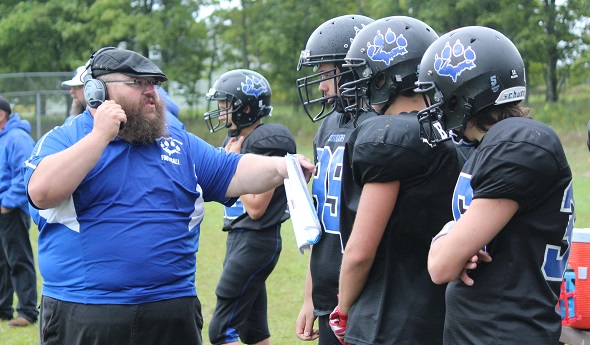
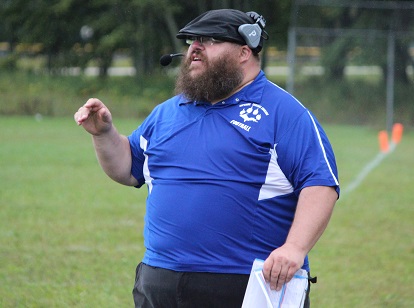
PHOTOS: (Top) Eben Junction Superior Central football coach Sam Eggleston speaks with some of his players during a game this season. (Middle) Eggleston monitors the action on the field. (Photos by Dennis Grall.)
1st & Goal: 2023 Week 2 Review
By
Geoff Kimmerly
MHSAA.com senior editor
September 4, 2023
Every season is a story, and Week 2 gave us plenty to consider as this one continues to unfold.
 We had pretty high expectations for this Labor Day weekend, which featured power-packed matchups from both local and statewide points of view – and we weren’t disappointed.
But there were several intriguing twists and turns as well – including numerous teams that came back impressively from opening-day losses – and we dive into many of those results below.
Bay & Thumb
HEADLINER Chesaning 27, New Lothrop 22 These two began playing each other regularly with the creation of the Mid-Michigan Activities Conference in 2018, and four-time league champion New Lothrop (1-1) had won the first five meetings of the recent series by an average score of 51-8 – including 40-14 a year ago. But Chesaning (1-1) built a 27-6 lead by the middle of the third quarter this time on the way to rebounding bigtime from a Week 1 four-point loss to Bath. Click for more from the Saginaw News.
Watch list Goodrich 45, Linden 28 The Martians (2-0) followed up a Week 1 win over reigning Division 5 runner-up Frankenmuth with this win over another returning league champion in Linden (1-1).
On the move Ubly 42, Elkton-Pigeon-Bay Port Laker 0 The Bearcats (2-0) have now won their first two games by a combined score of 92-13 over teams that went a combined 19-6 last season. Montrose 22, Durand 14 Add this to the Chesaning win and the MMAC might be in for more change at the top, as the Rams moved to 2-0 by handing reigning champ Durand its second defeat. Yale 34, Armada 28 The same might be said in the Blue Water Area Conference as Yale (2-0) broke a four-game losing streak against reigning champion Armada (1-1), avenging last year’s 42-18 defeat.
Greater Detroit
HEADLINER Warren De La Salle Collegiate 40, Muskegon 28 The reigning Division 2 champion Pilots (1-1) needed just a week to put the opening loss to Davison solidly behind them as they crossed the state and picked up a major bounce-back win over last season’s Division 3 runner-up Big Reds (0-2). The teams traded leads for most of the first three quarters with De La Salle carrying a five-point lead into the fourth and adding one more score to pull away. Click for more from the Muskegon Chronicle.
We take a look at Warren De La Salle, ranked #12 in our STATE CHAMPS! Top 25 Rankings as they went on the road and beat #18 Muskegon 40-28 on September 1st, 2023.
📽️ WXMI-TV@DLSFootball_MI | @DLSPilots | @coachrohn pic.twitter.com/Qo4bjZhqmI— STATE CHAMPS! Michigan (@statechampsmich) September 2, 2023
Watch list Roseville 33, Romeo 30 The Panthers (2-0) are making big headlines early, following last week’s shutout of Bloomfield Hills Brother Rice with this win over the Bulldogs (0-2) that avenged last season’s 30-6 loss.
On the move West Bloomfield 41, Birmingham Groves 19 The Lakers also are off to another notable 2-0 start after doubling up a Division 2 semifinalist from a year ago. Southfield Arts & Technology 20, Clarkston 17 The Warriors (2-0) have set their pace defeating a pair of Division 1 powers, this time breaking a four-game losing streak against the Wolves (0-2). Redford Union 14, Dearborn Heights Crestwood 12 Last season this ended up eventually deciding the Western Wayne Athletic Conference title for the Chargers, although this matchup was much closer than their 41-6 victory a year ago.
Mid-Michigan
HEADLINER Mason 42, DeWitt 23 The Bulldogs (2-0) affirmed themselves as the frontrunners for the Lansing area’s best team after jumping out to a 35-0 lead on the Panthers (1-1) in this matchup of 2022 Division 3 semifinalists. Fourth-year varsity senior AJ Martel was among standouts with 139 yards and two touchdowns rushing. Click for more from the Lansing State Journal.
Congrats to Mason for securing the #7 spot in our latest STATE CHAMPS! Top 25 Rankings. On August 31st, 2023, they beat DeWitt 42-23, led by Senior Running Back AJ Martel. He rushed for 139 yards and scored two touchdowns on 22 carries.
📽️ WILX-TV@MasonFootball2 | @MHSAA pic.twitter.com/lfJaeCswHX— STATE CHAMPS! Michigan (@statechampsmich) September 4, 2023
Watch list Lansing Sexton 48, Lansing Catholic 20 The J-Dubbs are off to their first 2-0 start since 2017, also their most recent winning season, and avenged a 35-0 loss to the Cougars (1-1) from a year ago.
On the move Haslett 41, Fenton 25 The Vikings bounced back from a Week 1 loss to DeWitt as Nakai Amachree scored six touchdowns. Ithaca 39, Standish-Sterling 26 The Yellowjackets (2-0) had lost the last two seasons to the Panthers (0-2), last season’s ending up Ithaca’s only defeat on the way to the Division 7 Regional Finals. Mount Pleasant 35, Midland 6 Add the Oilers (1-1) to the list of quick bounce-backers as they rebounded from a big Week 1 loss to down a Midland team that won 10 games last season and opened with a victory last week.
Northern Lower Peninsula
HEADLINER Gaylord 42, Kingsley 39 The Blue Devils are 2-0 for the second-straight season after holding off a late Kingsley comeback attempt. The Stags (1-1) scored twice over the final four minutes to again make this matchup a one-score game after Gaylord won last year’s meeting by a point. Click for more from the Traverse City Record-Eagle.
Watch list Cadillac 43, Escanaba 36 The Vikings (1-1) came back from a three-point season-opening loss to Midland to begin Big North Conference play with a key win over new league member Escanaba (1-1).
On the move Frankfort 28, Maple City Glen Lake 15 Just two weeks in, Frankfort finds itself 2-0 in the Northern Michigan Football League Legacy with a Week 8 matchup with East Jordan looking even more like one to circle. Boyne City 57, Elk Rapids 14 The Ramblers also are 2-0 after playing two 2022 playoff teams and with more tests ahead as the schedule doesn’t get any easier the rest of September. Mancelona 52, Tawas 20 The Ironmen (1-1) won one game last season and scored just 86 points over nine, but they equaled that victory total while avenging last year’s 30-8 loss to Tawas (1-1).
Southeast & Border
HEADLINER Carleton Airport 48, Riverview 27 The Jets (2-0) not only have defeated two league champions so far this fall – add this win to the 31-10 opener over Gibraltar Carlson – but they’ve set themselves up well starting Huron League play after missing out on a shared title a year ago when Riverview (1-1) won the matchup 18-13 and went on to make the Division 4 Semifinals. Click for more from the Monroe News.
Watch list Parma Western 20, Detroit Country Day 17 There’s been early talk that Western (2-0) is a team to watch more closely this fall, and this combined with the Week 1 win over Dearborn Divine Child definitely is justifying the buzz. Country Day (1-1) is coming off a run to the Division 5 Semifinals.
On the move Quincy 18, Reading 12 The Orioles (1-1) are seeking a first winning season since 2018, and this could be big as they hadn’t defeated Reading (0-2) since 2016 and lost last year’s meeting 42-0. Chelsea 27, Edwardsburg 14 The Bulldogs (1-1) evened their record this fall and avenged a 40-7 loss to the Eddies (0-2) from last as these two recent Division 4 champions continued a regular-season series. Saline 41, Dexter 25 The matchup that decided the Southeastern Conference Red outright title for Dexter (0-2) in Week 8 last year moved to the front of the league schedule this fall and still might end up having championship implications as Saline (2-0) is off to a strong start.
Southwest Corridor
HEADLINER Lawton 38, Traverse City St. Francis 6 The Blue Devils’ Kal Motter was another of the statewide stars of the weekend with five touchdowns as Lawton handed reigning Division 7 runner-up St. Francis its first regular-season loss since October 2020. The Gladiators (1-1) had won last year’s meeting 42-7 and hadn’t been held to single-digit scoring also since 2020. Click for more from the Kalamazoo Gazette.
Watch list Battle Creek Harper Creek 21, Battle Creek Central 13 The Beavers are 2-0 for the first time since 2017 having now avenged both 2022 losses to neighbors Lakeview in Week 1 and Central on Friday. Harper Creek had lost to the Bearcats 34-0 a year ago.
On the move Richland Gull Lake 7, Vicksburg 6 The Blue Devils are 2-0 for the first time since 2007 and after winning three games total last season, when they fell 28-6 to playoff regular Vicksburg (0-2). Paw Paw 42, Berrien Springs 6 The Red Wolves (2-0) added to their impressive opening victory over Big Rapids with another over the annually playoff-qualifying Shamrocks (0-2). Kalamazoo Central 47, Sturgis 34 The Maroon Giants’ opener ended up cancelled due to weather, but they made their late start sweet with this first win since Week 7 of 2021 – and against a 2022 playoff qualifier in the Trojans (1-1).
Upper Peninsula
HEADLINER Gladstone 42, Negaunee 14 Gladstone (2-0) is coming off its best season in more than a decade, but it still included losses to Negaunee (1-1) during the regular season and Regional Finals. This was a first step toward avenging all of that, and with some new significance – Gladstone joined reigning champion (and Division 6 runner-up) Negaunee in the Western Peninsula Athletic Conference Copper this season. Click for more from RRN Sports.
Our choice for play of the game tonight between Gladstone and Negaunee. Braves ahead 8-7 when Eli Cody picks off the pass and races in the other direction. Aaron Hughes chases him down and prevents the touchdown. Negaunee does not score. Braves go on to win 42-14. pic.twitter.com/gBrAGesI42
— Jack Hall (@JackHall600) September 1, 2023
Watch list Iron Mountain 40, Bark River-Harris 0 The Mountaineers (2-0) are another team running at full steam with a pair of wins over 2022 playoff teams, but with an interesting September coming up as they moved into the WPAC Iron this fall after regularly contending in the Copper over the last five seasons.
On the move Sault Ste. Marie 26, Cheboygan 0 For the fifth season in a row, the Blue Devils have started 2-0 – and for the second time in three seasons, they’ve opened with two shutouts. Calumet 42, Ishpeming Westwood 22 The Copper Kings picked up nice momentum following an opening loss to Escanaba by getting to 1-0 in the WPAC Copper with Negaunee up next. Kingsford 34, Houghton 0 The Flivvers also are unscored upon after two games, with Gladstone a major test next.
West Michigan
HEADLINER Rockford 31, Muskegon Mona Shores 8 The Rams (2-0) followed up an impressive opening win over Muskegon High with another stunning performance, holding Mona Shores (1-1) scoreless until the final minutes of the fourth quarter. This was just a four-point game a year ago, but Rockford now heads into Ottawa-Kent Conference Red play with a combined 58-15 margin over its first two. Click for more from the Grand Rapids Press.
Check out this 31-8 victory by Rockford, ranked #6th in our STATE CHAMPS! Top 25, against Muskegon Mona Shores!
📽️ WXMI-TV@MHSAA | @RockfordAD | @RockfordRamsFB pic.twitter.com/8SyhYag8dv— STATE CHAMPS! Michigan (@statechampsmich) September 2, 2023
Watch list East Grand Rapids 23, Grand Rapids South Christian 21 The Pioneers (2-0) are coming off two straight sub-.500 seasons, but that rarity could be moving into distant memory as they followed up a shutout of Cedar Springs by downing the reigning Division 4 champion Sailors (1-1) with the game-winner on the final play.
On the move Grand Rapids Catholic Central 38, River Rouge 6 Both are being talked about already in the championship mix, making this victory even more notable as GRCC moved to 1-1 and Rouge to 0-2. North Muskegon 41, Muskegon Catholic Central 21 The Norsemen (2-0) are one of the stories of the first two weeks, following an opening win over Pewamo-Westphalia by avenging last year’s only regular-season loss in sending the Crusaders to 0-2. Hudsonville Unity Christian 33, Muskegon Oakridge 21 These Crusaders (1-1) opened with a pair of contenders from the West Michigan Conference Lakes and followed Week 1 loss to Whitehall with an impressive victory over a 10-win team from a year ago.
8-Player
HEADLINER Newberry 16, Munising 6 Newberry’s only losses of the 2022 season were to Munising in Week 2 and again in a Division 1 Regional Final. But along with avenging those, this victory should provide plenty of momentum as Newberry heads into this week’s matchup with Rudyard, the only other opponent to come within single digits last season.
Watch list St. Ignace 46, Pellston 6 The Saints (2-0) appear to be adjusting to 8-player quickly as they increased their margin over their first two victories to a combined 96-12.
On the move Posen 56, Rogers City 14 The Vikings (2-0) handed the Hurons just their second regular-season defeat over the last three and now have reached 50 points in both games this fall. Indian River Inland Lakes 54, Lake Linden-Hubbell 46 The Bulldogs (2-0) got a late start as well after their Week 1 game was forfeited, but they started it memorably by edging a Lakes team coming off its second-straight seven-win season. Mendon 58, Colon 30 After winning last year’s Division 2 Regional Final meeting with the Magi by only two points, Mendon broke free with Jack McCaw and Owen Gorham both going over 100 yards rushing and combining for five touchdowns.
Second Half’s weekly “1st & Goal” previews and reviews are powered by MI Student Aid, a part of the Office of Postsecondary Financial Planning located within the Michigan Department of Treasury. MI Student Aid encourages students to pursue postsecondary education by providing access to student financial resources and information. MI Student Aid administers the state’s 529 college savings programs (MET/MESP), as well as scholarship and grant programs that help make college Accessible, Affordable and Attainable for you. Connect with MI Student Aid at www.michigan.gov/mistudentaid and find more information on Facebook and X (Twitter) @mistudentaid.
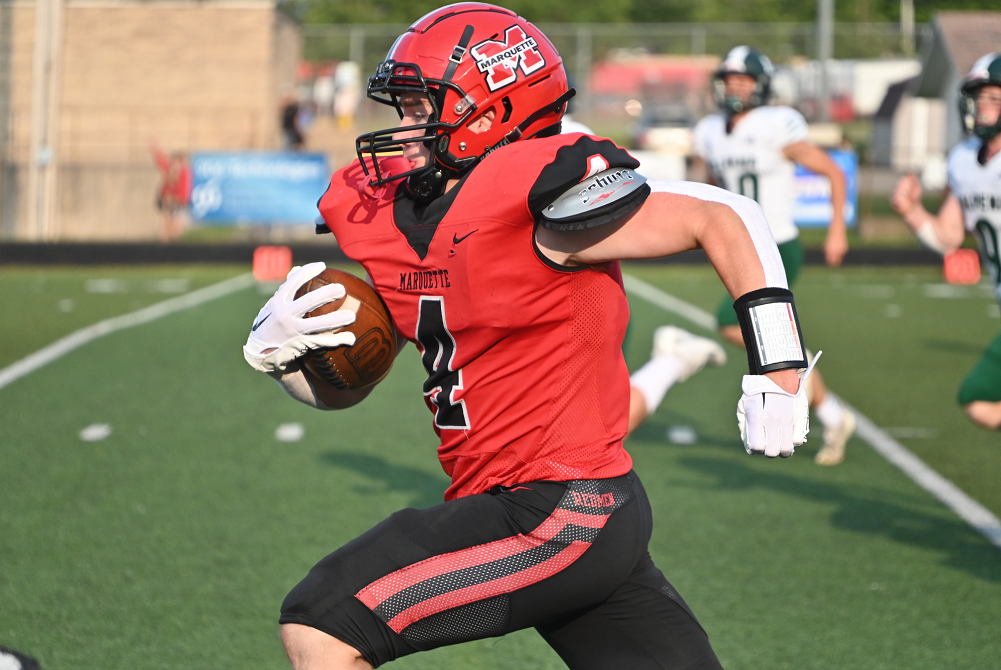
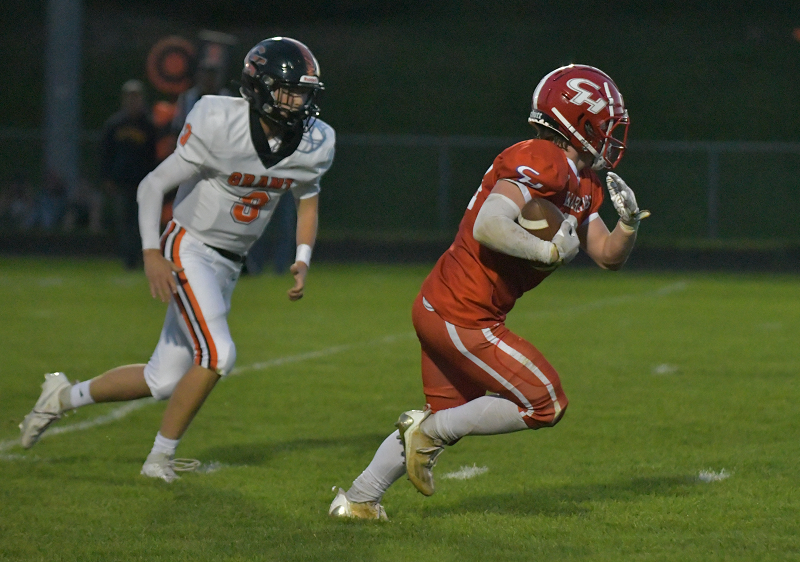
PHOTOS (Top) Marquette's Tucker Welch (4) finds a big hole and scores Marquette's first touchdown of its 49-0 win over Alpena. (Middle) Remus Chippewa Hills improved to 2-0 with a 43-13 win over Grant. (Top photo by Cara Kamps; middle photo by High School Sports Scene.)