

Writer-Turned-Coach Enjoys Debut
November 3, 2016
By Dennis Grall
Special for Second Half
ESCANABA — Sam Eggleston has seen high school football from two drastically different viewpoints. Now, even though he is an unpaid volunteer, he enjoys being on the sideline as a coach.
 Eggleston just completed his first season as a high school head coach, with Eben Superior Central winning its final three games to finish 4-5 in 8-player football. The Cougars were among the first teams in the state to join the 8-player format in 2010, their first year of football.
Eggleston was a sportswriter before becoming a coach, giving him different perspectives to watching the same event.
The 1998 Rock Mid Peninsula High School graduate worked at newspapers in Escanaba, Kenai, Alaska; Northville and Novi, and Marquette before becoming a freelance writer and website blog editor in 2008. He started the writing phase of his career in 2000 with the Daily Press in Escanaba, under my direction.
He served as a volunteer assistant football coach in Northville, then moved back to the Upper Peninsula and became a volunteer coach at his alma mater in 2011 when the Wolverines went to 8-player football. He joined Superior Central in 2014 and spent two seasons as a volunteer aide until landing the head job just two weeks before the 2016 preseason began.
“In both careers … you took a shot on me and I ran with it, and the same with coaching; they gave me a shot and I’ve run with it as best I can,” he said.
In addition to his unpaid position at Superior Central, in rural Alger County, Eggleston is responsible for fundraising for the self-funded football program, a major priority for his offseason.
“My coaching is over (for the season) now and the majority of my time will be spent on raising funds so we can get new helmets, get new pads to replace ones that are broke, spending money we don’t have so we’ve got to make that up now,” he said. “We have to win now to have successful fundraisers.”
As a sportswriter, Eggleston would simply switch gears and move on to coverage of the next athletic season, for instance once fall sports moved into winter. He also never had to worry about how coaches managed off-field X’s and O’s once their seasons concluded.
Life was totally different as a reporter. “I had a different approach, different viewpoint, different mindset to a game as a writer,” said Eggleston, who still has the heft of when he was a lineman but now looks like a lumberjack with his bushy beard and build.
“Now I have to worry about every kid and every position,” he said. “Sometimes I don’t even see the end result of the play because I’m watching the line play. I don’t even know how well my running back did until I see where they moved the stick.”
He may also be working on an injured player while the game goes on, trying to make play calls and other decisions at the same time.
As a sportswriter, he would be jotting down notes between plays or perhaps checking the result of a picture he took of the previous snap, totally unaware the coach was monitoring several assignments.
“I look back at the writer I was and as a coach now, and I would hate the type of writer I was,” he said.
Eggleston would analyze why a coach would switch to running a sweep rather than the counter that had been working, all while the coach may be working on an injured player that caused a change in offensive plans.
“As a writer I never had the insight to see everything. I just saw the overall game and kept track of every yard,” he said. “As a coach I can’t even tell if the play went five yards because I have three plays stacked up as the game goes on.”
While he was writing sports in the metro Detroit area, his weekly paper often covered games also being covered by the Detroit Free Press or the Oakland Press, with those stories appearing the next day. Eggleston’s story would appear maybe five days later, after everyone knew what happened.
 “I had to come in with a different angle. I tried to be a little more analytical and focus on strategy versus the flourish and try to get the meat of the game rather than get to the flowery parts,” he recalled. “I tried to take a different approach and make my stuff more interesting.”
His style apparently worked as the paper received several journalism awards and subscriptions remained strong.
Writing also provided some interesting backdrops. He had to use small charter planes to see some games in Alaska, or get to Nome to handle features about the Iditarod sled dog race.
He recalls covering a high school hockey game on an outdoor rink in Alaska and said “it was the first time I saw wind shear affect a hockey game.”
Eggleston also covered a football game where a kicker booted the ball off the uprights, then off a fence, and it bounced into the ocean in Homer.
He reported on a murder trial at that paper, where he would work the news desk in the morning, take time off and then handle sports at night. “It was super stressful,” he said.
Now walking the sidelines as a coach, he said “it definitely does feel like I’ve seen both sides of the coin, and I understand both sides of them better.”
He remembers just giving “little more rounded answers and (to) give both sides of the story” in postgame interviews. “A lot of coaches give canned answers. I try to be a little more in-depth and help try to write the story.”
In his early days as a sportswriter, he said “I would see the game unfold and see the pressures and why a coach would make a decision to go for it (on fourth down). I was a bit more critical of the coach and their decision,” he said, adding “I would probably have been a little more biting about it when I wrote the story.”
He admits in those days “I thought I knew everything there was to know about football. I played it,” he said. “I always approached the game like I was the professional and knew everything about the game. Now as a coach there are a host of responsibilities during every game. I am in completely different waters now. The hardest thing is keeping the kids pointed in the right direction as things go wrong.
“You’ve got the entire team and you’ve got to keep moving in a positive direction, keep the focus going forward. Forget the last play and work on the next one and get the kids to buy into that philosophy.”
He also compares his first writing assignment at the Daily Press with his first game this season at Ontonagon. “I did a (men’s baseball) story about the Escanaba Polecats, and you read my first line and said, ‘Did Yoda write this?’ I thought, oh my God, I don’t know what I’m doing.”
The Cougars lost their opener this fall 36-8, and Eggleston said “after being an assistant for four years, I still wasn’t prepared going into that Ontonagon game. We lost, and as I look back, if we played them right now I think we would beat them.
“I had no clue coming into that first game and didn’t have any idea how to get us back on track.”
He eventually figured enough out to finish 4-5 and found plenty of ways to enjoy being a coach.
Eggleston tries to eat lunch with his players every day, and he pays for his own meal.
“I want a family environment there; we all sit at the same table,” he said. “What I get back is relationships I never had before. I feel like I have 21 kids, and I love every minute of it.”
 Denny Grall retired in 2012 after 39 years at the Escanaba Daily Press and four at the Green Bay Press-Gazette, plus 15 months for WLST radio in Escanaba; he served as the Daily Press sports editor from 1970-80 and again from 1984-2012. Grall was inducted into the Upper Peninsula Sports Hall of Fame in 2002 and serves as its executive secretary. E-mail him at [email protected] with story ideas for the Upper Peninsula.
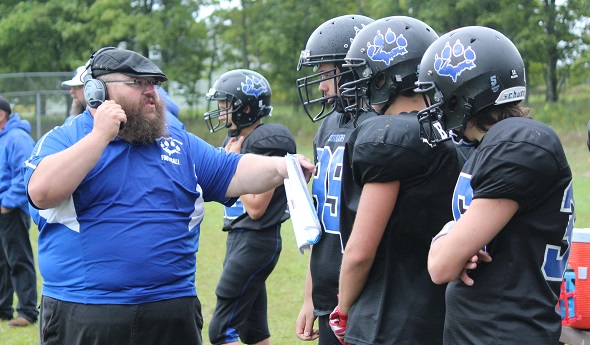
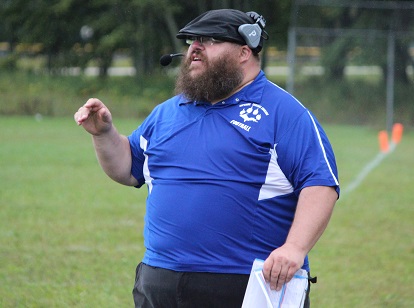
PHOTOS: (Top) Eben Junction Superior Central football coach Sam Eggleston speaks with some of his players during a game this season. (Middle) Eggleston monitors the action on the field. (Photos by Dennis Grall.)
Drive for Detroit: Week 4 in Review
September 23, 2019
By Geoff Kimmerly
Second Half editor
Week 4 of Michigan’s high school football season was filled with great stories, and we tried to make mention of as many as we could in this week’s “Drive for Detroit” review.
 A legendary coach returns with a big win. A neighbor beats its rival for the first time in a number of years – or decades. A league title contender gives up a sure win and takes a chance to help another celebrate those who have served our country.
And as often written in these opening paragraphs each week, those were just the start.
"Drive for Detroit" is sponsored by MI Student Aid.
Bay & Thumb
HEADLINER Frankenmuth 21, Freeland 7 The Eagles (4-0) now share the lead in the Tri-Valley Conference East with only Saginaw Swan Valley after sending Freeland (3-1) a game back. Frankenmuth avenged last season’s 15-8 loss to the Falcons with 21 unanswered second-half points, but can’t celebrate for long with Swan Valley up this week. Click for more from the Saginaw News and see highlights below from WJRT.
Frankenmuth avenges last years' loss to Freeland as the Eagles defeat the Falcons 21-7.@FrankenmuthF @muthstudentshttps://t.co/fsDxGNQewy
— ABC12WJRT (@ABC12WJRT) September 21, 2019
Watch list Richmond 35, Croswell-Lexington 18 The Blue Water Area Conference also has just two teams at the top now – Richmond and Almont – after the Blue Devils (4-0) sent Croswell-Lexington (2-2) into a tie for third.
Remember this one Millington 15, Hemlock 6 The Cardinals (1-3) took the first step needed to win out and guarantee extending their 15-year playoff streak by handing Hemlock (2-2) its second straight defeat.
More shoutouts Davison 48, Flint Powers Catholic 0 The Cardinals (4-0) posted their second straight shutout to hand Powers (3-1) its first defeat and stay atop the Saginaw Valley League Blue. Harbor Beach 47, Brown City 0 The Pirates (4-0) have given up just 17 points over four games but next will take on Ubly (40.5 ppg) for first place in the Greater Thumb Conference East.
Greater Detroit
HEADLINER Plymouth 14, Brighton 7 The Wildcats are 4-0 for the first time since 2011 and alone atop the Kensington Lakes Activities Association West after edging the reigning champion Bulldogs. Brighton (3-1) is one of four teams in the league sharing second with one defeat – and Plymouth handed that loss to three of them. Click for more from the Livingston Daily Press & Argus.
Watch list Oak Park 26, Birmingham Groves 14 Oak Park (3-1) has been one of Groves’ few regular-season stoppers the last few seasons and made it three in a row over the Falcons (3-1) to remain with Birmingham Seaholm the only teams undefeated in Oakland Activities Association White play.
Remember this one Detroit Martin Luther King 47, Detroit Cass Tech 7 Much credit goes to both Detroit Public School League powers for opening against some of the Midwest’s best – even though both started 0-2. King (2-2) gave itself a little bit of breathing room with a second straight win after opening with defeats to Detroit Catholic Central and Muskegon. Cass Tech (1-3) finds itself in a rare position; the Technicians fell to out-of-state powers Chicago Phillips and Lakewood St. Edward (Ohio), the first two weeks and likely will have to win out – including against King during the Detroit Public School League playoffs – to extend an 11-year playoff streak.
More shoutouts Orchard Lake St. Mary's 38, Walled Lake Western 35 The Eaglets, after going a combined 5-12 over the last two seasons, are 4-0 after handing Western its first loss. Bloomfield Hills Brother Rice 16, Warren De La Salle Collegiate 14 The Warriors (4-0) downed the reigning Division 2 champion Pilots (2-2) for the first time since 2016.
Mid-Michigan
HEADLINER East Lansing 35, Portage Northern 28 (OT) The Trojans (3-1) earned a major win for Lansing-area football as a whole, taking down arguably the top team from the southwest so far this fall in Northern (3-1). The Huskies are undefeated in Southwestern Michigan Athletic Conference West play along with St. Joseph, but gave up a season high in points to East Lansing. The Trojans couldn’t have wished for better heading into their next matchup with league rival DeWitt, a big winner over Holt this weekend. Click for more from East Lansing Info and see below for highlights from State Champs Sports Network.
ICYMI: Check out the highlights of the East Lansing (@eltrojans) vs. Portage Northern (@PortageNorthern) game from Friday night.
Brought to you by @LawrenceTechU, @MHSAA and @hungryhowies pic.twitter.com/gEGFhiiJOM— STATE CHAMPS! (@statechampsnet) September 22, 2019
Watch list New Lothrop 42, Montrose 21 The reigning Division 7 champion Hornets (4-0) haven’t slowed down a step from last season, with Montrose (3-1) the second of three second-place teams in the Mid-Michigan Activities Conference to fall to New Lothrop over the last two weeks.
Remember this one St. Johns 33, Williamston 21 The Redwings (3-1) got off to a deflating start with a Week 1 shutout against East Lansing, but that loss looks better with the Trojans’ success and also forgettable after wins like this one over the Hornets (2-2).
More shoutouts Beal City 35, Evart 7 The Aggies (4-0) stand alone in the Highland Conference after handing Evart (3-1) its first defeat, which continued a three-week string of dealing contenders their first league loss. Fowler 46, Laingsburg 24 By handing Laingsburg (3-1) its only loss, the Eagles (4-0) got past the main obstacle on the way to what could be a battle of unbeatens against rival Pewamo-Westphalia in Week 8.
Northern Lower Peninsula
HEADLINER Kingsley 26, Traverse City St. Francis 7 The Stags (4-0) broke a six-game losing streak against the Gladiators that had seen them struggle to even score against their rivals. But this time, St. Francis (2-2) was held to just seven points for the second time this season – and also just the second time in a regular-season game since the start of 2014. Kingsley sits atop the Northern Michigan Football League Legends standings with Week 9 opponent Boyne City. Click for more from the Traverse City Record-Eagle and see highlights below from MI Sports Now.
.@KASAthletics bests TC St. Francis for first win in series since 2012https://t.co/lXe5fnHTvh pic.twitter.com/A6jynno6cV
— MISportsNow (@MISportsNow) September 21, 2019
Watch list Alpena 41, Cadillac 38 Are the Wildcats (2-2) contenders in the Big North Conference? They join Travers City Central as the only teams without a league loss as they play for their first overall winning season since 2004, and this was a nice win with Cadillac (2-2) also on the rise.
Remember this one Traverse City Central 32, Traverse City West 0 The “Patriot Game” always is memorable, but will be this time especially for Central (3-1) as it avenged last season’s 21-14 defeat with a margin unrivaled in the series since West’s 31-point win in 2002.
More shoutouts Maple City Glen Lake 53, Frankfort 7 The Lakers (4-0) continued to shine with a season high in points against the Panthers (2-2). Johannesburg-Lewiston 40, St. Ignace 0 The Cardinals put up a third straight big win to start a string of five games against teams that are .500 or better so far.
Southeast & Border
HEADLINER Chelsea 28, Ypsilanti Lincoln 18 The Bulldogs (4-0) made the Division 4 championship game last season, even more impressive considering they didn’t win their league. But they took a major step toward earning that local crown this fall by ending a two-year losing streak to the rival Railsplitters (2-2) – and next up is reigning Southeastern Conference White champion Jackson. Click for more from the Chelsea Sun Times News.
Watch list Blissfield 28, Brooklyn Columbia Central 14 Seven of eight teams in the Lenawee County Athletic Association are 2-2 or better, and Blissfield (3-1) finds itself tied for first place after handing reigning co-champ Columbia Central (3-1) a loss for the second straight season.
Remember this one Clinton 34, Sand Creek 28 A late rally kept Clinton (4-0) tied for first in the Tri-County Conference and could be the difference down the road as Sand Creek (3-1) hopes for help to get back in the title mix.
More shoutouts Dexter 57, Jackson 21 The Dreadnaughts (3-1) are halfway to earning a second playoff berth in two seasons – and ever – after avenging last season’s 10-point loss to the Vikings (3-1). Jonesville 52, Union City 0 This win over 2018 playoff qualifier Union City moved Jonesville to 3-1, giving the Comets their most wins in a season since 2016 – and tying their most wins since 2014.
Southwest Corridor
HEADLINER St. Joseph 22, Stevensville Lakeshore 14 The coach Andrew Pratley era is only four games old, but the Bears (4-0) are only one win shy of tying last year’s success and in position to decide their fate in the SMAC West after this victory over Lakeshore (2-2). St. Joseph had lost eight straight to the Lancers, going back to 2013. The final month could be even more telling with league foes Portage Central and Northern sandwiching undefeated Battle Creek Lakeview and perennial power DeWitt. Click for more from the St. Joseph Herald-Palladium.
Watch list White Pigeon 14, Centreville 8 The Chiefs (4-0) won this matchup of 2018 playoff qualifiers to hold on to a share of first in the Southwest 10 Conference, with Centreville (2-2) now having lost to both co-leaders over the last two weeks.
Remember this one Lawton 29, Delton Kellogg 12 These two could end up champions in the Southwestern Athletic Conference divisions. Delton (3-1) should be pursuing the Valley title with Schoolcraft and Constantine. Lawton (4-0) and Gobles look to be early favorites in the SAC Lakeshore.
More shoutouts Edwardsburg 54, Vicksburg 7 The Eddies (4-0) are back on top in the Wolverine Conference sharing first with only Paw Paw after handing Vicksburg (3-1) its first loss. Portage Central 21, Battle Creek Central 19 Both made the playoffs a year ago, and the Mustangs (2-2) are just a bit more comfortable as they try to advance again while the Bearcats (1-3) now are forced to win out to guarantee a return.
Upper Peninsula
HEADLINER Ishpeming Westwood 38, Ishpeming 0 The Patriots (2-2) find themselves needing a number of things to fall their way to get back into their league’s title mix, but a great consolation prize at the end of the season will be this win over the rival Hematites (3-1). It broke a losing streak (on the field, not counting a forfeit victory in 2017) against Ishpeming that began in 1999 and included four playoff defeats. Click for more from the Marquette Mining Journal.
VIDEO: Check out the highlights of the Westwood (@westwoodpats) vs. Ishpeming game from Friday night.
Brought to you by @LawrenceTechU, @MHSAA & @hungryhowies pic.twitter.com/FDWzBLMC1D— STATE CHAMPS! (@statechampsnet) September 21, 2019
Watch list Calumet 14, West Iron County 0 The Copper Kings (4-0) have given up only 21 points over four games, handing West Iron (3-1) a shutout for its first defeat.
Remember this one Marquette 17, Escanaba 14 The Redmen (2-2) started this season with losses to Traverse City powers St. Francis and Central. But those games no doubt prepared them well to open Great Northern Conference play with a big win against their rival and the other reigning league co-champ Eskymos (3-1).
More shoutouts Kingsford 20, Gladstone 7 The Flivvers (2-2) enjoyed a jumpstart in their first game this fall against a Michigan opponent, handing Gladstone (2-2) a second straight defeat. Sault Ste. Marie 8, Petoskey 7 (OT) The Blue Devils (3-1) scored their only points in overtime to improve on their best start on the field since 2007 (not including 2015 when a Week 4 win came by forfeit).
West Michigan
HEADLINER Rockford 34, Muskegon Mona Shores 21 The Rams (4-0) welcomed back the state’s sixth winningest coach Ralph Munger after preseason heart surgery kept him off the sideline to start the fall, and they no doubt rode some added inspiration in avenging losses to Mona Shores (3-1) from the last two seasons. Jaiden Friesen scored five touchdowns, and Rockford’s defense held the reigning Division 2 runner-up Sailors to their second-fewest points over the last three seasons. Click for more from the Grand Rapids Press.
VIDEO: Check out the highlights of the Rockford (@rock4rams) vs. Mona Shores game from Friday night. Brought to you by @LawrenceTechU, @MHSAA & @hungryhowies pic.twitter.com/fJzslE7TxK
— STATE CHAMPS! (@statechampsnet) September 22, 2019
Watch list Byron Center 33, Holland Christian 6 The much-improved Bulldogs (4-0) have handed losses to three .500 teams including Holland Christian (2-2) to get to the Ottawa-Kent Conference Green powers, starting with Zeeland West this week.
Remember this one Muskegon Catholic Central 34, Ludington 21 This one jumped off the page, mostly because Ludington (3-1) had beaten reigning Lakes 8 Conference champ Manistee the week before. With Orchard View also surging, this league could be wide open.
More shoutouts Zeeland West 40, Lowell 26 The Dux (4-0) actually saw their scoring average fall to 45 ppg, and with wins as well over East Grand Rapids, Grand Rapids Christian and Holland appear ready for league competition. Muskegon Orchard View 42, Belding 35 Every week the story gets better for the Cardinals (4-0), who have guaranteed their best finish since 2014 and with another win will tie their best since 2008.
8-Player
HEADLINER Suttons Bay 20, Onekama 14 This was one of the week’s best stories, and it had nothing to do with how the teams played. Although these two are the likely Midwest Central Michigan Conference West favorites and will meet again possibly to decide the champion Week 8, they agreed to play a nonleague game this past week as well. Although both were eligible to receive forfeit wins against other opponents no longer playing this fall, Onekama (3-1) had made big plans for its “Warrior Game” military appreciation night and needed an on-field opponent to make it go. In stepped Suttons Bay, which moved to 4-0 with its best win this season. Click for more from the Manistee News-Advocate.
Suttons Bay rallies past Onekama in Warrior Gamehttps://t.co/OyA8MJUB6i pic.twitter.com/s6vGwNYnJC
— MISportsNow (@MISportsNow) September 21, 2019
Watch list Climax-Scotts 16, Camden-Frontier 12 It’s been impossible to not make mention of Climax-Scotts (4-0) almost every week so far with how it’s marched through some of the traditional best from its corner of the Lower Peninsula. Camden-Frontier (3-1) entered undefeated, and unbeaten Colon is up next.
Remember this one Litchfield 36, Waldron 22 The Terriers (3-1) now have as many wins as the last seven seasons combined, and could be set up to make a run at the playoffs for the first time since 2011.
More shoutouts Rapid River 66, Cedarville 58 (OT) The Rockets (1-3) haven’t scored like usual this season, but this overtime back-and-forth was a quick reminder of their past firepower – and a good time for it with Cedarville (2-2) always a force and league play starting. Hillman 52, Au Gres-Sims 20 The Tigers (4-0) stormed back after taking a forfeit win in Week 3, breaking a streak of three regular-season losses to the Wolverines (1-3).
Second Half’s weekly “Drive for Detroit” previews are powered by MI Student Aid, a part of the Office of Postsecondary Financial Planning located within the Michigan Department of Treasury. MI Student Aid encourages students to pursue postsecondary education by providing access to student financial resources and information. MI Student Aid administers the state’s 529 college savings programs (MET/MESP), as well as scholarship and grant programs that help make college Accessible, Affordable and Attainable for you. Connect with MI Student Aid at www.michigan.gov/mistudentaid and find more information on Facebook and Twitter @mistudentaid.
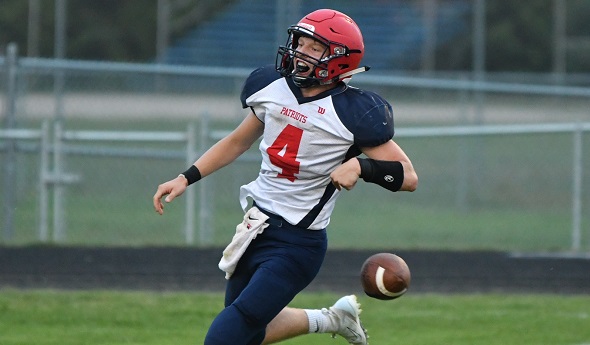
PHOTO: Ishpeming Westwood quarterback Taylor Dellangelo celebrates a touchdown against Ishpeming. (Photo by Cara Kamps.)