

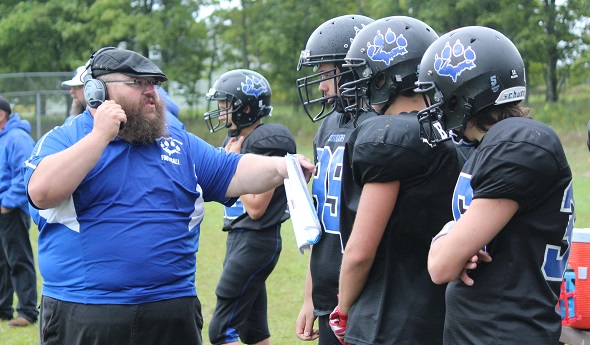
Writer-Turned-Coach Enjoys Debut
November 3, 2016
By Dennis Grall
Special for Second Half
ESCANABA — Sam Eggleston has seen high school football from two drastically different viewpoints. Now, even though he is an unpaid volunteer, he enjoys being on the sideline as a coach.
 Eggleston just completed his first season as a high school head coach, with Eben Superior Central winning its final three games to finish 4-5 in 8-player football. The Cougars were among the first teams in the state to join the 8-player format in 2010, their first year of football.
Eggleston was a sportswriter before becoming a coach, giving him different perspectives to watching the same event.
The 1998 Rock Mid Peninsula High School graduate worked at newspapers in Escanaba, Kenai, Alaska; Northville and Novi, and Marquette before becoming a freelance writer and website blog editor in 2008. He started the writing phase of his career in 2000 with the Daily Press in Escanaba, under my direction.
He served as a volunteer assistant football coach in Northville, then moved back to the Upper Peninsula and became a volunteer coach at his alma mater in 2011 when the Wolverines went to 8-player football. He joined Superior Central in 2014 and spent two seasons as a volunteer aide until landing the head job just two weeks before the 2016 preseason began.
“In both careers … you took a shot on me and I ran with it, and the same with coaching; they gave me a shot and I’ve run with it as best I can,” he said.
In addition to his unpaid position at Superior Central, in rural Alger County, Eggleston is responsible for fundraising for the self-funded football program, a major priority for his offseason.
“My coaching is over (for the season) now and the majority of my time will be spent on raising funds so we can get new helmets, get new pads to replace ones that are broke, spending money we don’t have so we’ve got to make that up now,” he said. “We have to win now to have successful fundraisers.”
As a sportswriter, Eggleston would simply switch gears and move on to coverage of the next athletic season, for instance once fall sports moved into winter. He also never had to worry about how coaches managed off-field X’s and O’s once their seasons concluded.
Life was totally different as a reporter. “I had a different approach, different viewpoint, different mindset to a game as a writer,” said Eggleston, who still has the heft of when he was a lineman but now looks like a lumberjack with his bushy beard and build.
“Now I have to worry about every kid and every position,” he said. “Sometimes I don’t even see the end result of the play because I’m watching the line play. I don’t even know how well my running back did until I see where they moved the stick.”
He may also be working on an injured player while the game goes on, trying to make play calls and other decisions at the same time.
As a sportswriter, he would be jotting down notes between plays or perhaps checking the result of a picture he took of the previous snap, totally unaware the coach was monitoring several assignments.
“I look back at the writer I was and as a coach now, and I would hate the type of writer I was,” he said.
Eggleston would analyze why a coach would switch to running a sweep rather than the counter that had been working, all while the coach may be working on an injured player that caused a change in offensive plans.
“As a writer I never had the insight to see everything. I just saw the overall game and kept track of every yard,” he said. “As a coach I can’t even tell if the play went five yards because I have three plays stacked up as the game goes on.”
While he was writing sports in the metro Detroit area, his weekly paper often covered games also being covered by the Detroit Free Press or the Oakland Press, with those stories appearing the next day. Eggleston’s story would appear maybe five days later, after everyone knew what happened.
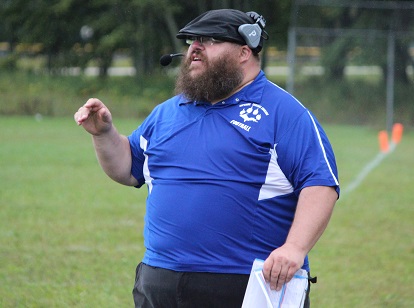 “I had to come in with a different angle. I tried to be a little more analytical and focus on strategy versus the flourish and try to get the meat of the game rather than get to the flowery parts,” he recalled. “I tried to take a different approach and make my stuff more interesting.”
His style apparently worked as the paper received several journalism awards and subscriptions remained strong.
Writing also provided some interesting backdrops. He had to use small charter planes to see some games in Alaska, or get to Nome to handle features about the Iditarod sled dog race.
He recalls covering a high school hockey game on an outdoor rink in Alaska and said “it was the first time I saw wind shear affect a hockey game.”
Eggleston also covered a football game where a kicker booted the ball off the uprights, then off a fence, and it bounced into the ocean in Homer.
He reported on a murder trial at that paper, where he would work the news desk in the morning, take time off and then handle sports at night. “It was super stressful,” he said.
Now walking the sidelines as a coach, he said “it definitely does feel like I’ve seen both sides of the coin, and I understand both sides of them better.”
He remembers just giving “little more rounded answers and (to) give both sides of the story” in postgame interviews. “A lot of coaches give canned answers. I try to be a little more in-depth and help try to write the story.”
In his early days as a sportswriter, he said “I would see the game unfold and see the pressures and why a coach would make a decision to go for it (on fourth down). I was a bit more critical of the coach and their decision,” he said, adding “I would probably have been a little more biting about it when I wrote the story.”
He admits in those days “I thought I knew everything there was to know about football. I played it,” he said. “I always approached the game like I was the professional and knew everything about the game. Now as a coach there are a host of responsibilities during every game. I am in completely different waters now. The hardest thing is keeping the kids pointed in the right direction as things go wrong.
“You’ve got the entire team and you’ve got to keep moving in a positive direction, keep the focus going forward. Forget the last play and work on the next one and get the kids to buy into that philosophy.”
He also compares his first writing assignment at the Daily Press with his first game this season at Ontonagon. “I did a (men’s baseball) story about the Escanaba Polecats, and you read my first line and said, ‘Did Yoda write this?’ I thought, oh my God, I don’t know what I’m doing.”
The Cougars lost their opener this fall 36-8, and Eggleston said “after being an assistant for four years, I still wasn’t prepared going into that Ontonagon game. We lost, and as I look back, if we played them right now I think we would beat them.
“I had no clue coming into that first game and didn’t have any idea how to get us back on track.”
He eventually figured enough out to finish 4-5 and found plenty of ways to enjoy being a coach.
Eggleston tries to eat lunch with his players every day, and he pays for his own meal.
“I want a family environment there; we all sit at the same table,” he said. “What I get back is relationships I never had before. I feel like I have 21 kids, and I love every minute of it.”
 Denny Grall retired in 2012 after 39 years at the Escanaba Daily Press and four at the Green Bay Press-Gazette, plus 15 months for WLST radio in Escanaba; he served as the Daily Press sports editor from 1970-80 and again from 1984-2012. Grall was inducted into the Upper Peninsula Sports Hall of Fame in 2002 and serves as its executive secretary. E-mail him at [email protected] with story ideas for the Upper Peninsula.
PHOTOS: (Top) Eben Junction Superior Central football coach Sam Eggleston speaks with some of his players during a game this season. (Middle) Eggleston monitors the action on the field. (Photos by Dennis Grall.)

2016 Week 5 Football Playoff Listing
September 19, 2016
By Geoff Kimmerly
Second Half editor
Here is a list of Michigan High School Athletic Association football playing schools, displaying their win-loss records and playoff averages through the fourth week of the season.
Schools on this list are in enrollment order for 11-player teams, with 8-player teams ordered by playoff average. An asterisk (*) beside a record indicates a team has eight or fewer games scheduled.
Those schools with 11-player teams with six or more wins playing nine-game schedules, or five or more wins playing eight games or fewer, will qualify for the MHSAA Football Playoffs beginning Oct. 28. Schools with 5-4, 4-3 or 4-4 records may qualify if the number of potential qualifiers by win total does not reach the 256 mark. Schools with six or more wins playing nine-game schedules or five or more wins playing eight games or fewer may be subtracted from the field based on playoff average if the number of potential qualifiers exceeds the 256 mark.
Once the 256 qualifying schools are determined, they will be divided by enrollment groups into eight equal divisions of 32 schools, and then drawn into regions of eight teams each and districts of four teams each. Those schools with 8-player teams will be ranked by playoff average at season’s end, and the top 16 programs will be drawn into regions of eight teams each for the playoff in that division, which also begins Oct. 28.
To review a list of all football playoff schools, individual school playoff point details and to report errors, visit the Football page of the MHSAA Website.
The announcement of the qualifiers and first-round pairings for both the 11 and 8-player playoffs will take place at 7 p.m. on Oct. 23 on the Selection Sunday Show on FOX Sports Detroit. The playoff qualifiers and pairings will be posted to the MHSAA Website following the Selection Sunday Show.
11-Player Playoff Listing
1. Utica Eisenhower, 2700, 4-0, 92.000
2. Clarkston, 2683, 3-1, 70.250
3. Grand Blanc, 2628, 4-0, 94.000
4. Howell, 2499, 3-1, 66.500
5. Dearborn Fordson, 2487, 4-0, 94.000
6. Detroit Cass Tech, 2368, 4-0, 70.000
7. Northville, 2325, 3-1, 76.750
8. Brighton, 2142, 3-1, 72.500
9. Detroit Catholic Central, 2128, 4-0, 94.000
10. Macomb L'Anse Creuse North, 1986, 4-0, 90.000
11. Dearborn, 1978, 3-1, 70.500
12. Lapeer, 1932, 3-1, 60.500
13. Saline, 1923, 4-0, 94.667
14. Bloomfield Hills, 1831, 4-0, 92.000
15. White Lake Lakeland, 1822, 4-0, 90.000
16. Grandville, 1810, 4-0, 94.000
17. Hudsonville, 1797, 3-1, 74.750
18. Warren Mott, 1768, 4-0, 90.000
19. Grand Ledge, 1694, 3-1, 68.500
20. Davison, 1668, 4-0, 84.000
21. Rochester Adams, 1666, 3-1, 66.250
22. Romeo, 1641, 3-1, 72.000
23. Walled Lake Northern, 1631, 4-0, 88.000
24. Grosse Pointe South, 1600, 4-0, 92.000
25. Temperance Bedford, 1597, 3-1, 66.750
26. Detroit Western International, 1584, 3-1, 44.750
27. Brownstown Woodhaven, 1579, 3-1, 64.750
28. Detroit East English, 1579, 3-1, 50.500
29. Livonia Churchill, 1578, 3-1, 72.250
30. Traverse City West, 1552, 3-1, 70.750
31. Warren Cousino, 1496, 3-1, 66.250
32. Detroit Martin Luther King, 1487, 4-0, 78.000
33. Detroit U-D Jesuit *, 1482, 3-1, 60.250
34. Jenison, 1481, 3-1, 64.500
35. Traverse City Central, 1394, 4-0, 96.000
36. Midland, 1388, 3-1, 60.500
37. Portage Central, 1388, 3-1, 62.750
38. Walled Lake Western, 1370, 4-0, 92.000
39. Grosse Pointe North, 1367, 3-1, 58.500
40. Battle Creek Lakeview *, 1353, 3-0, 84.000
41. Berkley, 1319, 3-1, 68.500
42. Grand Rapids Forest Hills Central, 1316, 3-1, 68.500
43. Wyandotte Roosevelt, 1311, 3-1, 66.750
44. Port Huron Northern, 1288, 3-1, 52.000
45. Wyoming, 1288, 3-1, 62.750
46. Midland Dow, 1254, 4-0, 84.000
47. Birmingham Brother Rice, 1250, 3-1, 68.400
48. Birmingham Groves, 1248, 4-0, 92.000
49. Muskegon Reeths-Puffer, 1198, 3-1, 58.250
50. Lowell, 1165, 4-0, 92.000
51. Holly, 1164, 3-1, 62.500
52. Farmington Hills Harrison, 1161, 3-1, 66.250
53. Greenville, 1142, 3-1, 70.500
54. Allen Park, 1094, 4-0, 94.000
55. Redford Thurston, 1090, 3-1, 62.500
56. Byron Center, 1070, 3-1, 62.500
57. Muskegon, 1052, 3-1, 66.500
58. Ortonville-Brandon, 1034, 3-1, 56.250
59. Detroit Cody, 1015, 3-1, 48.750
60. Mason, 1009, 3-1, 64.500
61. Zeeland East, 1007, 3-1, 58.750
62. DeWitt, 1002, 3-1, 76.500
63. St. Joseph, 989, 3-1, 68.500
64. Trenton, 969, 4-0, 90.000
65. Linden, 940, 3-1, 60.500
66. Cedar Springs, 936, 3-1, 68.500
67. Niles, 931, 3-1, 57.850
68. Coldwater, 929, 3-1, 66.250
69. Romulus, 929, 4-0, 35.333
70. Grand Rapids Christian, 912, 4-0, 88.800
71. Warren Fitzgerald, 891, 4-0, 80.000
72. New Boston Huron, 886, 3-1, 54.750
73. Battle Creek Harper Creek, 880, 4-0, 74.000
74. Chelsea, 867, 4-0, 84.000
75. Redford Union, 865, 3-1, 50.250
76. Stevensville Lakeshore, 865, 3-1, 70.500
77. Vicksburg, 861, 3-1, 54.750
78. Dearborn Divine Child, 859, 4-0, 78.000
79. Zeeland West, 857, 3-1, 70.750
80. Edwardsburg, 855, 4-0, 74.000
81. Sparta, 834, 3-1, 50.500
82. Fowlerville, 833, 3-1, 56.750
83. Cadillac, 817, 3-1, 62.250
84. Hamilton, 810, 4-0, 82.000
85. Bloomfield Hills Cranbrook Kingswood, 797, 3-1, 50.250
86. Marysville, 794, 4-0, 76.000
87. Detroit Osborn, 786, 3-1, 54.500
88. Milan, 775, 4-0, 78.000
89. Pontiac Notre Dame Prep, 749, 3-1, 72.250
90. River Rouge, 741, 3-1, 56.750
91. Three Rivers, 730, 3-1, 60.000
92. Escanaba, 722, 4-0, 90.000
93. Detroit Mumford, 714, 3-1, 50.500
94. Ludington, 695, 3-1, 46.750
95. Detroit Country Day, 692, 4-0, 70.000
96. Alma, 674, 3-1, 56.750
97. South Haven, 674, 3-1, 58.250
98. Wyoming Kelloggsville, 660, 3-1, 51.417
99. Croswell-Lexington, 659, 3-1, 58.500
100. Lake Fenton, 654, 4-0, 72.000
101. Grosse Ile, 653, 4-0, 84.000
102. Whitehall, 653, 4-0, 66.000
103. Wyoming Godwin Heights, 645, 3-1, 52.917
104. Grand Rapids Catholic Central, 644, 4-0, 84.000
105. Benton Harbor, 643, 4-0, 70.000
106. Corunna, 639, 4-0, 74.000
107. Hudsonville Unity Christian, 629, 4-0, 88.000
108. St. Clair Shores South Lake, 617, 3-1, 64.750
109. Lake Odessa Lakewood, 614, 4-0, 68.000
110. Hancock, 608, 3-1, 38.350
111. Detroit Denby, 593, 3-1, 54.500
112. Muskegon Oakridge, 590, 3-1, 40.750
113. Southfield Bradford, 587, 3-1, 52.500
114. Portland, 579, 4-0, 82.000
115. Remus Chippewa Hills, 577, 4-0, 74.000
116. Richmond, 562, 3-1, 62.750
117. Freeland, 561, 4-0, 84.000
118. Essexville Garber, 550, 3-1, 52.750
119. Algonac, 547, 4-0, 66.000
120. Ida, 546, 4-0, 68.000
121. Carrollton, 543, 3-1, 48.750
122. Kingsford, 543, 3-1, 61.200
123. Olivet, 541, 3-1, 50.750
124. Harper Woods, 540, 3-1, 52.250
125. Frankenmuth, 533, 4-0, 70.000
126. Lansing Catholic, 532, 3-1, 66.750
127. Grant, 520, 3-1, 46.750
128. Kalkaska, 517, 4-0, 60.000
129. Reed City, 496, 4-0, 72.000
130. Grayling, 492, 3-1, 52.750
131. Stockbridge, 482, 3-1, 52.750
132. Grand Rapids West Catholic, 475, 3-1, 46.500
133. Durand, 463, 4-0, 56.000
134. Parchment, 448, 3-1, 38.250
135. Menominee, 439, 4-0, 71.600
136. Ithaca, 426, 4-0, 72.000
137. Clare, 419, 3-1, 50.750
138. Montague, 414, 4-0, 62.000
139. Houghton, 412, 3-1, 38.500
140. Tawas *, 412, 3-1, 40.500
141. Calumet, 406, 3-1, 50.750
142. Morley Stanwood, 404, 3-1, 48.500
143. Negaunee, 400, 4-0, 66.000
144. Warren Michigan Collegiate, 398, 3-1, 56.500
145. Adrian Madison, 397, 3-1, 48.750
146. Charlevoix, 393, 4-0, 54.000
147. Millington, 393, 4-0, 72.000
148. Constantine, 386, 3-1, 48.750
149. Montrose, 386, 3-1, 52.500
150. Byron, 385, 3-1, 46.250
151. Quincy, 381, 4-0, 50.000
152. Watervliet, 380, 3-1, 48.750
153. Maple City Glen Lake, 379, 3-1, 46.750
154. Houghton Lake, 374, 3-1, 48.750
155. Laingsburg, 374, 4-0, 58.000
156. Roscommon, 367, 4-0, 70.000
157. Grass Lake, 363, 4-0, 68.000
158. Kent City, 362, 3-1, 46.500
159. Schoolcraft, 358, 4-0, 58.000
160. Oscoda, 352, 3-1, 44.500
161. Ravenna, 350, 3-1, 46.750
162. Leroy Pine River, 347, 3-1, 52.750
163. Madison Heights Madison, 343, 3-1, 64.500
164. Traverse City St. Francis, 341, 4-0, 70.000
165. Lawton, 333, 4-0, 52.000
166. Clinton, 331, 4-0, 62.000
167. Grand Rapids NorthPointe Christian, 330, 3-1, 40.250
168. Reese, 328, 3-1, 46.750
169. McBain, 326, 3-1, 54.500
170. Riverview Gabriel Richard, 320, 3-1, 50.500
171. Bridgman, 312, 3-1, 42.250
172. Iron Mountain, 302, 3-1, 52.083
173. New Lothrop, 298, 4-0, 58.000
174. Gobles, 289, 4-0, 60.000
175. Saugatuck, 289, 4-0, 0.000
176. Pewamo-Westphalia, 288, 4-0, 62.000
177. Gwinn, 287, 3-1, 42.500
178. Cassopolis, 278, 4-0, 60.667
179. Grosse Pointe Woods University Liggett, 277, 4-0, 62.000
180. Elkton-Pigeon-Bay Port Laker, 274, 4-0, 56.000
181. Carson City-Crystal, 268, 3-1, 34.000
182. Sand Creek, 268, 4-0, 48.000
183. Hudson, 267, 4-0, 66.000
184. Unionville-Sebewaing, 267, 3-1, 10.444
185. Detroit Loyola, 266, 3-1, 52.250
186. East Jordan, 261, 3-1, 34.500
187. Ubly, 260, 4-0, 62.000
188. Springport, 259, 4-0, 52.000
189. Concord, 258, 4-0, 52.000
190. Onekama, 254, 3-1, 30.500
191. Whittemore-Prescott, 251, 3-1, 44.500
192. Royal Oak Shrine Catholic, 249, 3-1, 52.500
193. Saginaw Nouvel, 248, 3-1, 54.750
194. Lincoln Alcona, 245, 3-1, 34.500
195. Evart, 242, 3-1, 44.500
196. Ottawa Lake Whiteford, 242, 4-0, 58.000
197. Breckenridge, 235, 4-0, 48.000
198. St. Joseph Lake Michigan Catholic, 232, 4-0, 50.000
199. Melvindale Academy for Business & Tech, 224, 3-1, 44.250
200. St. Ignace, 219, 3-1, 46.750
201. Norway, 214, 4-0, 41.200
202. Newberry, 212, 4-0, 50.000
203. AuGres-Sims, 206, 3-1, 38.500
204. Saginaw Michigan Lutheran Seminary, 200, 3-1, 48.250
205. Vestaburg, 195, 4-0, 50.000
206. Merrill, 191, 3-1, 32.000
207. Fowler, 185, 3-1, 38.250
208. Frankfort, 171, 4-0, 48.000
209. Gaylord St. Mary, 170, 4-0, 42.000
210. Climax-Scotts, 169, 4-0, 52.000
211. Muskegon Catholic Central, 163, 4-0, 78.000
212. Lake Linden-Hubbell, 157, 4-0, 60.800
213. Colon, 156, 3-1, 34.750
214. Clarkston Everest Collegiate, 115, 4-0, 54.000
8-Player Playoff Listing
1. Powers North Central, 115, 4-0, 48.800
2. Deckerville *, 177, 4-0, 48.000
3. Cedarville, 156, 4-0, 48.000
4. New Haven Merritt Academy, 165, 4-0, 46.000
5. Engadine, 91, 4-0, 44.000
6. Portland St. Patrick, 92, 4-0, 42.667
7. Lawrence, 186, 4-0, 42.000
8. Owendale-Gagetown, 48, 4-0, 42.000
9. Crystal Falls Forest Park, 159, 3-1, 38.750
10. Peck, 143, 3-1, 36.750
11. Rapid River, 116, 3-1, 36.500
12. Wyoming Tri-unity Christian, 168, 4-0, 36.000
13. Camden-Frontier *, 159, 3-0, 34.667
14. Battle Creek St. Philip, 143, 4-0, 34.000
15. Stephenson, 177, 3-1, 31.700
16. Marion, 132, 3-1, 31.167
17. Waldron, 83, 3-1, 29.417
18. Pickford, 149, 3-1, 28.750
19. Hale, 129, 3-1, 28.750
20. Fife Lake Forest Area, 162, 3-1, 27.417
21. Webberville, 178, 3-1, 27.167
22. Posen, 94, 2-2, 21.917
23. Morrice, 168, 2-2, 21.500
24. Mayville, 196, 2-2, 21.250
25. Ontonagon, 126, 2-2, 21.250
26. Flint International Academy, 185, 2-2, 19.500
27. Onaway, 190, 2-2, 17.500
28. Tekonsha, 135, 1-3, 14.583
29. Brethren, 152, 1-3, 13.667
30. Carney-Nadeau *, 140, 1-2, 12.667
31. Caseville, 98, 1-3, 12.000
32. Eben Junction Superior Central, 125, 1-3, 11.917
33. Flint Michigan School for the Deaf *, 47, 1-2, 11.583
34. Baraga, 150, 1-3, 11.417
35. Ewen-Trout Creek, 115, 1-3, 11.250
36. Burr Oak, 72, 1-3, 11.167
37. Bellaire, 133, 1-3, 9.750
38. St. Joseph Michigan Lutheran, 97, 1-3, 9.750
39. Burton Madison Academy, 198, 1-3, 9.500
40. St. Helen Charlton Heston Academy, 137, 1-3, 9.500
41. Carsonville-Port Sanilac, 118, 1-3, 9.500
42. Manistee Catholic Central, 189, 1-3, 9.000
43. Pellston, 169, 0-4, 2.000
44. Covert *, 95, 0-4, 2.000
45. Kinde-North Huron, 157, 0-4, 1.750
46. Litchfield, 85, 0-4, 1.500
47. Akron-Fairgrove, 105, 0-4, 0.750
48. Big Rapids Crossroads Academy, 193, 0-4, 0.500