

Class A Champs Repeat in Grand Fashion
March 16, 2013
By Bill Khan
Special to Second Half
EAST LANSING — With the cameras capturing Grand Haven’s championship celebration, Abby Cole successfully avoided an emotional meltdown.
That changed in the privacy of the Bucs’ locker room deep inside the Breslin Center.
It was there that the 6-foot-5 senior center was struck by the realization that she would never play a meaningful basketball game again. It certainly didn’t help during a postgame tribute to her seniors that coach Katie Kowalczyk-Fulmer uttered the words, “Abby, I love you. I’m going to miss you.”
That’s when the tears flowed. At least Cole held it together for the photographers.
“I promised myself this year if we won that I wouldn’t cry, because I looked awful in all the pictures last year,” Cole said following Grand Haven’s 60-54 overtime victory over Grosse Pointe South in the MHSAA
Class A championship game on Saturday. “The honor of getting this medal put on my neck, holding up the trophy with my team, singing to our student section … then we go in the locker room.”
Cole said she has played basketball since she was 5 or 6 years old. She has known Kowalczyk-Fulmer that entire time. Now Cole will never again play for her long-time mentor, moving on to play volleyball at
the University of Michigan.
“Once she got to me (in the locker room), I couldn’t handle it,” Cole said. “I’m done with basketball. That’s so hard for me. It’s been a huge part of my life, definitely helped shape me as a person. I’m really going to miss it.”
And Grand Haven fans definitely will miss Cole.
The program had reached the MHSAA Semifinals only once (1981) before getting at least that far the last three seasons and winning 51 straight games. The Bucs lost 39-38 to Detroit Renaissance in the 2011
Semifinals, then won a 54-53 thriller over Grosse Pointe South in last year’s Final.
The rematch was as good as advertised, although it took time for the drama to build.
 Grand Haven (28-0), which rallied from 18 points down to beat South last season, led 40-29 with 34 seconds left in the third quarter. With Cole on the bench with four fouls, the Blue Devils (25-2) began
cutting into the lead. They went ahead for the first time since early in the first quarter, 49-48, when sophomore Cierra Rice scored with 3:25 left in the fourth quarter.
That would be South’s only lead, as Grand Haven’s Hannah Wilkerson responded with a basket eight seconds later. There was no more scoring in the fourth quarter after a 3-pointer by South’s Gretchen Shirar
tied the game 52-52 with 1:52 left in regulation.
The Blue Devils held for the final shot after getting the ball with 45.9 seconds left. A pass down low went out of bounds with 6.4 seconds left.
South attempted the same play that worked for a back-door bucket by Rice on the Blue Devils’ go-ahead basket three minutes earlier.
“I think they saw it coming,” Rice said. “They had a bunch of defenders there ready to take the ball. It just bobbled everywhere once we tried to run it again.”
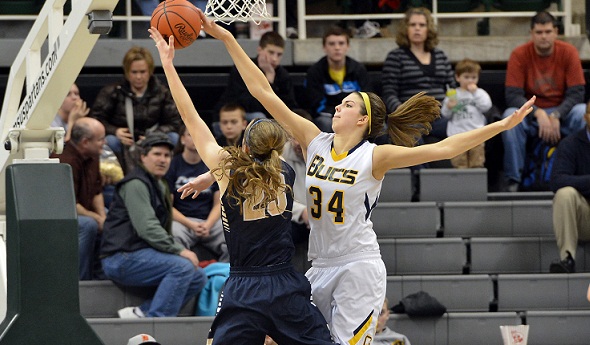
Grand Haven scored the first five points of overtime, including four on back-to-back baskets by Cole. The margin was never closer than three points after that. Cole, who finished third in Miss Basketball voting, was only 2 for 5 with seven points during regulation time. She finished with 11 points, seven rebounds and eight blocks.
“Abby can score inside, but they weren’t just going to let us lob it in,” Kowalczyk-Fulmer said. “She wasn’t going to be able to score 30 points or anything. We just had so many contributions from so many
kids.”
Grand Haven shot 75.9 percent from the field to overcome an otherwise bizarre stat sheet. South took 78 field goal attempts to Grand Haven’s 29 and had only five turnovers while forcing the Bucs into 32.
“Having lost for the second straight year to the same team, obviously it hurts,” South coach Kevin Richards said. “But I just love the way our girls competed. Even at halftime, I like how we played hard. We
had the tempo we wanted. Give Grand Haven credit — they made some plays when they needed to.”
Cole was only Grand Haven’s third-leading scorer in the championship game, as senior Wilkerson shot 8 for 8 while scoring 17 points and junior Taylor Craymer shot 5 for 7 in a 14-point effort.
“Last year we had a lot of talent,” Wilkerson said. “This year a lot of girls stepped up. We worked hard for this one.”
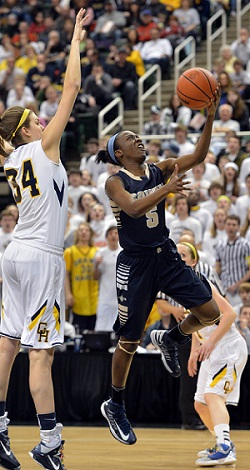
PHOTOS: (Top) Grand Haven's Abby Cole blocks a shot during Saturday's Class A Final; she had eight blocks in the game. (Middle) Grosse Pointe South's Cierra Rice (5) attempts to drive past Cole. (Click to see more at HighSchoolSportsScene.com.)
Breslin Bound: Girls Report Post-Break
January 8, 2014
By Geoff Kimmerly
Second Half editor
If the first month of this MHSAA girls basketball season is an indication, this winter's march to the Class A championship game could be one of the most entertaining we've seen over the last decade.
That's the clearest observation from games played during the holiday break, which included a number of Class A contenders shining against top competition.
Below are 10 teams gathered from all four classes that stuck out over the last two weeks. (Records are based on results reported to the MHSAA Score Center.)
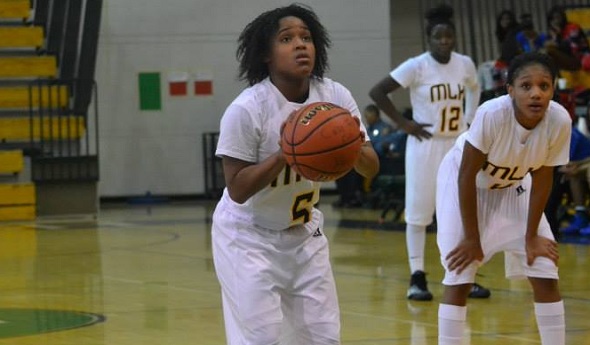
1. Detroit Martin Luther King (6-1, Class A) – The Crusaders appear to be the team to beat again in Class A, thanks in part to a nine-point win over contender Grand Ledge at the Motor City Roundball Classic; the only loss was to Kettering Fairmont from Ohio.
2. Flint Powers Catholic (8-1, Class B) – A 33-point win over strong Flat Rock at the Roundball Classic was further proof the Chargers will be in the mix in March; the only loss was to talented Farmington Hills Mercy.
3. Waterford Kettering (5-0, Class A) – The Captains had a strong December overall, finishing with a 10-point win over Freeland and a 28-pointer over Detroit Renaissance both at the Roundball Classic.
4. Muskegon Mona Shores (5-1, Class A) – After winning nine games last season, Mona Shores is more than halfway there thanks in part to a 45-41 win over reigning Class A champion Grand Haven.
5. Grand Haven (6-1, Class A) – Stars graduate and the Buccaneers keep plugging along (aside from the loss to Mona Shores), with six wins to open the season including a three-pointer over Kent City and a one-pointer over Grand Rapids Forest Hills Central to win the Davenport Invitational.
6. Eben Junction Superior Central (7-1, Class D) – The Cougars didn’t lose last season until the Regional Semifinal, and have lost this season to only Class C Ishpeming after already beating the Hematites on opening night.
7. Williamston (4-1, Class B) – Since opening with a three-point loss to Lansing Everett, the Hornets are undefeated after picking up break wins over Frankenmuth by six and Oak Park by 17.
8. Newberry (4-2, Class C) – The Indians are more than halfway to equaling last season’s win total of seven, with their most recent loss (to Brimley) by only a bucket.
9. Gobles (6-0, Class C) – The Tigers are becoming a girls basketball power to go along with their football prowess, putting together another big start after making their District Final a year ago.
10. Northville (6-0, Class A) – The Mustangs have followed a 16-win season with six more victories including the championship at their holiday tournament thanks to a two-point win over solid Dexter.
PHOTO: Detroit Martin Luther King is playing again like a Class A favorite with a 6-1 start against tough competition. (Photo courtesy of the Detroit Public School League.)