

Despite Torn ACL, Lapeer's Erla Drives On
By
Paul Costanzo
Special for MHSAA.com
February 26, 2020
Hannah Erla was so devastated by the diagnosis, she basically stopped listening.
 The Lapeer senior point guard had torn her ACL, which in her mind meant her final high school season was over after just four games. She wouldn’t be able to lead the Lightning to their first District title since her freshman year. She was done playing for coach Andrew Roberts. She would end her career about 100 points shy of 1,000.
As all this was swirling through Erla’s head, the good news came: she could still play.
“There was maybe a pause, then he said it after,” Erla said. “I was so upset, I wasn’t comprehending what he was saying.”
After Erla processed the news, her next decision was a simple one. She wouldn’t have surgery on her knee until after the season. She would wear a brace, and she would finish her high school career on the court. After talking with more doctors, getting the proper clearances and missing just two games, Erla was back in uniform leading the Lightning.
“What drives me to play is that it’s my last year of high school, and I’ll never be able to play with my friends again, or have Roberts coach me,” she said. “I just want to win a District with my team. … It was immediate. I decided right then that I was going to finish out the season and reach my goals to get 1,000 and try and win a District.”
Erla reached 1,000 points in the waning seconds of Lapeer’s game Feb. 7 against Grand Blanc. The District title is yet to be decided, and Erla still has some work to do to ensure she’s on the court to make that happen.
She has missed the Lightning’s past three games because the swelling in her knee has increased. She plans to be on the court, however, for the regular-season finale Friday at home against Bay City John Glenn, and the postseason which begins March 4 for Lapeer.
Betting against her seems unwise considering what Erla already has overcome. But either way, she’s already provided a shining example for the program.
“Hannah always wants to get into the gym,” Roberts said. “Hannah plays and works hard in the offseason. We ran a summer camp for kids, and I made sure that I stressed that she’s a four-year player because of her, because she has put this extra time in. When you have a walking, living example of that, it holds so much more water than just saying it.”
Roberts took over the Lapeer girls basketball program at the same time Erla was entering it. As a freshman, she wasn’t a starter, but she still managed to earn honorable mention all-Saginaw Valley League recognition. As a sophomore and junior, she earned first-team honors.
 Lapeer, which was 5-13 entering Tuesday’s game against Midland Dow, started this season 3-0, with all three wins coming by double digits. It was early in the fourth game, a 41-39 loss to Davison on Dec. 13, when the Lightning lost its leader. Erla ran toward a Davison player who was bobbling the ball, but as she planted her foot and tried to turn, her knee gave out. Erla said she didn’t hear the pop that players so often recall when tearing their ACL, and she was able to walk on it. The trainer told her she couldn’t return, however.
“Our trainer went out there and knew she was done for that game,” Roberts said. “When they say they’re done, and it’s a knee issue, you tend to think the worst.”
Erla’s tear was described as straight across, and not jagged, which allowed her to get the green light to play with a brace. She returned to action Jan. 7.
“I’m happy, selfishly, to have her,” Roberts said. “But I’ve never seen it done before, so I was pretty apprehensive, because the last thing I wanted to do was hurt her. I was excited to have her, but at the same time very, very nervous. When you start talking to people, there were other situations out there, which kind of eases your mind a little bit. You have to go by what the expert says, not what I think.”
Erla had to adjust to playing with her injury, as she had lost some of her signature explosiveness. Roberts said her strength as a shooter became more prominent.
“I just let things come more naturally rather than before when I tried to do most of the work,” she said. “This time, I just waited for my shot. At first, it was (frustrating) because I wasn’t expecting it. I was expecting to play how it used to be, but then I adjusted and I wasn’t frustrated anymore.”
In 14 games this season, Erla is averaging 12.6 points, three rebounds and 1.2 steals per game. She is also shooting 80 percent from the free throw line.
One of those free throws earned Erla her 1,000th point one month after she returned to action. She said the moment was made more special because of what she had to endure to get there.
“It was a lot of pressure; I was all worked up over it,” Erla said. “After I hit it, I was overwhelmed with emotion and so thankful to reach that goal. I was just beyond happy and overwhelmed with emotion. I didn’t know what to think. I was crying and hugging my teammates.”
After the season ends, and after spring break, Erla said she will have her surgery in early spring. She is still hoping to play basketball at the next level, and Roberts said she has been in contact with several NAIA programs. The most important quality Erla, who holds a 4.1 GPA, said she is looking for is a good engineering program.
Roberts says that whoever signs Erla will be bringing in a great asset.
“I would sign her because right now, she needs to score in high school for us to be successful,” he said. “It might take a year or so, but when you develop her into more of a point guard, you’re going to have a guard who can break a defender down and get into the paint – that's what she does. A healthy Hannah can get into the key at will.”
 Paul Costanzo served as a sportswriter at The Port Huron Times Herald from 2006-15, including three years as lead sportswriter, and prior to that as sports editor at the Hillsdale Daily News from 2005-06. He can be reached at [email protected] with story ideas for Genesee, Lapeer, St. Clair, Sanilac, Huron, Tuscola, Saginaw, Bay, Arenac, Midland and Gladwin counties.
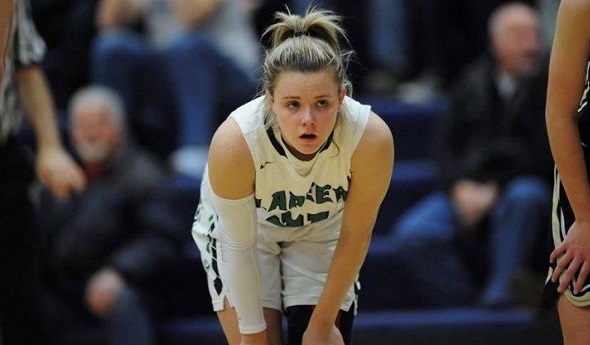
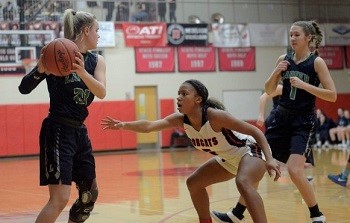
PHOTOS: (Top) Lapeer’s Hannah Erla lines up for a free throw against Bay City Western this season. (Middle) Erla prepares to make her move against Grand Blanc. (Photos by Ross Carithers, courtesy of Hannah Erla.)
Tradition-Rich Kingston Adding to Legacy
By
Paul Costanzo
Special for MHSAA.com
January 31, 2018
Camryn MacGuire remembers watching Kingston varsity basketball games and dreaming about the day she could be on the court.
Evan Neff enjoyed going to games so much as a kid, he kept coming back even after his family moved away for a few years while he was in middle school.
Now both are leading the way for the Cardinals on the court as the Kingston girls and boys basketball teams are inspiring another group of youngsters in their small town.
“I know a lot of little kids come to our games and are huge fans,” said Neff, a sophomore on the boys team. “I know I’ve talked to a couple eighth graders, and they say they can’t wait to play on varsity with me their sophomore year. I think a lot of the littler kids can’t wait to be a part of it.”
Basketball is king in Kingston, and this winter, Cardinals fans have plenty to cheer about. The girls team was 12-0 heading into Wednesday night’s game against Croswell-Lexington, and ranked No. 1 in Class D by the Detroit Free Press and No. 2 by The Associated Press.
The boys started the season on a nine-game winning streak, and are 11-2.
“I think it’s the same thing wherever you’re going to: if you’re winning, if you’re putting a good product out there, you’re going to see a lot of people there,” boys coach Dave Lester said. “In our little town, it seems like everybody is there for the girls games and guys games. We’ve got a great, great student body. Our home games are electric. It’s a fun atmosphere. It’s fun to coach, and it’s gotta be fun to play.
“It’s what high school sports are all about. I think that atmosphere attracts your younger athletes to want to be a part of it. If they’re there and seeing us win, that’s contagious.”
 Lester and girls coach Jay Green have been part of it for the better part of the past three decades, first as players for Kingston and now as coaches.
They played together in the late 1980s, and in Green’s senior year, he helped the boys team reach the MHSAA Quarterfinals.
Green returned to coach the girls team and win four District titles in four years – along with his brother, Dave – during the late 90s. Lester took over the girls program in 2003 and coached the team to the Quarterfinal. The Greens came back to the program in 2011, and Lester took over the boys team midway through the 2013-14 season.
“I think there’s probably a little more passion toward what you do, and what you’re trying to instill into the girls and the boys because you are an alumni,” Jay Green said. “I think both of us could say we were successful alumni in the past. And we both learned under coach Leon Westover when we played, then developed our own ideas, and we have that pride of seeing both the boys and girls doing well.”
Green credits his team’s current success, in part, to the parents in the program, who have taken the time to get their girls to the gym for years and been supportive throughout.
MacGuire agreed.
“My parents, and a bunch of the girls on my team’s parents were always pushing us, and always getting us to play as much as we could,” the point guard said. “They were always telling us that big things were coming. Our starting five is all juniors, and we’ve been playing together since the fourth grade or third grade.”
Kingston’s girls aren’t focused too much on the rankings, or the record, but more on preparing themselves for the postseason. They’ve already scored a win against Class C power Sandusky, and the game against Cros-Lex will provide a test against a strong Class B program. A game against another Class B school, Yale, was postponed because of weather this past Monday.
“I love playing bigger schools,” MacGuire said. “It gives you more competition, and you get to push yourself even more; then it’s even better if you come out with the win. It’s going to benefit us in the tournament.”
Their classmates are providing plenty of support to both teams. MacGuire said there’s been a buzz in the hallways all season, and both she and Neff said their teams make sure to cheer each other on whenever their schedules allow.
 “I never really watched girls basketball until seventh or eighth grade when we moved back to Kingston,” Neff said. “I remember watching those teams, and I was really impressed. My eighth grade year, they had like four or five freshmen on varsity, and I knew they were going to be outstanding. Those girls work really hard, and they’re great athletes.”
“We try to make it to as many (boys) games as we can, even the road games,” MacGuire said. “We support each other both ways. It’s a good atmosphere.”
No Kingston team has ever been beyond the Quarterfinals, but the conference and District championships have piled up through the years. And as dedicated players keep walking into the program, it could just be a matter of time before a group of them breaks through.
“It’s just a tradition here, and our kids know it,” Lester said. “When you walk into our gym, there’s tons and tons of basketball banners. We really talk about tradition and how it would be great to continue that tradition and put up more banners.
“Obviously, we would like to make a long run. At some point, you want to win a state championship, but it’s a process. We’ve got some kids who were playing a lot of basketball, putting a lot of time into it. They want to win, and they want to be a part of that tradition.”
Paul Costanzo served as a sportswriter at The Port Huron Times Herald from 2006-15, including three years as lead sportswriter, and prior to that as sports editor at the Hillsdale Daily News from 2005-06. He can be reached at [email protected] with story ideas for Genesee, Lapeer, St. Clair, Sanilac, Huron, Tuscola, Saginaw, Bay, Arenac, Midland and Gladwin counties.
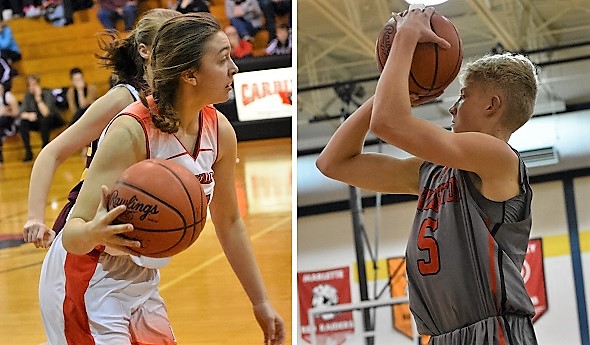
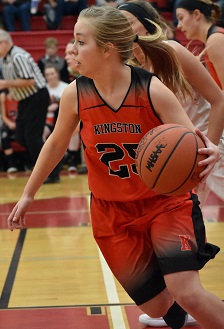
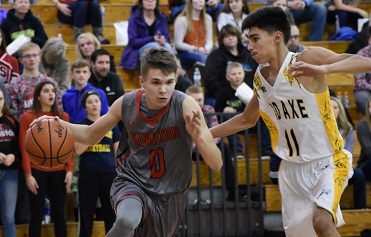
PHOTOS: (Top) Kingston’s Carley Smith, left, pushes the ball upcourt while junior Nathan Cloyd, right, launches a shot. (Middle) Gerilyn Carpenter looks for open teammates during a game this season. (Below) Sophomore Evan Neff works to get around a Bad Axe defender. (Photos by Spot On By Shari.)