

Eaton Rapids Adds to History-Making Run
March 14, 2014
By Geoff Kimmerly
Second Half editor
EAST LANSING – Bailey Baker plans to graduate from Eaton Rapids this spring with 16 varsity letters won in four sports. Like others on her basketball team, she’s had plenty of success on others as well.
But there’s something special about what the Greyhounds have accomplished this week during the longest run in school hoops history.
Eaton Rapids played in its first Class B Semifinal on Friday, and will try for its first MHSAA championship Saturday night after downing reigning runner-up and No. 9-ranked Flint Powers Catholic 46-36 at the Breslin Center.
The Greyhounds – an honorable mention in the final Associated Press Class B poll – have eliminated three top-10 teams during the tournament, including also No. 6 Ypsilanti Arbor Prep in the Quarterfinal and No. 9 Olivet in the District Final. And they continued another impressive postseason streak as well – they’ve beaten all of their playoff opponents by at least 10 points.
“We all have side sports, but this is the one we’re all together,” said Baker, who also next weekend will receive an MHSAA Scholar-Athlete Award. “We’ve wanted this forever, and to finally have this opportunity is amazing.
“Win or lose, it’s going to be my favorite high school memory.”
Eaton Rapids can make this historical run even sweeter by getting past top-ranked and undefeated Grand Rapids South Christian in the Final at 6 p.m. Saturday.
It’s unwise to count the Greyhounds (22-5) out.
They’ve had strong teams during coach Willis Whitmyer’s 15 seasons, but the best usually ran into frequent championship contenders DeWitt, Portland or others down the road.
 Eaton Rapids also is playing with some emotional edge. All five starters are seniors, and there are eight total. Whitmyer said longtime assistant Richard Stoken will be leaving the program after 13 seasons, and Whitmyer said he’s also not sure if he’ll be back next winter.
“We’ve had five teams I thought could’ve gotten here in my tenure, but we found some way to screw it up or the other team took it from us,” Whitmyer said. “This is huge for us. It’s huge for the community. They’re wrapped up in it, and they should be. They’re a huge part of it.”
The latest stunning performance began with a 14-2 run during Friday’s first five minutes. The Greyhounds carried an eight-point lead into the final three minutes of the first half.
But Powers was not to go that quietly, especially with a lineup filled with contributors from last season’s championship game run. The Chargers (23-3) gained a one-point lead heading into the final minute of the third quarter.
It was short-lived. Eaton Rapids senior center Allie Ditmer scored at the buzzer to give the Greyhounds back the advantage, and they never trailed again.
“We battled back, but I think we started to run out of gas a little bit. I think battling back took a toll on us,” Powers coach Thom Staudacher said.
“It definitely hurts. We’re usually on the other end of the stick.”
Eaton Rapids kept Powers’ trio of senior leading scorers to 19 points, down from their combined average of 33 per game. The Greyhounds also outrebounded the Chargers 38-22, thanks in large part to Dittmer’s 14 boards to go with a game-high 15 points.
Baker provided another little surprise as well. A 54-percent free-throw shooter, she connected on 11 of 12 attempts for the majority of her 13 total points.
“Just being a senior, and with how much we wanted it this year, rather than getting me more nervous it made me more calm,” Baker said of going to the line. “I should be taking those free throws. I’m a senior now. I need to have that leadership.”
Powers will graduate six seniors who helped return the program to the state’s elite. Sara Ruhstorfer and sophomore Francesca Coury led Friday with eight points, while senior Michela Coury had 10 rebounds.
Click for a full box score and video from the press conference.
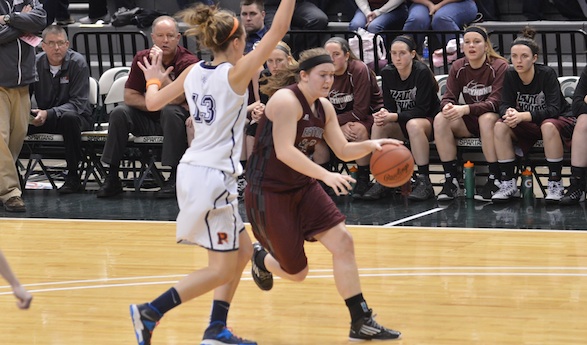
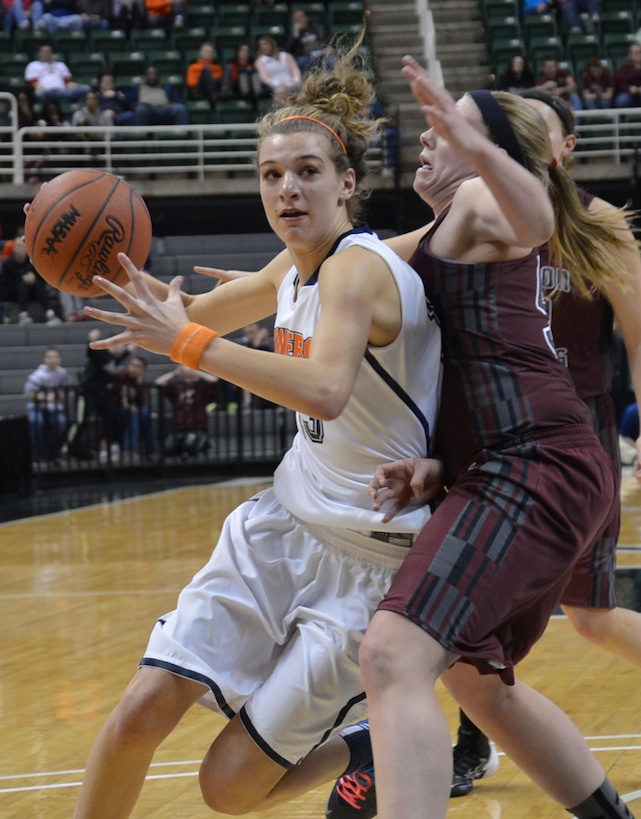
PHOTOS: (Top) Eaton Rapids’ Bailey Baker pushes past Powers’ Michela Coury during Friday’s Semifinal. (Middle) Coury makes her way to the basket despite being defended closely.
HIGHLIGHTS: (1) Flint Powers trailed Eaton Rapids from the beginning of the game until Ally Haran makes a midcourt steal and converts it into a basket to tie the score at 26-26. (2) After her team fell behind in the final minute of the third quarter, Eaton Rapids' Allie Dittmer scores at the buzzer to put the Greyhounds on top to stay against Flint Powers.
Breslin Bound: Girls District Preview
February 24, 2014
By Geoff Kimmerly
Special to Second Half
Nearly 700 girls basketball teams will begin a march this week they hope will end March 15 with an MHSAA championship trophy at Michigan State University's Breslin Center.
District tournaments tip-off all over the state tonight, giving every team an equal start – even though the last three months have given us a decent idea which we might be following to East Lansing next month.
Follow the brackets on MHSAA.com. Below are some of the teams we could see emerge when these three weeks are done.
Class A
Detroit Martin Luther King (17-1) – The Crusaders have been favorites since the fall, with some of their most impressive wins over Grand Ledge and rival Detroit Cass Tech. King won the Detroit Public School League tournament championship again this month, with its only loss to Ohio’s Kettering Fairmont in December. Miss Basketball candidate Marte Grays dominates the middle at 6-foot-2.
Farmington Hills Mercy (19-1) – Mercy gets the slight nod above Bloomfield Hills Marian out of the Detroit Catholic League after avenging an earlier overtime loss to Marian with a one-point win in the league tournament championship game. Mercy finished the regular season with a three-point victory over reigning Class B champion Goodrich, and also beat reigning B runner-up Flint Powers earlier this season.
Grand Ledge (18-2) – The Comets should be a slight favorite to emerge from an incredibly-strong mid-Michigan Class A group that includes contenders Haslett, DeWitt and Holt. The lone losses were to Detroit King and while missing one of their top players against DeWitt on opening night. However, Richland Gull Lake (18-1) will be a tough obstacle in the District.
Grosse Pointe South (18-1) – The Class A runner-up the last two seasons, South is undefeated in Michigan this winter; the Blue Devils' lone loss was by a bucket to Illinois’ Crete Monee in December. Only two teams – Canton and league opponent Utica Ford – have gotten within single digits since the calendar turned to 2014. The best win so far might’ve been against Farmington Hills Harrison, which finished 17-3.
Class B
Detroit Country Day (17-1) – Given their longtime record of success, it’s tough to believe the Yellowjackets haven’t played in an MHSAA championship game since 2010. This could be the season for a return – a 16-point loss to Ypsilanti Arbor two weeks ago hurt, but a number of solid wins seems to indicate Country Day could still be there at the end of March. Point guard Asia Doss is a Miss Basketball finalist.
Flint Powers Catholic (17-2) – Last season’s MHSAA runner-up showed signs it was on the way back up with a junior-loaded lineup that maybe wasn’t expected at that point to reach the final game of the season. The Chargers have met much higher expectations this winter, even despite a late loss last week to Class C Saginaw Nouvel. Powers won its mostly Class A league, a good prep for what should be a competitive District.
Goodrich (18-2) – The Class B champion the last two seasons, Goodrich might be the favorite again with its only losses to Class A powers Haslett and Farmington Hills Mercy (see above). Only two other teams have gotten within single digits – Freeland and Class A Detroit Cass Tech – and Goodrich owns another solid win over Class B contender Ypsilanti Arbor Prep.
Grand Rapids South Christian – An MHSAA Semifinalist a season ago, South Christian has looked even stronger this winter, with only a few schools including league rivals Grand Rapids Catholic Central and Wayland giving the Sailors much of a challenge. They shouldn’t have too much trouble this week, although the Regional could include GRCC and Holland Christian – the latter looking for a rematch after falling to South Christian by only three in early January.
Class C
Blissfield (17-0) – The Royals have upped their collective game after winning a District title in 2013 despite finishing third in the Lenawee County Athletic Association. This season, they’re league champs and in a District with three teams they beat by double digits during the regular season. They’ll be favored through the Regional as well, although they could run into reigning champ Manchester.
Flint Hamady (20-0) – Hamady is looking to get back to an MHSAA championship game for the first time since winning Class C back-to-back in 2009-10. So far, so good; only Class A Davison and Flint Carman-Ainsworth and Genesee Area Conference Blue rival New Lothrop got within single digits of the Hawks during the regular season. Four of six opponents in the District also are from the GAC Blue.
Saginaw Nouvel (15-5) – Don’t judge this one by record alone. Last season’s MHSAA runner-up played one of the toughest schedules among Class C contenders. Four losses were to Class A Haslett and Class B Midland Bullock Creek, Flint Powers Catholic and Detroit Country Day – all four of those could be in the conversation for MHSAA titles in their respective classes – and the fifth loss was to Indiana’s South Bend St. Joseph. Class C contender Reese and strong Class A Midland were among those Nouvel toppled this month.
St. Ignace (18-2) – A regular at Breslin Center, St. Ignace could be back despite moving back into Class C after winning the Class D championship in 2013. The Saints once again mixed in a good share of competition from downstate, falling to Reese but beating Detroit Renaissance, and Petoskey twice, among others. The Regional could provide some challenges, but St. Ignace should be up to them again as it pursues its fifth straight Semifinal trip.
Class D
Athens (17-3) – The Indians play in one of the state’s most competitive small-school leagues, the Big 8 Conference, and have made the Class D Quarterfinals the last three seasons and the Semifinals the last two while finishing MHSAA runner-up in 2011-12. All three of their losses were to Class C teams – Concord, Reading and Mendon – that could make noise in that class. Athens then won rematches against Concord and Reading.
Frankfort (19-1) – This could be Frankfort’s best since its back-to-back MHSAA championship teams of 2005-06. The Panthers have improved from 13-10 last season, with their only loss this winter to undefeated Class B contender Manistee. They’ve had a few more close games than other favorites, but that can be a good thing – Frankfort staved off Class C Traverse City St. Francis to win by four, Class B Kingsley to win by six and Class A Romulus also to win by four. The Panthers then beat Kingsley by 22 in their rematch.
Crystal Falls Forest Park (20-0) – The Trojans are attempting to finish an impressive three-season run that’s included two Regional titles and an MHSAA Semifinal appearance. No opponent has come within 20 points of Forest Park this season. Guard Lexi Gussert caught the state’s attention with 34 points in that Semifinal loss in 2012 and has scored more than 2,400 points during a career that’s made her a Miss Basketball finalist.
Posen (20-0) – The Vikings hope to ride their second straight perfect regular season past the Regional Final, where they fell last season to eventual MHSAA champion St. Ignace. Only Lincoln Alcona on opening night has come within single digits of Posen, and the Vikings bested Alcona by 13 in their rematch this month.
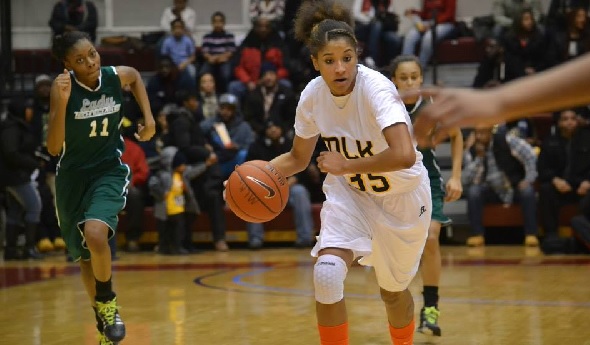
PHOTO: Detroit Martin Luther King's Marte Grays (35) pushes the ball upcourt during the Detroit Public School League tournament championship game win over Detroit Cass Tech. (Photo courtesy of the Detroit Public School League.)