


Girls Basketball Finals Returning to Breslin
September 30, 2019
By Geoff Kimmerly
Second Half editor
The Michigan High School Athletic Association’s Girls Basketball Semifinals and Finals weekend could return to the Breslin Student Events Center as quickly as this upcoming 2019-20 season, with Michigan State University hosting the event this winter and in future seasons when the Spartans women’s basketball team is not selected as an opening-round host for the NCAA Tournament.
Breslin hosted the Girls Basketball Semifinals and Finals from 2004-06 and 2010-17. However, the potential for a conflict with the NCAA Division I Women’s Basketball Tournament led to the MHSAA moving the event for the past two seasons. The NCAA awards top-four seeded teams an opportunity to host the first two rounds of its Division I tournament, and the NCAA event falls almost annually on the traditional dates of the MHSAA girls basketball championship weekend – setting up the possible conflict of both events being scheduled to play at Breslin at the same time.
During an initial three-year contract beginning this winter, Breslin tentatively will be the host of the MHSAA Girls Basketball Semifinals and Finals. If, beginning in 2021, the Spartans are seeded fourth or higher for the NCAA Tournament and selected to host first and second rounds, the MHSAA Girls Semifinals and Finals will be played at Read Fieldhouse’s University Arena on the campus of Western Michigan University. Hope College’s DeVos Fieldhouse in Holland will serve as the alternative site if Breslin is not available in 2020, as Read is hosting the Mid-American Conference Gymnastics Championships during the weekend of the MHSAA Girls Semifinals and Finals.
“We are thankful for the graciousness of all parties involved to allow for this opportunity to bring the Girls Basketball Semifinals and Finals back to the Breslin Center,” MHSAA Executive Director Mark Uyl said. “From the Breslin Center staff, to coach Suzy Merchant and the MSU women’s basketball program, to MSU law enforcement, ticketing and hospitality and then Western Michigan and Hope College and their facilities people for agreeing to reserve their arenas for us in case it’s needed – this agreement happens only because of the immense cooperation by everyone involved.”
The MHSAA Girls Basketball Semifinals will be played this upcoming season March 19-20, 2020, with all four championship games March 21. The NCAA Division I Women’s Basketball Tournament’s opening weekend is March 20-23, with the bracket and seeds to be announced Monday, March 16.
The MHSAA Boys Basketball Semifinals and Finals traditionally are played at the Breslin Center the following weekend, this upcoming season March 26-28. All games for the NCAA Men’s Basketball Tournament are played at neutral sites, and there is no possible conflict between the two events.
Read Fieldhouse, home to Broncos teams including the women’s and men’s basketball programs, unveiled a new basketball court at the start of the 2015-16 season among a variety of improvements to the facility over the last five years. The MHSAA Girls Basketball Finals were played at Read from 1983-85, and WMU also hosted the MHSAA Girls Volleyball Finals from 1996 through the 2007 winter season, the last before the MHSAA season for the sport moved to the fall.
DeVos Fieldhouse, the 2020 provisional site, is home to Hope’s hoops teams among other athletic programs and previously hosted the 2013 NCAA Division III Women’s Basketball Final Four.
Thompson Erases Doubt, Makes History
By
Paul Costanzo
Special for MHSAA.com
February 14, 2017
 When Jacara Thompson tore the anterior cruciate ligament in her left knee this past summer, she thought she was done playing basketball.
The fact it was the second torn ACL of her high school career, along with the timing of the injury, had the Swartz Creek superstar doubting her future.
“I thought I wasn’t going to play basketball anymore,” Thompson said. “This is my second knee blowout and I need to be done – that was my first thought. I was going to miss my whole senior year, and that was really hard.”
Thompson proved her initial thoughts wrong, however, and is back on the court making history. Recently, she broke a school record that had stood since 1979, setting the all-time mark for scoring at Swartz Creek. She had scored 1,179 career points through Feb. 10, now well ahead of the former mark of 1,087.
“I don’t even know how to explain it,” Thompson said of setting the record. “Nobody in my family has ever broken a big record like that or anything. It really didn’t hit me until people started telling me congratulations.”
Those congratulations would have been well deserved for any player hitting that mark. For those who have watched Thompson overcome two major knee surgeries and break the record despite missing 17 games, the moment was even more special.
“I was extremely proud,” Swartz Creek girls basketball coach Adrian Trzebiatowski said. “As a player, you have a tremendous amount of respect for anyone that achieves that goal. As a coach, to see a young woman grow up, to blossom, to develop into a very good basketball player and an amazing person, it is an extreme sense of pride and admiration for what she’s gone through.”
It was in Trzebiatowski’s second season at Swartz Creek that Thompson entered high school, and the slashing guard was making an impact on the varsity team as a freshman. But her debut lasted only six games as Thompson’s first torn ACL, in her right knee, came early in her career.
She came back with a strong sophomore campaign, and as a junior joined the state’s elite, averaging 25 points per game and totaling 501. She was named Class A all-state second-team by The Associated Press.
“Early in her career she was a slasher – she could take a bump or two or three and still get to the basket,” Trzebiatowski said. “Last year we really committed to lifting weights, and she could finish with contact. She was able to get herself to the line and finish layups. I wish there was a stat column for how many and-ones she has. She was a strong player who could really plow and weave her way to the basket.”
Thompson also was developing a stronger mid-range game and working on her outside shot to keep defenders even more off-balance. Before she could showcase her advancing skills and build on the momentum of her junior season, she suffered her second ACL tear.
While an initial doubt she could return again was in her own mind, it was something her coach never saw.
“She knew how to rehab, and knew what she had to do to get back,” Trzebiatowski said. “As far as mental toughness, Jacara overcoming this is probably one of the toughest athletes I’ll ever coach.”
As Thompson worked her way back again, she said it was her Swartz Creek teammates who helped her get to the right place mentally.
 “I finally got over it when I started to practice with my team,” Thompson said. “I couldn’t scrimmage with them, but they made me feel even better, that you’re going to be even stronger when you come back.”
Trzebiatowski said the team had to learn to play without Thompson over the summer, but despite that, Thompson’s impact on the young Dragons squad remained strong.
“Everybody looked at her as a leader, but I don’t think she’s always felt that way until this year,” Trzebiatowski said. “When we actually voted for team captains, the team decided before we even voted that Jacara would unanimously receive the vote for team captain. That’s never happened to me.”
Thompson missed the first two games of the season, but has come back strong. She’s averaging 17 points per game and has now added a more dangerous 3-point shot to her repertoire, something she said already has caused opposing defenders to take notice.
“I kind of always knew I had to get better at it,” she said. “Shooting wasn’t really my big thing. I always loved driving and getting to the basket and to the free throw line, but I knew I had to add an outside game. I feel like (defenders) look for me to go the basket every time, but now that I have an outside shot, they’re going to have to check me. They’ve caught on. They call me a shooter now.”
She said she feels like her old self now, although it took a while to get there.
“I’d say probably about 90 percent of it is mental, really,” Thompson said. “Because you have to think about what move am I going to do? Am I going to tear my ACL again? You think about every move you do when you’ve been through two ACL surgeries.”
Thompson is undecided on her basketball future, but said she wants to play at the college level. Her injuries have helped her to focus on her off-court future, however. No matter where basketball takes her, Thompson wants to study to become a physical therapist.
“I had always thought about going overseas and even trying to make it to the WNBA,” she said. “I don’t think I want that anymore. I want to do something to help people with ACL injuries.”
 Paul Costanzo served as a sportswriter at The Port Huron Times Herald from 2006-15, including three years as lead sportswriter, and prior to that as sports editor at the Hillsdale Daily News from 2005-06. He can be reached at [email protected] with story ideas for Genesee, Lapeer, St. Clair, Sanilac, Huron, Tuscola, Saginaw, Bay, Arenac, Midland and Gladwin counties.
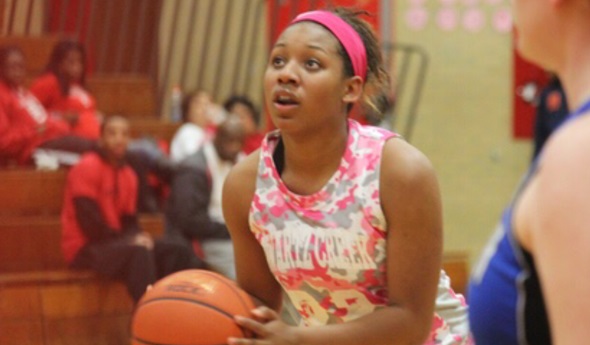
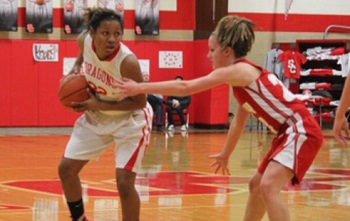
PHOTOS: (Top) Swartz Creek's Jacara Thompson prepares to shoot a free throw. (Middle) Thompson, back this season after multiple knee surgeries during her career, looks to get past a defender. (Photos courtesy of the Swartz Creek girls basketball program.)