

Plan Plays Out Well for Cousino Standout
By
Tom Markowski
Special for Second Half
December 1, 2016
WARREN – As a teacher at Carter Middle School, Mike Lee, the varsity girls basketball coach at Warren Cousino, was approached by one of his students who made a rather boisterous statement.
 “There was this girl,” Lee said. “She was in the sixth grade and she came up to me and said, ‘I’m going to play for you as a freshman.’ No, I didn’t believe her. She was long, but she was a bean pole.”
Intrigued, Lee went to watch this skinny 10-year-old play and was impressed but not yet sold.
This girl is now one of the state’s best basketball players. Her name is Kierra Fletcher, and she won the hearts of everyone in the Warren Consolidated School system – which includes high schools Cousino, Mott and Sterling Heights – by leading the Patriots, and the Warren district as a whole, to their first girls MHSAA Finals basketball title.
By the time Fletcher was in the eighth grade, Lee knew Fletcher’s bold statement would come to fruition. She was that good.
“She was still skinny,” Lee said. “It wasn’t until her junior year that she bulked up.
“Obviously, she’s talented. I am pretty lucky to have someone like Fletch. But it’s what she does for the other players that makes her special. She makes them better. She puts them in spots to succeed. They want to play faster. There’s a higher energy. On the defensive side, you know she’s out there, getting steals and such. The others feed off of her.”
Fletcher, 16, is 5-foot-9 and a bundle of energy. And that energy was there from the start.
“I was out in (first grade) early,” Fletcher said. “My mom said I was talking all of the time. The teachers (in preschool) told her I was way ahead of the other kids.”
Born and raised in Detroit, Fletcher attended Dove Academy until the third grade, when her family moved to Warren. She attended Siersma Elementary within the Warren Consolidated district and then went to Carter.
Fletcher was also ahead of the curve when it came to basketball. She started playing competitively in the Warren recreation leagues, but before that she got the itch playing in her grandmother’s driveway.
“She had a basket in her backyard,” Fletcher said. “I would play by myself, and sometimes I’d play with an older cousin and my dad (Anthony Fletcher). My dad used to be really good. He played in college and he could have gone pro, but he had a bad heart and had to stop playing.”
Fletcher began playing AAU basketball in the fifth grade. It took less than a week for the coaches to move Fletcher up to play with the sixth grade team. That was nothing new for her. And she said it’s one reason why she continued to improve.
“I had been playing up for a while,” she said. “I always played with older kids. They had more experience, and I learned from it. What I learned was it doesn’t matter how old or how big you are. I’d play well and they wouldn’t know I was younger, and they’d tell me to keep playing and that made me feel good.”
 Fletcher was on the bench for her first varsity game as a freshman, but she didn’t stay there long. Lee put her in the game in the first quarter, much to Fletcher’s surprise.
“I’ll never forget it,” she said. “It was against Romeo, and it was our home opener. I was nervous. I didn’t want to mess up.”
That nervousness and her coming off the bench didn’t last long. Soon she was in the starting lineup gaining more confidence as the season progressed.
As a sophomore she was one of the top players in the Detroit area, as she averaged 25 points and 12 rebounds per game. That fine season placed her in at least one publication’s 2015-16 preseason top 25 (State Champs! ranked her No. 14), and soon everyone who followed the sport knew about her.
Fletcher averaged 23 points, 10 rebounds, 9.4 assists and 5.5 steals as Cousino (23-4) made its run on the way to eventually defeating Detroit Martin Luther King, 67-65, in the Class A Final to complete a remarkable season for the Patriots and Fletcher.
Fletcher saved her best for last, as she had 37 points, nine rebounds and five assists in the Semifinal (a 60-45 win over Hudsonville), and had 27 points, eight rebounds and five assists against King.
“I love to compete,” she said. “I love the friendships. I’ve met a lot of people playing basketball. Sports teaches you discipline, in the way you live life. Sports has a way of bringing people together.”
Fletcher turned down a number of other college scholarship offers, including one from University of Michigan, to sign with Georgia Tech. She has a 3.7 grade-point average and plans on majoring in public policy and working for the U.S. Government.
“I also have aspirations of playing professionally,” she said. “Overseas or in the WNBA.”
 Tom Markowski is a columnist and directs website coverage for the State Champs! Sports Network. He previously covered primarily high school sports for the The Detroit News from 1984-2014, focusing on the Detroit area and contributing to statewide coverage of football and basketball. Contact him at [email protected] with story ideas for Oakland, Macomb and Wayne counties.
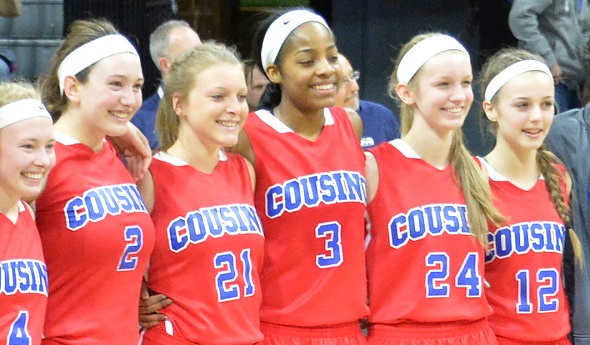
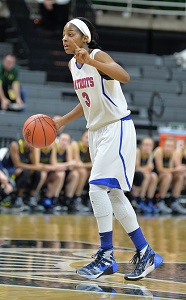
PHOTOS: (Top) Kierra Fletcher (3) poses for a photo with her teammates after Warren Cousino won last season’s Class A championship. (Middle) Fletcher brings the ball up the court during her team’s Semifinal win over Hudsonville.
Breslin Bound: Girls Report Week 1
December 9, 2013
By Geoff Kimmerly
Second Half editor
Just like that, fall is done – and so is the first week of MHSAA girls basketball season.
“Breslin Bound” also is back, giving fans a quick lowdown each week on 10 teams that impressed me over the seven days prior.
What’s below isn’t a statewide ranking by any means – simply a top-10 list of notables that stuck out last week and a little info on each as we start the yearly quest to learn more about the teams we’ll be watching most when our tournament begins during the final week of February.
This week’s list (records/results based on those submitted on MHSAA.com):
1. DeWitt (2-0, Class A): The Panthers are expected to do big things this winter again, but may not have been expected to beat Grand Ledge 62-51; the Comets are considered a Class A championship contender.
2. Marquette (3-0, Class A): The Redettes are building off last season’s fine finish with another quick start that included wins over downstate Brighton and U.P. power St. Ignace at Petoskey’s Invitational.
3. Midland Bullock Creek (2-0, Class B): The Lancers have had an excellent run in girls basketball over the last decade, and it’s looking good to continue after a 10-point win over Saginaw Nouvel and a 12-pointer over Frankenmuth to open 2013-14.
4. Farmington Hills Mercy (2-0, Class A): The Marlins always are in the hunt, but another 2-0 start was noteworthy because it included avenging last season’s loss to Canton.
5. Eaton Rapids (2-0, Class B): The Greyhounds opened by beating potential Class A power Haslett by 13 and followed with a five-point win over solid Corunna.
6. Olivet (2-0, Class B): The Eagles long have been a girls basketball power, but rarely have opened with and beaten a Class A team like Lansing Waverly, which went on to finish the week with a win over frequent contender East Lansing.
7. Frankfort (2-0, Class D): A quick start for the Panthers included a 42-38 likely-to-be-considered upset of solid Class C Traverse City St. Francis.
8. Reese (2-0, Class C): The Rockets restarted after last season’s 23-1 finish with wins over traditionally strong Class B Frankenmuth and Millington.
9. Rock Mid Peninsula (2-0, Class D): The Wolverines won six games in 2012-13, but opened with a 38-point victory over Rapid River and an eight-pointer over Carney-Nadeau.
10. Warren Mott (3-0, Class A): The Marauders are nearly halfway to last season’s eight wins thanks to three quick victories during the first week.
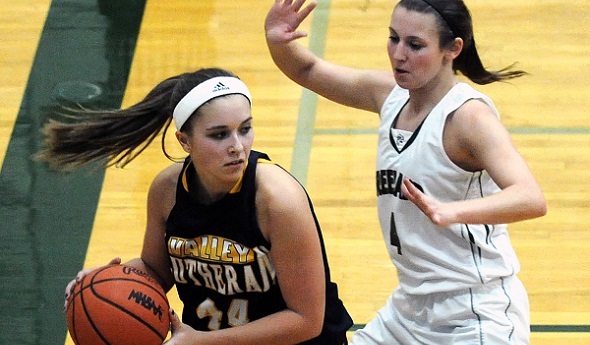
PHOTO: A Saginaw Valley Lutheran player (left) looks to pass around a Freeland defender during the Falcons' win last week. (Click to see more at HighSchoolSportsScene.com.)