

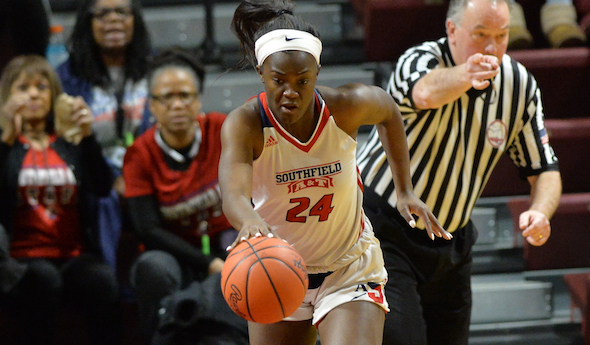
Southfield Leads Fast, Holds On to Lead Last
March 22, 2019
By Geoff Kimmerly
Second Half editor
GRAND RAPIDS – Give Muskegon a ton of credit. After 11 minutes Thursday, it’s Division 1 Semifinal at Van Noord Arena was all but over.
And Southfield Arts & Technology knew the feeling.
Two years ago, the Warriors found themselves down 20 points in the third quarter of their Semifinal against East Kentwood. They pulled all the way back to within two of the lead before ultimately losing to the Falcons by four.
This time, Southfield A&T got up 18 points three minutes into the second quarter at Van Noord Arena. But while Muskegon charged back to within two of the lead with 53 seconds to play, the Warriors prevailed 54-50 to earn their first championship game berth.
“Being (at the Semifinals) before, it helped me keep my composure and mentally stay in it. Because two years ago, we were down by a lot at the half, and we had to come back with the same fight that Muskegon tried to put against us,” A&T junior guard Cheyenne McEvans said. “I understand what Muskegon was trying to do, and how East Kentwood held us off is how we had to hold them off from coming back.
“We hung on at the end because we just wanted it, and we all just had to talk to each other and keep each other in the game. I try to take really good pride in keeping my teammates involved mentally, and keep their heads up. So I just told them, the run that they’re going on, we’ve just got to hold it – hold it together to the end of the game.”
The Warriors (24-1) will face Saginaw Heritage in Saturday’s 12:15 p.m. championship game, seeking the first title for the 3-year-old school and also the first for one of the schools that merged to create A&T since Southfield Lathrup’s 2005 Class A win.
Neither team Thursday scored for nearly the first three minutes. But once the Warriors got started, they put up nine straight points over 80 seconds. During the second quarter, they connected on 64 percent of their shots from the floor to carry a 29-13 lead into halftime.
 But the Big Reds – making their first Semifinal appearance – began to show signs of revival. They had missed their first 13 shots and 18 of 19 on the way to the 21-3 deficit. But beginning with senior Alyza Winston’s basket with 4:30 to play in the first half, Muskegon made 44 percent of its shots from the floor the rest of the way.
“We’re really a second-half team, if you look at the Regional games, the District games, we came out second half with a whole different energy,” Winston said. “That’s really just us.
“I feel like this game we just needed it more in the first half than we had it, but that’s normal for us.”
A&T still led 44-31 with a quarter to play. Muskegon junior guard De’shonna Day’s basket with seven minutes to play made the deficit single digits again at 44-35. That started a 17-8 run, and a Day 3-pointer pulled the Big Reds to within 52-50 with 53 seconds to play.
Muskegon (21-5) got the ball back on a jumpball. But A&T did hold on – two more times. First junior center Jasmine Worthy blocked off the lane to force a travel as the Big Reds looked to tie. After senior Soleil Barnes made two free throws with six seconds left to push the lead back to four, the Warriors got a steal to end the game.
“Having been to the final four, and won a championship before, I know defense is really going to make a difference,” said A&T coach Michele Marshall, who led the Lathrup title run. “You can score a ton of points, but ultimately you’re going to have to get some stops.
“When we play defense the way we did in that last possession, it becomes very difficult to get easy shots, and all we’re trying to do is make the most difficult shot with our defense.”
Senior forward Alexis Johnson led A&T with 18 points and 12 rebounds, while McEvans and Barnes both finished with 12 points. Sophomore guard Kayiona Willis had five assists.
Winston, a Miss Basketball Award finalist this season, finished with 25 points, and Day had 13 and seven rebounds. Senior center Nia Miskel grabbed 10 rebounds.
Now A&T gets the rare opportunity to avenge its lone defeat. The Warriors fell to Heritage 45-43 on Dec. 8 at the Ypsilanti Arbor Prep Icebreaker Invitational.
“I feel like this is the game we can use to cross out our record, if we can get this win,” Johnson said. “We want to come out with a clean record and we feel we’re number one in the state, and this game will prove it.”
PHOTOS: (Top) Southfield Arts & Technology’s Alexis Johnson pushes the ball upcourt during Friday’s Division 1 Semifinal win over Muskegon. (Middle) The Big Reds’ De’shonna Day moves the ball around the perimeter.
Breslin Bound: Girls Report Week 6
January 14, 2014
By Geoff Kimmerly
Second Half editor
By the end of this week, we'll have reached the midpoint of this girls basketball regular season.
But plenty of teams are showing they might just be warming up for a much longer run this winter.
Below are 10 that impressed last week, including a handful which have made it through the season's first month and a half without a loss. (Records are based on results reported to the MHSAA Score Center.)
1. Hemlock (8-0, Class C) – After winning a respectable 12 games last season, Hemlock has dominated this winter and already beaten reigning Tri-Valley Conference Central champion Freeland.
2. Holt (8-0, Class A) – The Rams have consistently piled up wins for more than a decade, but often in the shadow of rival East Lansing; a 12-point win over the Trojans last week has helped Holt look like another Lansing-area contender.
3. Charlotte (6-0, Class B) – The Orioles, who finished a game over .500 in 2012-13, proved their perfect start is for real with a two-point win over rival and mid-Michigan power Eaton Rapids on Friday.
4. St. Louis (8-0, Class C) – Volleyball usually is the Sharks’ best game, but they finished tied for third in TVC West hoops last season and have a one-game lead this time thanks to an 18-point win over second-place Carrollton last month.
5. Haslett (6-1, Class A) – Quietly the Vikings also are looking like a team to watch in Class A, although an 11-point win over rival DeWitt on Friday rang loudly.
6. Cadillac (7-1, Class B) – Only a four-point loss to Manistee on the season’s second Friday has kept the Big North Conference-leading Vikings from a perfect start.
7. Midland Dow (8-1, Class A) – Since a four-point loss to Saginaw Heritage before holiday break, Dow has won five straight by an average of 17 points per.
8. Gaylord St. Mary (6-1, Class D) – The Snowbirds are returning to their former roost as a Class D power, with their lone flaw this winter a loss to Mount Pleasant Sacred Heart.
9. Negaunee (5-3, Class C) – After a 1-3 start, the Miners have won four straight to rise to the top of the Mid-Peninsula Athletic Conference.
10. Grand Rapids Covenant Christian (7-2, Class C) – A 1-2 start is a distant memory thanks to six straight wins including handing the first defeat to league foe Kentwood Grand River Prep.
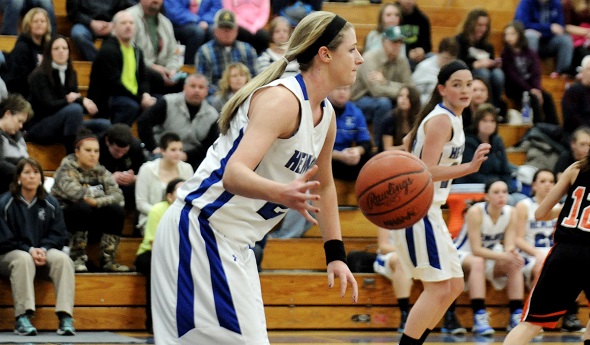
PHOTO: Hemlock defeated league foe Alma last week to improve to 8-0 overall this season. (Click to see more at HighSchoolSportsScene.com.)