

Young Yellowjackets Advance in Class B
March 20, 2015
By Geoff Kimmerly
Second Half editor
EAST LANSING – Frank Orlando considered the question for a few seconds Friday and mentioned his 2003 Detroit Country Day team – and the three players next to him, who were toddlers then, all started to giggle.
“They say I’m old as dirt,” Orlando said, and then referred to sophomore Destiny Pitts. “And she’s right, too.”
The question: Is this the youngest team Orlando has coached in 34 seasons? With five freshmen, three sophomores and only two seniors, the answer is yes, younger than the junior-dominated squad that won Class B in 2003.
But on Saturday, it also can join his best.
A near-perfect shooting performance in the first half of Friday’s Class B Semifinal helped Country Day break away and earn a championship opportunity with a 69-39 win over No. 2 Goodrich, the highest-ranked team left in the field.
“We came here as a team together, for one mission only, to win today,” Country Day freshman Kaela Webb said. “Besides the bright lights and the stage that we were playing on, we had to stick together. And we were stressing that in the locker room when we first got here too.”
Country Day (21-4) will play in its 15th MHSAA Final, seeking its 11th title but first since 2009, when it faces Haslett in the day’s last game at 6 p.m.
The Yellowjackets played like a veteran team against Goodrich (25-2), the back-to-back champion in 2012 and 2013.
Yes, Orlando said this is his youngest team. But he said it's also one of the best defensively that he’s coached.
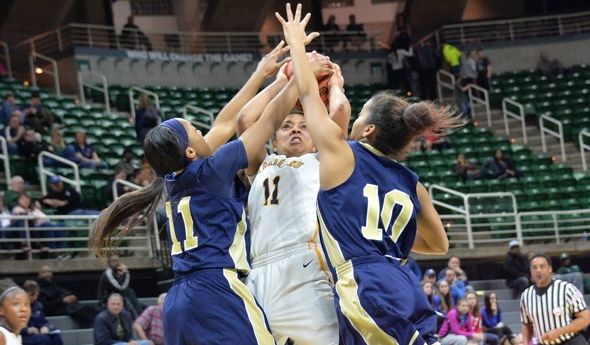
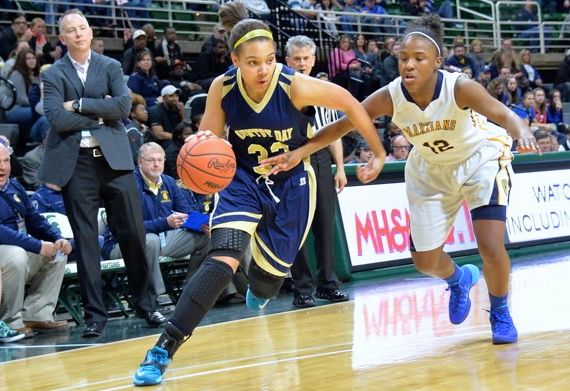 The Yellowjackets were giving up 34 points per game heading into Friday. They allowed junior guard Alexis Sevillian 18 points and senior guard and Miss Basketball Award winner Tania Davis 12. But they held the Martians to 30 percent shooting total and outrebounded them 40-25.
“The maturity I’ve seen in this team is one of the best improvements I’ve seen in my tenure at Country Day,” Orlando said. “They’ve come from 14-year-olds who haven’t played to playing at a level of expertise. I’m so proud of them and their maturity that’s now taken place. I guess you would say it’s a nice time for it.”
Orlando went on to explain that even when teams aren’t scoring, they can compete with good defense. But the Yellowjackets didn’t face that scenario Friday.
They made 50 percent of their shots during the first half, including all six 3-point tries, and finished shooting 44 percent for the game and 50 percent from beyond the arc.
Country Day used a 13-3 run to start the second quarter and build a 15-point lead, and an 11-4 run over the final three minutes of the third quarter to regain a comfortable advantage after Goodrich had pulled within six points at 35-29.
“We joked at halftime that if they don’t miss any tonight, there’s nothing we can do. … For me, it was comforting knowing they could not play this well again in the second half,” Goodrich coach Jason Gray said. “(But) we got tired. They’ve got a lot of athletes, and we just couldn’t put together that run we needed in the second half. “
Pitts finished with 28 points, including six 3-pointers, and grabbed 10 rebounds. Senior Jordan Wright added 11 points and 10 rebounds, and Webb had 10 points, three assists and three steals.
Davis finished as a four-year starter for Goodrich and was the team’s leading scorer in its 2013 Class B Final win. She’ll continue her career next season at the University of Iowa.
“Coming into freshman year, I never thought I’d be here at Breslin three times, never thought I’d win Class B Player of the Year (from The Associated Press) two years in a row, never though I’d be Miss Basketball,” Davis said. “It’s been unbelievable. It’s been unthinkable. It’s been my dream, coming up, pretty much.”
Click for the full box score and video from the press conference.
PHOTOS: (Top) Jordan Wright (11) and Arika Tolbert (10) block the shot of Goodrich’s Alexis Sevillian during Friday’s Semifinal. (Middle) Country Day’s Destiny Pitts works to drive around Goodrich’s Ciya Hawkins.
Focused on Finish, West Bloomfield Completes Run to Reign Again
By
Keith Dunlap
Special for MHSAA.com
March 23, 2024
EAST LANSING — Following Friday’s overtime Semifinal win over Rockford – a rematch of last season’s Division 1 championship game – many may have thought West Bloomfield already had clinched this year’s title.
But the deciding matchup with Grand Blanc still loomed Saturday, and trying to get over Friday’s emotional high was a bit of a task for the Lakers.
“A little bit,” West Bloomfield senior Summer Davis said. “But we came here for one goal, and that was to win a state championship. I think everybody got that.”
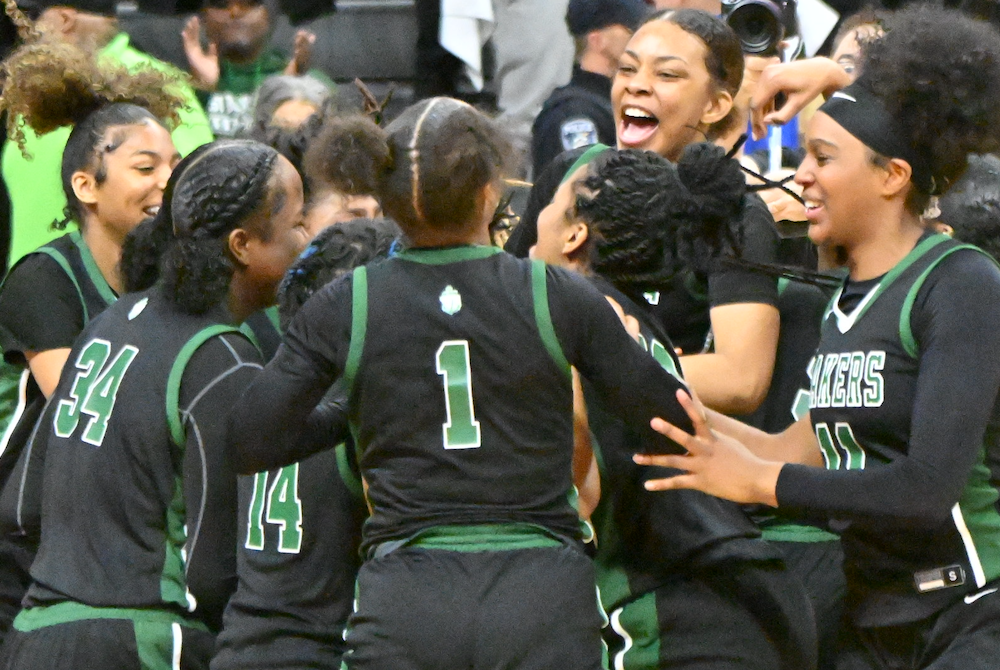
 West Bloomfield left no doubt that there wouldn’t be a letdown from the start Saturday, holding Grand Blanc to just one point in the first quarter and ultimately cruising to a 60-30 win.
It was the second championship in three years for the Lakers, who finished a mission that began following a tough loss to Rockford in last year’s championship game.
The Lakers finished this season 27-1, unbeaten in Michigan with their only loss to an Ohio opponent.
“I couldn’t be more proud of our players,” West Bloomfield head coach Darrin McAllister said. “I’m super proud of our seniors. I’ve had them since they were sophomores. I kind of watched them grow up. They turned out to be two-time champions today, and I couldn’t be more proud of them.”
West Bloomfield wouldn’t have been in the title game if not for senior Indya Davis banking in a 3-pointer at the regulation buzzer Friday, forcing overtime in the Lakers’ eventual 55-47 win over the Rams.
West Bloomfield continued to roll right into Saturday, scoring the first 10 points against the Bobcats and ultimately leading 15-1 going into the second quarter.
 “We had to have the mentality coming out of ‘don’t underestimate them,’” Summer Davis said. “Just play hard.”
The Lakers built their lead to 33-17 by halftime, and then all but put the game away outscoring Grand Blanc 18-8 in the third quarter and taking a 51-25 lead into the fourth.
The game was a rematch of a regular-season finale between the teams, which West Bloomfield won by 39 points.
Summer Davis scored 14 points, senior Kendall Hendrix had 13 and Indya Davis had 11 points and eight rebounds for West Bloomfield, which shot 53.7 percent from the field and 8 of 18 from 3-point range.
Grand Blanc was making its first appearance in a Final and finished its season 23-5. Senior Chelsea Bishop scored 20 points to lead the Bobcats, which shot 26.2 percent from the field and made just 2 of 15 shots from 3-point range.
Grand Blanc also turned the ball over 19 times, and West Bloomfield capitalized with 12 points off those changes in possession.
“We thought we had to get a good start out of the gate, and we just didn’t,” Grand Blanc head coach Bob Taylor said. “We got behind early, and it seemed like it was all uphill.
“That team is very, very good. Every time they had a shot, they made it. They got the ball into the high post, they moved the ball and they played good defense. When we got behind, it was just hard.”
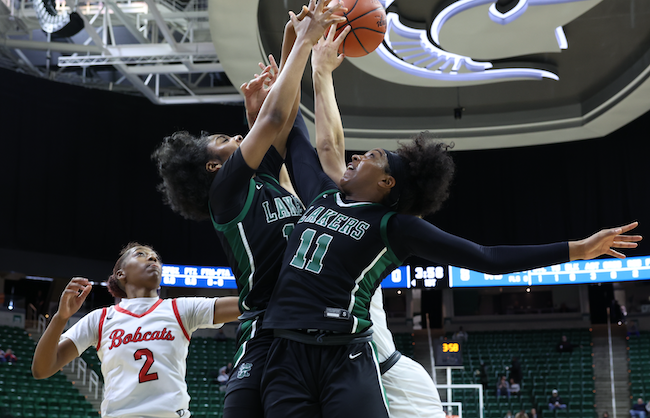
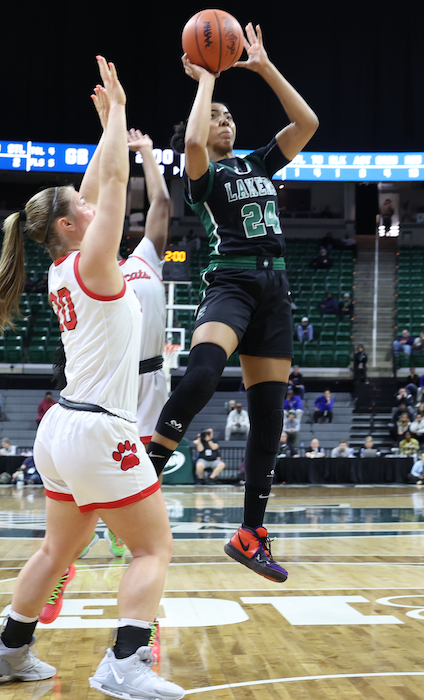
PHOTOS (Top) West Bloomfield players celebrate their Division 1 championship Saturday at Breslin Center. (Middle) Several players including the Lakers’ Kendall Hendrix (11) challenge for a loose ball. (Below) Indya Davis (24) pulls up for a jumper with Grand Blanc’s Kate DeWitt (20) defending. (Photos by Hockey Weekly Action Photos.)