

Milford Racing to Spell Victory Again
By
Tom Markowski
Special for Second Half
August 30, 2017
HIGHLAND TOWNSHIP – Cross Country at Milford is not so much a sport as it is a way of life.
 That might sound a tad overstated. But you would have a difficult time convincing Nicole Gringling.
Gringling is a senior at Milford High. She’s competed at the Lower Peninsula Division 1 Finals her first three seasons and played a big role on the school’s first MHSAA championship team in girls cross country last season.
The boys program has won five titles, all under Brian Salyers, the head coach for both teams.
An adopted child, Gringling latched onto the sport – and the people who are a part of the cross country community in this western Oakland County town – when she was in middle school. Gringling started swimming at age 4 and gave up the sports competitively seven years later for this opportunity to race outdoors instead.
“I fell in love with cross country,” she said. “Running is more fun (than swimming). I kind of have a rough background. I just have so much fun running with my friends. It’s where I belong.
“I’m definitely looking forward to running in college. It’s part of my personality.”
Milford returns five of its six top runners from a year ago, Gringling being one, and is again one the state’s top teams.
But that doesn’t seem to be important or at the top of the list of priorities for the team or Salyers. It instead gets back to what Gringling said: running cross country is fun. That’s what’s important. And if you win, well, that's makes it more fun.
 To understand what cross country means to those in this community one must go back 50 years or more to when the legendary Lee Averill coached Milford’s cross country teams, boys and girls. Averill, a Milford graduate who died in 2014 at age 76, would go on to coach at West Bloomfield and lead his 1989 girls team to an LP Class A title.
Gene Balawajder took over the cross country program in 1970, and though he never coached an MHSAA champion, he came close and along the way was paramount in the continuation of a proud program Averill established. Balawajder’s girls team placed second to Dearborn Edsel Ford at the Class A Final in 1984.
Milford’s girls would win a number of county titles, including in 1988, a year when the boys finished third in at the LP Class A Final.
Salyers was a member of that boys team. That was his senior year, and although Salyers wasn’t one of the top runners (and a better basketball player at the time), he grew to love the sport. In 1996, after graduating from Western Michigan University, Salyers took over the program and Balawajder became the athletic director. To help with the transition, Glen Edwards, Balawajder’s longtime assistant, served as Salyers’ assistant the first two years.
Salyers knew then that he was taking over a special program, one he needed to embrace and enhance.
“The tradition is rich here,” he said. “It’s something we take pride in.
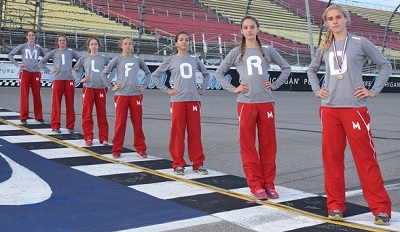
“In terms of having a cross country culture, it runs all through the school. When you put those letters on, M-I-L-F-O-R-D, you play for your school, your parents.”
The letters, those on the jerseys, has become part of Salyers’ imprint on the program – a touch that adds a little more pride. Seven runners represent each school at Michigan International Speedway, and each Milford runner who earns his or her place among those seven wears one of the letters, whether it be the block “M” or the “I” and so on.
Gringling wore the D her freshman year, the L her sophomore season and the letter I last fall.
Junior Victoria Heiligenthal, Milford’s top runner who placed 14th at MIS in 2016 and is the current county champion, is all in with the team aspect of the sport. Like Gringling, Heiligenthal competes in track & field too, her best events being the 800-meter run and the 1,600.
 “Wearing the letters is one of my favorite things,” she said. “It’s really a lot of fun. All of the tradition the program has. Even the new conference (Lakes Valley) we’re in is something we look forward to.”
During the offseason, Salyers organizes events and camps to keep the athletes involved and fresh. He holds a team camp near Rapid River in the central Upper Peninsula where his runners train, but also get away from running and (with cell phones hopefully put away) have fun playing Frisbee or football – anything to create camaraderie and stronger friendships. There’s also a group camp, a much larger gathering where the underclassmen and the incoming freshmen mingle with the varsity squad.
“We have a saying,” Gringling said. “And that’s we care about each other more than the other team cares about their teammates.”
Salyers creates an upbeat atmosphere where winning isn’t the goal, but by having fun and working hard you, as an individual, will win even if it’s just by cutting a half second off of your best time.
“There’s a hometown feeling here,” he said. “It’s a fading element in high school sports. The transfers and all that is conflicting with that.
“I don’t know what high school sports will be like in 10 or 15 years. There have been a lot of changes. We try to keep an old-school atmosphere.”
And Salyers is not one to forget the past. When Milford won its first cross country title with the boys team in 2003, he had Balawajder come up to the podium with the team to celebrate in hoisting the trophy.
“That might be my proudest moment,” Salyers said.
There have been many.
 Tom Markowski is a columnist and directs website coverage for the State Champs! Sports Network. He previously covered primarily high school sports for the The Detroit News from 1984-2014, focusing on the Detroit area and contributing to statewide coverage of football and basketball. Contact him at [email protected] with story ideas for Oakland, Macomb and Wayne counties.
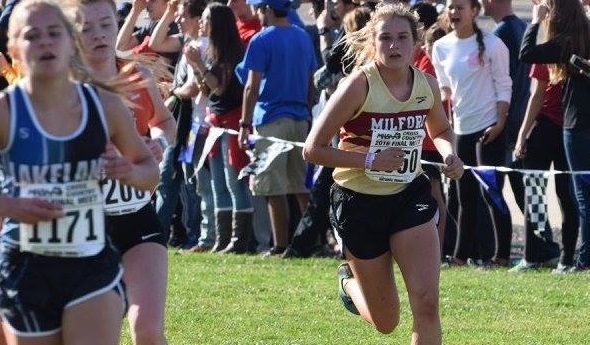
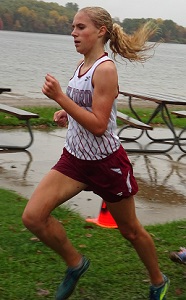
PHOTOS: (Top) Nicole Grindling (far right) rounds a curve during last season’s LPD1 Final at Michigan International Speedway. (Middle) Milford’s seven runners spell out their school name on the track after winning their first title. (Below) Victoria Heiligenthal works to stay ahead of another competitor during a race last season. (Photos courtesy of Brian Salyers.)
Together Since Middle School, Gobles' Record-Setting 4 Building On Historic Run
By
Pam Shebest
Special for MHSAA.com
September 24, 2025
GOBLES — When coach Marc Kline first met Libby Smith, he thought the sixth grader did not have much potential as a runner.
 Was he wrong.
Over the next few years, Kline noticed “there was a seriousness about her from seventh, eighth and beyond. You could just see even then, she’s going to be good, and she is good.”
“Good” is an understatement.
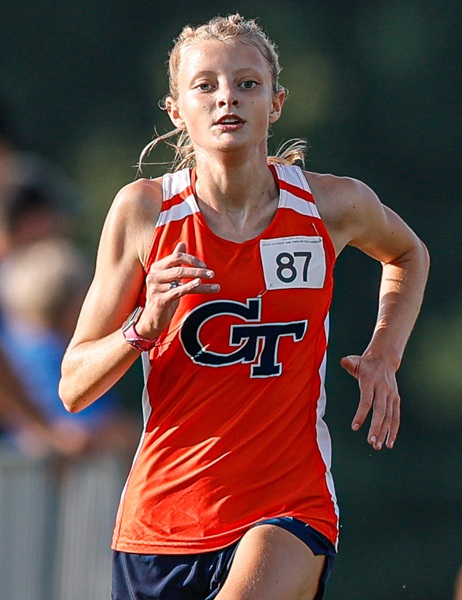
Last year as a sophomore, Smith finished third at the MHSAA Lower Peninsula Division 4 Cross Country Final. Her time of 18:26.4 helped lead Gobles to a sixth-place finish, the Tigers’ best in school history.
Since then, she has been chipping away, trying to get below the 18-minute mark.
She is getting closer, recording a personal record 18:07.0 to win Saturday’s Pewamo-Westphalia Invitational. Smith has now won six of the team’s last eight meets and finished second in the other two.
“I like the running part and the training,” said Smith, who lifts weights five days a week and runs on her own after school practices.
 On those solo runs, “My mom (Casey) follows me on an electric scooter,” she said. “My dad (Mitchell) does, too. They take turns riding with me, and I like that.”
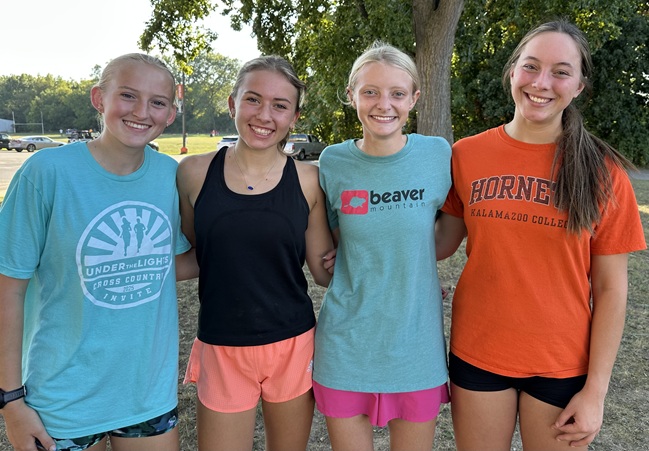
In practice, Smith trains with three buddies, and the four have been running friends since middle school.
“We’re the only ones in our grades who run, so we are like a tight little group of runners since sixth grade,” Smith said.
Her “little group” also consists of senior Madison Cooley and juniors Lauren Shaffer and Ava DeYoung.
“All four of them are our top four in Gobles history,” Kline said. “They all set the school record in (girls) cross. That’s like the perfect storm from my perspective. That’s amazing.”
Every time Smith runs another personal best, she breaks her own school record. Currently, Shaffer is second-best at 19:33.4, also a personal record recorded Saturday. DeYoung (19:48.2) is third in the record book and Cooley (20:33.7) fourth.
All four runners passed the former top mark of 20:41.5 set by Cheyenne Allyn-White in 2014.
“We all started so young, and that really helped and we all improved together,” DeYoung said. “When one person improved, you wanted to stick with them, you wanted to just keep pushing. We all worked together, and we all improved together.”
Sophomores Addison Tomsic and Alyssa Sparks plus freshman Taylor Cooley round out the team.
The only senior, Madison Cooley is also team captain.
 “It definitely makes a lot more responsibility,” she said. “I had to make shirts for the team, have to make sure they’re doing all the warmups and cool downs.
“Sometimes I have to keep myself in check and be positive all the time. Sometimes it’s pretty hard.”
Facing her last season on the team, Cooley said it’s important to stay in the moment.
“You have to cherish the moments,” she said. “Our captain last year (Zoie Wood) was a senior and was on my team since eighth grade.”
Kline said Cooley has been fun to watch in the leadership role this season.
“Her leadership skills have improved so much,” he said. “She’s very critical to the team.
“She’s planning to run track (in college). It’s really amazing to watch a sprinter take on a 5k role.”
While Smith led the team to the Finals last fall, Shaffer, who finished 33rd (20:45.5), was second on the team.
The junior started running at a very early age when her dad, Eric Shaffer, coached cross country at Gobles.
“I used to come to the practices after school,” she said. “I followed them around and have been running since then.
“A lot (of success) is being consistent, (training) over the winter and summer so you’re always running.”
Kline said Shaffer is gritty and shy.
“She loves her family a ton,” he said. “I can see a special relationship between her and her dad, which is really fun to see. She has a lot of talent as well.”
DeYoung, who started running in middle school, said the fab four instantly clicked.
“It was really fun and I just stuck with it,” she said. “We have such a unique bond together. We do easy runs together when we can just talk about our day.
 “There are other times when it’s a good pace and (Smith) goes off ahead. It’s so fun to see her do so good. It makes us all so proud of her. I would say it inspires us to do better because we all want to strive to be more like what she’s doing.”
DeYoung suffered four stress fractures of the tibia as a freshman and is still working her way back to peak form.
“I had a lot of support from my teammates,” she said. “Even when I was struggling and having hard times, they were always there for me.
“I really enjoy running and enjoy running with my teammates, and I wanted to get better. Even with the setbacks, I was working and striving to get better all the time.”
Kline said DeYoung is one of the hardest workers on the team.
“Her integrity level is so high,” he said. “I appreciate her. (Because of the injuries), she’s not been able to hit where she was early and is coming around really well this year.”
All four also run track during the spring, and while both sports involve running, Kline said track and cross country are like night and day.
“Cross country, everyone’s focused on one event, training, goals,” the coach said. “It’s all unified, and there’s a great sense of family that can develop from that team.
“In track, there’s 17 different events, people get so scattered. It’s really difficult in one sense to get that team feel in track, so that’s a big difference.”
Looking at this cross country season, “I am so excited about the opportunity we have this year,” Kline said. “Their buy-in, their interest and their love for each other.”
 Pam Shebest served as a sportswriter at the Kalamazoo Gazette from 1985-2009 after 11 years part-time with the Gazette while teaching French and English at White Pigeon High School. She can be reached at [email protected] with story ideas for Calhoun, Kalamazoo and Van Buren counties.
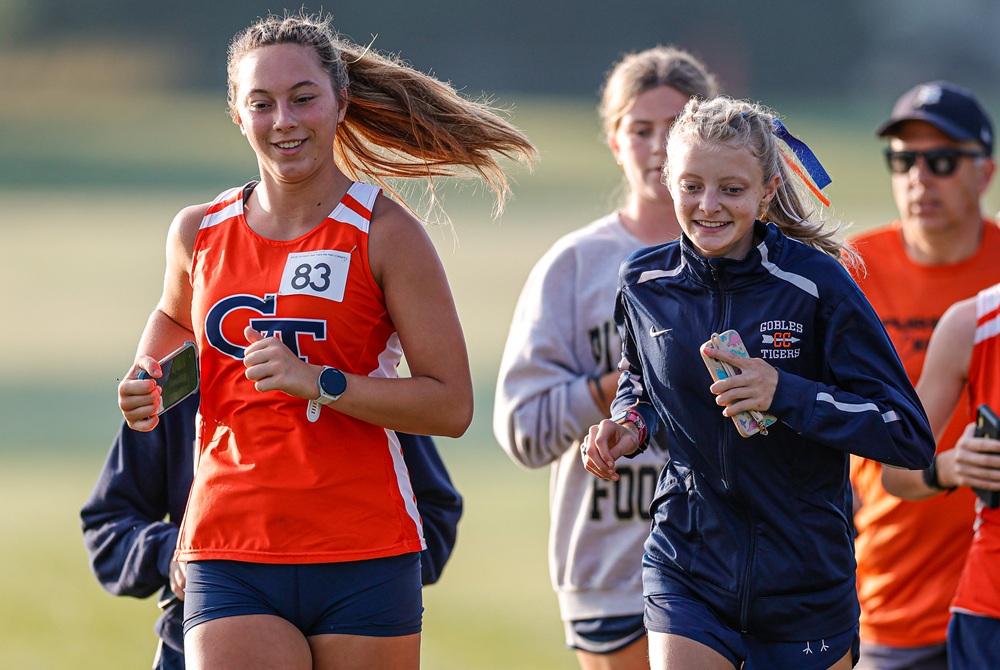
PHOTOS (Top) Gobles runners including Madison Cooley, front left, and Libby Smith warm up at the Portage Early Bird Invitational this season. (2) Gobles girls cross country coach Marc Kline. (3) Smith and Cooley are joined by, from far left, Ava DeYoung and Lauren Shaffer. (4) Smith runs at Portage. (Portage photos by Miles Postema. Coach and group photos by Pam Shebest.)