

Pioneer's Huff Blazed Cross Country Trail
October 3, 2017
By Ron Pesch
Special for Second Half
Today, you’ll find her seated behind a desk in Denver. A CPA and the mother of three, including a former Olympic speed skater, Beth Jurgensmeyer still runs. The MHSAA’s first girls individual cross country champion, she was introduced to the sport as an 8-year old.
The daughter of Reverend Robert O. Huff, a Lutheran minister, and his wife Jane, she was born in Indianapolis. The fifth of six children and the couple’s first daughter, she and the family moved to Midland when Beth was a baby.
“I had a kidney infection,” said Jurgensmeyer, “and a doctor had told us that running would help clear it up. Now I don’t know if that was true, but I started running for Fleet Feet in Midland. It was fun.”
Still going strong today, Fleet Feet was formed in 1967. A track and field and cross country program, it was designed with the goal of keeping kids active. The club competed in AAU competitions, and Huff excelled.
A friend and fellow runner from Fleet Feet introduced her to speed skating.
“Cindy Kressler invited me to skate with her family in the park in Midland. Her brother, Craig, was a pretty good speed skater and ended up an Olympian in 1980. So, I did that in the winter.”
Huff excelled in that sport as well, skating for the Midland Speed Skating Club and earning “Pony Girl“, “Midget” and “Junior” recognition at Michigan Skating Association-sponsored events across the state, and at other races around the Midwest.
“My brothers were all older than me, and they all played sports,” she added. “Football, basketball, baseball, hockey. So I competed too.”
 But in sixth grade Huff’s family moved. Pastor Huff had received a call to a church in Ann Arbor. It was his fourth assignment.
“There, I continued to skate, now with the Wolverine Club (based out of Detroit). I ran with the Michigamme Club, and we were coached by (Kenneth) ‘Red’ Simmons.”
Born in 1910, Simmons was a football and track star at Redford High School in Detroit, then at Michigan Normal College (now Eastern Michigan University) before serving 25 years with the Detroit Police Department. Upon retirement Simmons, along with his wife, formed “The Michigammes,” a women’s track club designed to allow girls to compete. In 1976, he was named the first coach in the history of women’s track and field at the University of Michigan.
Huff never missed a beat, winning more than a dozen state age group championships between 1973 and 1976.
“I attended Slauson,” she continued. “That fed into Ann Arbor Pioneer. Back then, it was the only high school in Ann Arbor that had 9th grade. I liked that. You go there you’re the little kid, running with the older ones, trying to keep up. You’re able to keep a low key. I wasn’t very big, and the uniform was sliding down my shoulders. My Mom took it to a seamstress and had mine altered so it would fit.
“My parents never pressured me. My participation was never assumed. Each year, my Dad would ask me a question, ‘Beth, do you want to run again?’ I did - I loved to run. I’d sleep in my shorts and shirt, wake up in the morning, slip on my shoes and run before class. Because of Fleet Feet and The Michigammes, I’d run hundreds and hundreds of races before I got to high school. I knew I was pretty good, but I always liked to be kind of unknown.”
Flying under the radar didn’t last long. By season’s end, Huff, along with sophomore Dana Loesche, had emerged as the team’s top runners.
“After my freshman year, people suggested I run between cross country and track seasons,” Jurgensmeyer recalled. “I told them, ‘I skate in the winter.’”
Now coached by Scott Hubbard, Huff was Pioneer’s top runner as a sophomore and led the cross country team through a stellar year.
Hubbard had run in high school for Ann Arbor Huron and later at Eastern Michigan University. Many today know Hubbard as the longtime voice of the Detroit Marathon. “Beth was very, very good. She was just average size, but she was whippet fast,” he said. “(But) at the state level, cross country for girls was not a sport sponsored by the MHSAA in 1977.”
 Yet since 1975, an unsanctioned state championship was hosted in Michigan. In both 1975 and 1976, the event was held at Ann Arbor Pioneer. The 1977 event was run at Potterville High School in November. A total of 370 runners from 105 schools competed in the meet, a substantial increase from the 243 runners that had participated a year previous. Miriam Boyd of Port Huron, one of Michigan’s all-time great prep distance runners, finished with the top individual time, followed by Carol Schenk of Flint Kearsley and sophomore Huff. Crosstown rival Ann Arbor Huron ended the day with the team honor, while Pioneer finished third in Class A.
“It was different then,” said Jurgensmeyer, laughing. “My Mom would make me a peanut butter and jelly sandwich. On race days there would be two oranges and a Hershey bar. Now, they’d tell you that all that sugar would not be the best thing for you. After a race, you’d go to the car, grab a clean shirt, go to the awards ceremony and go home. My Dad, he couldn’t really watch many races. Saturday’s were busy, as he had weddings or prepared for Sunday. Sometimes, when I would run, he’d be there standing with four or five others from church, as they prepared to go to a meeting. He couldn’t stay the whole race, and that was OK.”
“While in Ann Arbor I met a man, John McCravey, who was in medical training at the University of Michigan,” Jurgensmeyer remembered. “He was one of the people who really wasn’t afraid to offer something other than praise. ‘Beth, your arm swing is awful!’ It was nice to hear criticism. I could get better.”
Today, Dr. John McCravey still practices in Tennessee.
“I had come to U of M for a one-year residency. I had run at Dartmouth, and coached while going to med school in Memphis. In Ann Arbor, I worked with Elmo Morales, the founder of the Ann Arbor Track Club. We started age group cross country. The running boom was on, and Ann Arbor was a hotbed. Beth was older than many of the pupils in the program, and clearly a lot better than most at that point. We became running pals. (Because of) the skating, she had great endurance.”
The pair logged hours in the streets of Ann Arbor, including time during the brutal winter of 1977-78.
 “We talked the whole time. As a coach, it’s great when you can run with a student. You can see what they’re doing, feel the biomechanics, and offer advice. ”
In Class A in the spring of 1978, Huff finished second to Boyd in the two-mile at the MHSAA’s sixth annual Girls Track and Field Meet. In the fall, Huff, now a junior, earned Michigan’s first Lower Peninsula Open Class cross country individual championship.
Seven months later, Huff would win the two-mile in track. Only, it wouldn’t be in Michigan.
In December 1979, the Huff family left Ann Arbor for Janesville, Wisconsin, as her father accepted a new assignment.
At Craig High School, Huff again joined the cross country and track teams and quickly emerged as their top runner. Her 10:53.19 time at the Division 1 Wisconsin Interscholastic Athletic Association championship meet set a new state mark. During her senior year in Wisconsin, a case of mononucleosis and a stress fracture set her back, and impacted her running seasons.
Her next move was on to college, where she ran for the University of Tennessee. There, she competed in the 10,000 meters. After college, she married, had kids, and stopped running competitively. After returning to Midland, she resumed speed skating, and introduced her kids to the sports she loved. She coached them as far as she could.
Jurgensmeyer’s son, Ryan Bedford, excelled in cross country at Midland High School before hanging up the shoes to focus on speed skating. He was a 2009 world champion and a member of the 2010 Olympic team. Daughter Kristin also excelled as a runner and speed skater. Beth’s oldest son stayed with the more traditional sports of football and basketball.
Reflecting back on her years as an athlete and as a coach, she added, “Today, parents are overly involved. It’s so high-pressure so early that kids become miserable. Research shows if you start specializing kids too young in one sport, they will be done by age 18. I always wanted my kids to try all sorts of sports and not just specialize. Just let kids fall. Let them get dirty.”
“Really, women’s sports are the best thing to ever happen to sports,” said Hubbard, remembering the long haul involved in opening up those opportunities to the girls. “I was so fortunate to be witness to that. The world is really much richer because of it.”
 Ron Pesch has taken an active role in researching the history of MHSAA events since 1985 and began writing for MHSAA Finals programs in 1986, adding additional features and "flashbacks" in 1992. He inherited the title of MHSAA historian from the late Dick Kishpaugh following the 1993-94 school year, and resides in Muskegon. Contact him at [email protected] with ideas for historical articles.
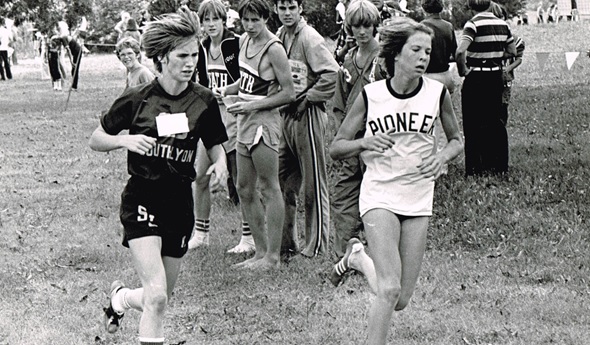
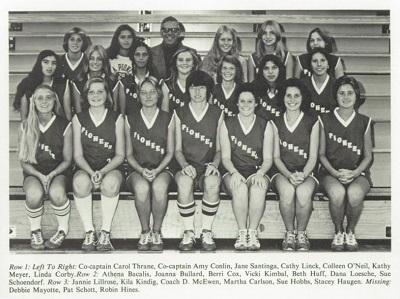
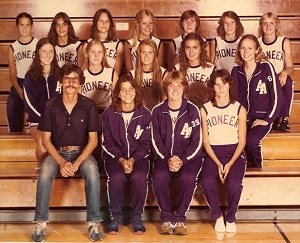
PHOTOS: (Top) Ann Arbor Pioneer's Beth Huff, right, runs just ahead of South Lyon's Cheryl Scheffler during the Ann Arbor Greenhills Invitational in 1978. (Middle top) Huff, second row and third from right, was a freshman on the 1976 near-undefeated Pioneer cross country team that lost only to Livonia Stevenson. (Middle below) In this clip from the Detroit Free Press' Sunday magazine, Huff is shown running in Ann Arbor with Pete Hallop, far left, and Mike Lutz, who went on to play bass for rock group Brownsville Station. (Below) Huff, top row second from right, starred as well for Pioneer's 1979 cross country team, winning the first MHSAA individual championship in the sport. (Photos courtesy of Beth Huff.)
Preview: Senior Stars Enter Final Stretch
November 1, 2018
By Geoff Kimmerly
Second Half editor
Michigan International Speedway will showcase Saturday the last MHSAA Finals for a pair of the most successful champions all-time in this state.
Hart’s Adelyn Ackley will run for her third individual championship while attempting to lead her team to a repeat in Lower Peninsula Division 3. Rockford’s Ericka VanderLende won last season’s Division 1 individual title with one of the fastest 5K times in Finals history, and she enters this weekend with the state’s fastest time this fall.
A total of 958 runners will take to the course at MIS for the girls races, which begin with Division 4 at 10:50 a.m. – the boys start the day with their Division 4 at 9:30. Below are some of the teams to watch and a glance at each of the individual fields as well. Click for all Finals qualifiers, a map of the course and links to buy tickets and watch the Finish Line camera on MHSAA.tv, and come back to Second Half later Saturday for coverage of all four meets. (NOTE: “Rankings” of individual runners below are based on data at Athletic.net, which orders runners based on the single fastest times they’ve run this season.)
Division 1
Reigning champion: Troy
2017 runner-up: Northville
2018 top-ranked: 1. Northville, 2. Clarkston, 3. Ann Arbor Pioneer.
Troy held off Northville by five points to claim last season’s championship, but the Mustangs have six of their seven runners back including sophomore Yasmine Mansi (ninth in 2017) and senior Nicole Cybul (18th). Those two rank ninth and 11th, respectively, among runners regardless of division this fall. All five scorers are back from the Clarkston team that finished eighth a year ago, and Ann Arbor Pioneer brings back four of its top six from the team that finished fourth. Junior Zofia Dudek placed 20th individually for the Pioneers last fall, and freshman Sarah Forsyth ranks 16th regardless of division among this season’s best.
Individuals: Rockford’s VanderLende owns the state’s fastest time this fall by 14 seconds after winning her Regional in 16:43.3. But the returning crew accompanying her is also strong. Waterford Mott senior Rylee Robinson (third), West Bloomfield senior Kyla Christopher-Moody (fourth), Grand Haven senior Gabby Hentemann (eighth) and White Lake Lakeland senior Madeline Rehm (10th) joined VanderLende and Mansi in the top 10 in 2017. Farmington senior Abby Inch (11th), Highland Milford senior Victoria Heiligenthal (12th), Fenton junior Alexa Keiser (13th), Portage Northern senior Peyton Witt (16th), Midland Dow senior Anastasia Tucker (17th) and Romeo junior Madelyn Malczewski (19th) make it 14 of last year’s top 20 coming back to MIS.
Division 2
Reigning champion: Lansing Catholic
2017 runner-up: Grand Rapids Christian
2018 top-ranked: 1. East Grand Rapids, 2. Petoskey, 3. DeWitt.
East Grand Rapids has finished runner-up twice (2015 and 2016) since last winning the championship in 2011, and is back in Division 2 after placing 13th in Division 1 last fall. The top three finishers from that team return, and six runners rank among the top 29 in Division 2. Petoskey finished 19th last season but without a senior; five returnees are joined by two freshmen, and sophomore Emma Squires ranks seventh in the division. DeWitt has three runners ranked among the top 35 and returns four from the team that finished third last season, led by senior Ashley Shipps (13th individually in 2017).
Individuals: Division 2 graduated two of the state’s top runners this decade this spring, and the field still is loaded. Lansing Catholic’s Jaden Theis (sixth in 2017) and Lauren Cleary (third) have broken 18 minutes, Theis’ 17:07.3 on Sept. 29 ranking her fourth regardless of division as she looks to follow up her sister Olivia’s individual title last season. Mason also has two returning top-20 finishers – runner-up and now-senior Cecilia Stalzer and junior Lucy Petee (20th), while Plainwell junior Makenna Veen (fifth), Goodrich senior Jillian Lange (seventh) and Big Rapids senior Meghan Langworthy (10th) also are back from the top 10. St. Johns junior Taryn Chapko (11th), Wayland junior Rylee Cronkright (12th), Pontiac Notre Dame Prep junior Jennifer Ohlsson (14th) and Paw Paw senior Molly Thompson (18th), along with DeWitt’s Shipps, give the division 12 returning top-20 placers from a year ago.
Division 3
Reigning champion: Hart
2017 runner-up: Benzie Central
2018 top-ranked: 1. Hart, 2. Grandville Calvin Christian, 3. Clare.
Hart has ranked among the top teams in the state regardless of division the last two seasons, keyed in part by a number of members of the Ackley family. Adelyn Ackley will attempt to become the 26th three-time girls Finals champion, and her top time of 17:00.6 ranks her third in the state regardless of division. Total, five of Hart’s top six from last season are back including as well sophomores Savannah Ackley (sixth place individually) and cousin Lynae Ackley (20th). Calvin Christian is seeking its first championship in this sport after finishing third a year ago, and returns four of the top five runners from that team. Clare was fifth last season without a senior; senior Lainey Veenkant (12th individually) leads five returnees and two freshmen heading to MIS.
Individuals: Juniors took the top five places last season; the fifth-place runner is in Division 4 this fall, but Ackley will again be part of a chase with Shepherd senior Amber Gall (second), Kent City senior Lauren Freeland (third) and McBain senior Klaudia O’Malley (fourth). North Muskegon junior Isabella Lindsay (eighth) and Hanover-Horton senior Judy Rector (10th) also are back from the top 10. Rounding out returnees from the top 20 are Bad Axe junior Jelena Prescott (13th), Manton junior Paige Swiriduk (15th), Benzie Central junior Paige Johnston (17th) and Traverse City St. Francis senior Katelyn Duffing (19th) – making for 13 of the top 20 total.
Division 4
Reigning champion: Mount Pleasant Sacred Heart
2017 runner-up: Ubly
2018 top-ranked: 1. Mount Pleasant Sacred Heart, 2. Saugatuck, 3. Pittsford.
The Irish have won the last three Division 4 championships, last year by 99 points – but they’re in for perhaps the toughest race of this run against Saugatuck, which edged Sacred Heart to win the Division 4 race at the Oct. 6 Portage Invitational (although Sacred Heart was missing its fifth runner). The Irish have five of their seven runners back from last year’s championship team, with senior Scout Nelson coming in third individually in 2017, junior Desiree McConnell eighth and senior Lauren MacDonald 19th. Total, Sacred Heart has four of the top 19 ranked runners in Division 4. Saugatuck has three of the top 13, including senior Thea Johnson, who finished fifth in Division 3 in 2017. The Indians as a team last season finished fourth in Division 3 without a senior; the five scoring runners are back. Pittsford was 10th in Division 4 last season with just one senior, and five of the top six runners from that team will run this weekend led by senior Renee Osborne (16th individually in 2017).
Individuals: Four freshmen finished among the top 18 last season – led by Lansing Christian now-sophomore Madison Volz in fifth – and a freshman could be the story Saturday. Muskegon Western Michigan Christian’s Abby VanderKooi joins Rockford’s VanderLende as the only runners to clear 17 minutes this season, and VanderKooi’s best time of 16:57.3 is nearly 1:13 faster then Volz’s best as the second-ranked runner in Division 4. VanderKooi will work to outpace 12 top-20 returnees. In addition to those already mentioned, the following also are back: Hudsonsville Libertas Christian senior Anna Mason (sixth), Ubly senior Haili Gusa (seventh), Western Michigan Christian senior Josie Aardema (12th), Lansing Christian sophomore Lexi Kinnas (13th), Concord sophomore Skylar Thompson (14th), Royal Oak Shrine junior Ellie Kendell (15th) and Mayville sophomore Haley Rowbotham (18th).
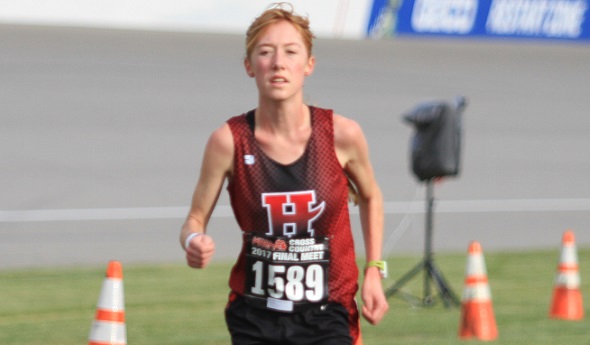
PHOTO: Hart’s Adelyn Ackley charges down the final stretch on the way to winning her second straight Division 3 championship last fall at MIS. (Click for more from RunMichigan.com.)