

Northern Hopefuls Chase Dream Finishes
June 2, 2017
By Dennis Chase
Special for Second Half
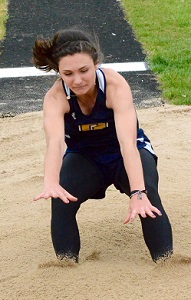
TRAVERSE CITY – Can Gaylord’s Casey Korte, despite missing three weeks in May with shin splints, defend her MHSAA Lower Peninsula Division 2 title in the long jump?
 Can Benzie Central’s ironman, Brayden Huddleston, medal and earn all-state honors in four Division 3 distance races?
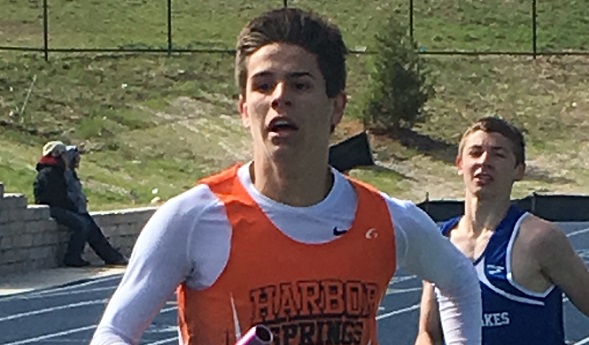
Can Harbor Springs sophomore Jeremy Kloss – the top seed in the 1,600 and 3,200, along with his teammates in the 3,200 relay – pull off a trifecta in Division 4?
Can the Traverse City West 400-meter relay team win the school’s first boys MHSAA Finals title in a running event?
In northern Michigan, those four storylines will be among the most compelling Saturday at the MHSAA track & field championships.
Casey Korte
The 17-year-old multi-sport athlete has been battling nagging leg injuries the last two seasons, but still won the long jump last June with a leap of 18-0¼.
Shin splints forced Korte to take three weeks off last month. She returned for the Regional and kicked off the rust by winning the long jump (17-01.25) and helping the 800-meter relay team qualify for the MHSAA Finals.
 “It’s good,” she said of her health.
Her distance in the long jump was third best among state Regional performers.
“Usually my goal every meet is to be in the mid-17s,” she said. “Nobody was close to it (17-1¼) at the Regional so I was good with it.”
Korte had an interesting warmup Tuesday at Gaylord’s Meet of Champions. She won the 100, high jump and was on the victorious 800-meter relay, but took second in the long jump at 15-5½.
“Usually I don’t do the long jump last,” she said. “I do it second. But the way the meet was set up I did it after all my other events, and after it had rained and gotten cold and windy. My legs wouldn’t let me take off and jump.”
Korte does not expect similar problems Saturday.
“My goal is to double as a state champion,” she said. “Last year, during long jump, all the factors came together. I was feeling good, the high jump was going well, the wind was perfect. Everything went well. I’m hoping it happens again.”
Korte finished fourth in the high jump at last year’s Finals, but did not qualify in that event this year.
Nonetheless, it’s been a banner senior year for Korte. She was the team Most Valuable Player and an all-region pick in volleyball, then followed it up with a first-team all-state campaign in basketball, averaging 19.8 points, 12.3 rebounds and 3.5 steals per game. Korte signed to attend and play basketball at Cornerstone University.
But her focus now is on the track. And what would it mean to her if she could repeat in the long jump?
“It would show that my hard work paid off,” she said. “A state championship isn’t just handed to you. You have to work hard for it. It would be awesome to know I did that. It’s still surreal that I was the state champion last year. There are times I still can’t believe it.”
Brayden Huddleston
Huddleston is preparing for an event-filled day at the Division 3 Finals. The senior is seeded second in the 800, seventh in the 1,600 and eighth in the 3,200. He also runs a leg on Benzie’s 3,200-meter relay, which is seeded third.
His goal? Medal in all four.
His goal? A podium finish in all four events.
 “It’s pretty rare (to run four distance races at the Finals), especially if you’re a kid that has a shot to potentially win,” Benzie Central coach Asa Kelly said. “We talked. I said, ‘You’ve got to be a little crazy to do this.’ He said, ‘I want to.’
“He’s one of those exceptional kids that when he does something, he does it really well. He’s a 4.0 student, a salutatorian. I said, ‘You could be one of those rare kids that could be all-state in four distance races.’ That doesn’t happen too often. He’s committed 100 percent to this. It’s going to take a lot of careful planning (Saturday), as far as warming up, cooling down, diet, fluids. I think he’s going to do great.”
Huddleston, who will run at Bradley University, said he’s ready.
“They say it’s crazy to do (four distance races) at state finals, but I like that challenge,” he said. “I’m ready to put forth my best effort and see what I can do.’
Huddleston said he’s most concerned about the quick turnaround between the 800 and 3,200.
“I’m most nervous about that,” he said. “I think there’s only one heat in the girls two-mile at state finals so the turnaround will be quick. But I think I’m in good shape. This is the most fit I’ve ever felt.”
Huddleston won the Ryan Shay 1,600 meters in a season-best 4:19.84 at Tuesday’s Traverse City Record-Eagle Honor Roll meet. That time ranks second to St. Louis’ Evan Goodell’s 4:18.18 in LP Division 3 this year.
“I was shooting to see how close I could get to the school record of 4:14.7 by Jake Flynn,” Huddleston said. “I fell a little short, but I was running by myself, and running into a wind for half the lap. You take those things away and it puts me right in the ballpark. I was happy with my effort. It’s good to be rolling into the state finals.”
Huddleston smiles when he talks about a second seed in the 800.
“I’ve always looked at myself as a distance runner,” he said. “The two mile has been my best event. But this year I ran a couple open 800s, and I fell in love with it. It’s a strategic race.”
The 3,200 will be his last race of the day.
“He knows going in there will be guys who will be fresh,” Kelly said. “What a badge of honor if he could go out there and say, ‘This is my fourth event and I’m going to try and be all-state and beat some guys who haven’t run at all today.’”
Jeremy Kloss
Kloss will toe the line in three Division 4 distance races. His Regional times of 4:26.71 in the 1,600 and 9:49.52 in the 3,200 were best in the division. The Rams also had the top 3,200 relay time of 8:20.69.
Kloss, who was second in the LP Division 4 Cross Country Final, said he’s peaking at the right time.
“With the state meet coming up, it was time to kick it into gear, get motivated, get serious,” he said.
Kloss, who is coached by his father Mike, said he would like to achieve some goals he set at the beginning of the season – to run in the high 9:30s in the 3,200 and low 4:20s in the 1,600.
“I think I can,” he said.
Jeremy is the youngest of four brothers to run for the Rams. His mother, Emily, coaches the girls team.
“I was born in early October and wasn’t even a month old when I went to my first state finals cross country meet,” he said.
His brother Jake ran on the school’s LP Division 4 cross country championship teams in 2002 and 2003.
Jeremy Kloss was sixth in the 1,600 and 3,200 as a freshman. He said the 1,600 is his favorite event because it combines the speed of the 800 with the endurance of the 3,200.
“It’s the perfect medium,” he said.
And has he received any advice from his older brothers – Jake, Ben and Scott – who will all be in attendance Saturday?
“No, other than ‘Why aren’t you running faster?’” he said with a laugh.
Kloss would like the last laugh tomorrow.
“I’m very excited for it,” he said.
TC West 400-meter relay
In Division 1, Traverse City West enters the 400-meter relay seeded second to Rockford (42.57) with a time of 42.63 seconds.
“First is obviously a goal,” senior Dalton Michael said. “It’s there, but we’ll see.”
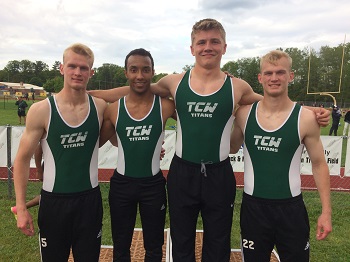 Twins Donovan and Dalton Michael lead off the relay, followed by Lukas Sawusch and Erik LaBonte. Dalton Michael was the state’s Mr. Soccer in the fall.
“We’re all multi-sport athletes,” LaBonte said. “We’ve been working together the whole (spring). We’re getting better.”
The Titans placed seventh in the relay a year ago, but Donovan Michael is the only returnee. Dalton missed his junior season of track with a dislocated knee. LaBonte was bothered by a hip injury.
But that’s in the past.
“We’re coming into (Saturday) knowing we’re a good team,” Donovan Michael said. “If we have a good day, we could do really well.”
Coach Tom Brown said the Titans will need a school record-breaking performance to be in the hunt. The 42.63 in the Regional tied the school mark.
“I think we’ll have to run in the 41s,” Brown said. “That’s something Rockford did (41.6 at the Michigan Interscholastic Track Coaches Association state team meet last weekend).”
Detroit Cass Tech, led by three Big Ten football recruits, won the 400 relay last June in 42.26.
“I think we can go faster,” Sawusch said. “Our handoffs haven’t been great, so we need to work on that this week.”
Focusing on the exchange zone has been a point of emphasis in practice.
“The 4X1 is all about handoffs,” Brown said.
The Titans believe they have the speed.
“We’ve had 22 kids in school history run sub-11.3 – 18 different kids in the last seven years,” assistant coach Jason Morrow said. “The kids have worked hard at it.”
LaBonte, who also plays football, is the lone underclassmen in the group. Sawusch is headed to Spring Arbor to run track. The Michaels will play soccer at Western Michigan University. Dalton, who earned All-American honors from the National Soccer Coaches Association, became the second Titan to win Mr. Soccer, after Casey Townsend earned the honor in 2006 and 2007. Dalton had 29 goals and eight assists this past fall for West. Donovan added 20 goals and 20 assists.
What would it be like to add a Division 1 championship medal in track to his Mr. Soccer award?
“It would be a dream come true,” Dalton Michael said. “It would be one to remember.”
 Dennis Chase worked 32 years as a sportswriter at the Traverse City Record-Eagle, including as sports editor from 2000-14. He can be reached at [email protected] with story ideas for Manistee, Wexford, Missaukee, Roscommon, Ogemaw, Iosco, Alcona, Oscoda, Crawford, Kalkaska, Grand Traverse, Benzie, Leelanau, Antrim, Otsego, Montmorency, Alpena, Presque Isle, Cheboygan, Charlevoix and Emmet counties.
PHOTOS: (Top) Harbor Springs’ Jeremy Kloss carries the baton during a relay this season. (Middle top) Gaylord’s Casey Korte lands a long jump. (Middle below) Benzie Central’s Braydon Huddleston. (Below) Traverse City West’s 400 relay, from left: Dalton Michael, Lukas Sawusch, Erik LaBonte, Donovan Michael. (Top photo courtesy of the Kloss family, middle top photo courtesy of the Gaylord Herald Times.)
Performance: Waverly's Keshaun Harris
May 24, 2019
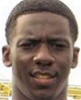 Keshaun Harris
Lansing Waverly senior – Track & Field
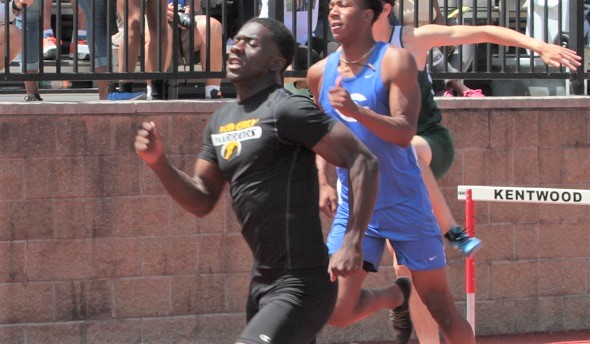
The reigning Lower Peninsula Division 1 champion in the 300-meter hurdles, Harris put himself in position to challenge for multiple titles at next weekend’s MHSAA Finals with wins in both the 300 (38.71 seconds) and 110 (14.23) at last week’s Regional at East Lansing, earning him the Michigan Army National Guard “Performance of the Week.”
Harris’ winning 300 time was his season best, as was his 14.14 prelim time in the 110. Also an all-league football player during the fall and starting guard in basketball, Harris is among the state’s elite on the track and undefeated in both hurdles races this spring despite getting a slow start after hurting his right ankle in his final basketball game this winter. As noted, he won the LPD1 title in the 300 last season in a personal-record 37.81 seconds and just missed the double finishing seventh hundredths of a second behind East Kentwood’s Job Mayhue in the 110. Harris also finished second in the 110 and third in the 300 at the LPD2 Finals as a sophomore, and qualified for the LPD2 Finals in both races as a freshman, earning seventh place in the 110.
 The 37.81 at last year’s Finals and the 14 flat he ran in the 110 at the 2018 Regional are Waverly school records – which says a lot as the Warriors have produced a number of state contenders over coach David Pike’s 29 seasons leading one of mid-Michigan’s strongest programs. Harris will announce next week where he’ll continue his academic and athletic careers at the collegiate level – he has Division I and II opportunities – and will bring both first-class hurdling skills and a 3.6 GPA with aspirations of studying kinesiology and becoming an athletic trainer.
Coach David Pike said: “Keshaun’s success in the hurdles is due to his focus on getting better every day. He’s always the last one off the track, taking time each day to get the repetitions he needs to become fluent with each motion. The quickness and fluidity of his hurdling action come from years of focused practice. That’s not to say he’s hurdling 365 days a year. In fact, much of his success in track and field comes from his involvement in other sports. Football has helped him develop the strength and toughness needed to run through hurdle contact. Basketball with all of its jumping and rapid changes of direction has helped him become a more explosive and kinesthetically aware athlete. In the end, the bottom line is that Keshaun’s dedication to daily incremental improvement as an athlete has put him in position to compete for the state title in both the high and 300 hurdles.”
Performance Point: “Nobody really knew this but my coach, but I was sick,” Harris said in recalling the Regional. “I was pushing through it, so I just went out there and ran my best races of the season. I was dealing with the flu. .... Before the race I had to hydrate a lot. My body was a little weak. I had to make sure I got my body moving, got in a good warm-up, stayed loose and warm. I just went out there and gave it everything I’ve got and ran my best.”
Remembering runner-up: “(Last year’s 110 Final) has been in the back of my mind since it happened last year. My goal is still to be the state champion in both the 110 and 300. That’s been the goal since I came to Waverly, since I’ve been a freshman. That’s always been the goal, and always been a motivation too. … Last year I wasn’t as good with my form as I am this year. So this year as I go into this last week, I’m just working on form, getting over hurdles and getting back down quick and keeping everything tight.”
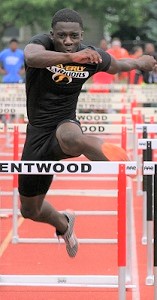 Multi-sport mechanics: “I think (all my sports) work together, because I’m always active doing something. Even in the winter or the summer, I’m always doing something. When track season comes around, I’m already in shape, and I’m already feeling good and strong. (Track has) made me even faster on the court or the field. I’m very elusive. I’m very flexible. So it’s helped me in a lot of areas.”
Looking up, looking ahead: “Aries Merritt, he’s an Olympic champion, and Grant Holloway goes to Florida and he’s another guy I look up to. I also look up to guys I ran against – Kentre Patterson (East Lansing), Noah Caudy (Lake Odessa Lakewood), even Job Mayhue who beat me last year. I still look up to all those guys, figure out what they’re doing and how I can input it into my hurdling. In track, you run against these guys so much. Once they’re gone, you’ve built a relationship with them, so it’s cool.”
Staying in sports: “I just like working with athletes and just being around sports, so I think (trainer) would be the perfect job to do. Actually, at the start of this season I had an ankle injury, I sprained it during my last basketball game, and that had me out for a month. As I worked with the athletic trainer at my school, I developed a love for wanting to become an athletic trainer and wanting to study kinesiology.”
- Geoff Kimmerly, Second Half editor
Every week during the 2018-19 school year, Second Half and the Michigan Army National Guard recognizes a “Performance of the Week" from among the MHSAA's 750 member high schools.
The Michigan Army National Guard provides trained and ready forces in support of the National Military Strategy, and responds as needed to state, local, and regional emergencies to ensure peace, order, and public safety. The Guard adds value to our communities through continuous interaction. National Guard soldiers are part of the local community. Guardsmen typically train one weekend per month and two weeks in the summer. This training maintains readiness when needed, be it either to defend our nation's freedom or protect lives and property of Michigan citizens during a local natural disaster.
Past 2018-19 honorees
May 16: Gabbie Sherman, Millington softball - Read
May 9: Nathan Taylor, Muskegon Mona Shores golf - Read
May 2: Ally Gaunt, New Baltimore Anchor Bay soccer - Read
April 25: Kali Heivilin, Three Rivers softball - Read
March 28: Rickea Jackson, Detroit Edison basketball - Read
March 21: Noah Wiswary, Hudsonville Unity Christian basketball - Read
March 14: Cam Peel, Spring Lake swimming - Read
March 7: Jordan Hamdan, Hudson wrestling - Read
February 28: Kevon Davenport, Detroit Catholic Central wrestling - Read
February 21: Reagan Olli, Gaylord skiing - Read
February 14: Jake Stevenson, Traverse City Bay Reps hockey - Read
February 7: Molly Davis, Midland Dow basketball - Read
January 31: Chris DeRocher, Alpena basketball - Read
January 24: Imari Blond, Flint Kearsley bowling - Read
January 17: William Dunn, Quincy basketball - Read
November 29: Dequan Finn, Detroit Martin Luther King football - Read
November 22: Paige Briggs, Lake Orion volleyball - Read
November 15: Hunter Nowak, Morrice football - Read
November 8: Jon Dougherty, Detroit Country Day soccer - Read
November 1: Jordan Stump, Camden-Frontier volleyball - Read
October 25: Danielle Staskowski, Pontiac Notre Dame Prep golf - Read
October 18: Adam Bruce, Gladstone cross country - Read
October 11: Ericka VanderLende, Rockford cross country - Read
October 4: Kobe Clark, Schoolcraft football - Read
September 27: Jonathan Kliewer, Grand Rapids Forest Hills Northern soccer - Read
September 20: Kiera Lasky, Bronson volleyball - Read
September 13: Judy Rector, Hanover-Horton cross country - Read
PHOTOS: (Top) Lansing Waverly's Keshaun Harris charges toward the finish during last season's Lower Peninsula Division 1 Final in the 300 hurdles. (Middle) Harris clears a hurdle during the 110 championship race in 2018. (Click to see more from RunMichigan.com.)