

Track Gaining Speed Toward Future with Electronic Starting Devices
By
Steve Vedder
Special for MHSAA.com
May 23, 2023
Aubrey Greenfield thinks it might be the perfect time to reevaluate 130 years of tradition.
For a number of reasons, from technical to personal, the Oxford senior sprinter believes it makes sense for the crack of a starting pistol to be eliminated from high school track meets.
Because track meets would benefit in various ways from lowering costs to easier setup at meets to the human factor of competitors not having to flinch at the crack of a pistol shot, Greenfield believes the sport has a chance to embrace new technology – electronic starting devices (ESD).
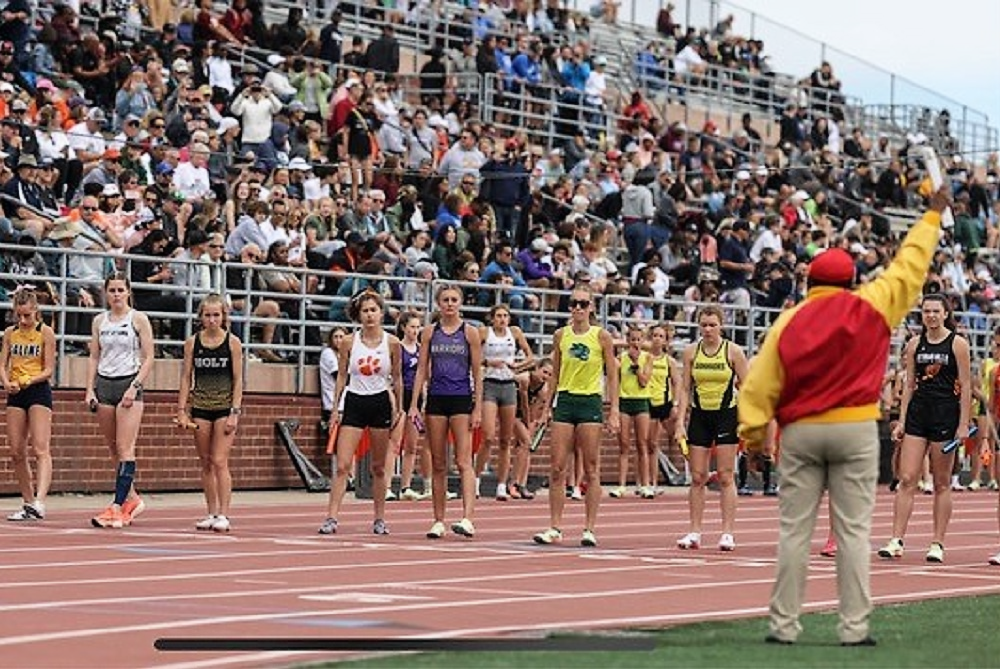
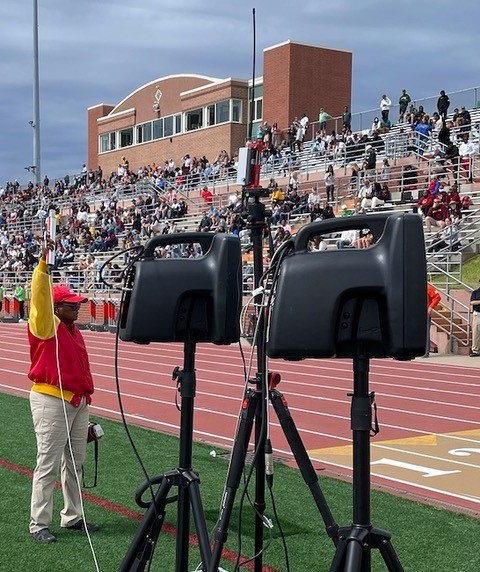
In essence, an ESD replaces the starting pistol with a light flash, tone sound or both to begin a race.
"High school sports should put the athlete first," Greenfield said. "We should promote sports, and eliminating starting pistols promotes health in terms of PTSD or trauma for athletes and spectators and that would be good. I would like to think people would say that's a good idea."
In fact, Greenfield would go as far as to say if there was not an implementation of electronic starting devices, many of her teammates would have considered giving up the sport.
"If it's something that helps us compete safely, we're all for it," she said.
Greenfield's opinion apparently is spreading. Michigan High School Athletic Association senior assistant director Cody Inglis said the use of ESD makes it both affordable for meet starters and sensible for athletes and fans to rethink the use of starting pistols. While the MHSAA is not mandating electronic starting devices, it does promote the use of what Inglis calls "emerging technology." He notes that ESD are becoming the norm for organizations such as USA Track & Field, the NCAA and an increasing number of high schools.
 "I think we have to embrace new technology, and we think this will be something that takes hold," Inglis said.
A key part of embracing ESD is the human element. The tragic Oxford High School shooting Nov. 30, 2021, that took the lives of four students while injuring seven others should not be relived even for a fleeting instance at a high school sporting event. Oxford athletic director Tony DeMare said the school began using ESD at every meet, including the MHSAA Lower Peninsula Division 1 Finals last June. He said that decision was embraced by virtually all schools Oxford encountered.
"We were very convinced that the alternative (of ESD) would promote a healthy attitude," DeMare said. "We were overwhelmed with the positive response. If a school was on the fence about it or might not be for it, I think we've started to see the tide turn in favor of people willing to listen and learn about electronic starting devices."
Inglis said the MHSAA is acutely aware of what the crack of a starting pistol can mean to athletes and fans.
"It's unimaginable what Oxford went through, and this is a small way we can help," he said. "We look at a (starting pistol) and think, ‘Could we do something else?’ It's a way of helping to solve a problem."
Over the last several years, the MHSAA has embraced finding an alternative to starting pistols. Inglis noted the discussion started with the cost and diminishing availability of 32-caliber ammunition that meet starters use. A box of ammunition, if it can be found, is around $75 a box.
In addition to cost, there is potential damage from excessive exposure to 150-plus decibels of sound generated by the traditional 32-caliber blanks. Medical studies show damage to ears caused by decibel levels above 120 dB.
The tragedy at Oxford accelerated the conversation.
Inglis said the cost of ESD can be likened to a school sinking money into artificial surfaces at football fields. Yes, there is a great cost at first, but over time money is ultimately saved. An ESD system itself ranges between $200 and $500. Speakers also may need to be purchased, but with ESD starting events like the 800 and 1,600-meter relays positioned near the outside lanes 8, 7, 6 and 5 would result in improved hearing by athletes at the start of a race.
There is one challenge with ESD that track administrators are working to overcome – lighting conditions that lessen the ability to see the ESD’s LED light or strobe when the button is pressed by a starter to begin a race. But that vision difficulty resulting from clear blue skies and backgrounds of setting suns can be substantially improved by incorporating a black background with an ESD – something as simple as a starter holding up black cardboard behind the lighting mechanism at the start of an event.
Inglis said when all factors are considered, the use of ESD makes sense.
 "With the climate we live in nowadays, no lookalike guns is good," he said. "We're not mandating this. But people are saying this is affordable."
While switching to ESD would break 130 years of tradition, the timing could be a step forward, said Jeff Hollobaugh, co-author of the book "The Fleet Feet of Spring: Michigan's High School State Championships in Track & Field." He said while no definitive answer is possible, it's likely starting pistols were used at the inaugural state meet at the Jackson Fairgounds in 1895. The meet, which included events like tossing a 16-pound shot put, bike races and a 100-meter sprint, was sponsored by the Michigan Interscholastic Athletic Association (a predecessor to the MHSAA) and comprised mostly of the state's larger schools.
Hollobaugh's sentiments echo what many involved in today's high school track & field believe in terms of making a transition from starting pistols to electronic starting devices.
"It's a change, not necessarily good or bad, just different," he said. "It's not a drastic change, but it will take some getting used to. But it is the future. In the end, we'll all be fine."
DeMare believes the future of high school track will definitely include ESD.
"Our desire is that the practicality and sensibility of this will overcome the alternative," he said. "I think we'll see the automation and electronics taking hold of certain elements in track, and people will embrace it."
PHOTOS (Top) Runners watch official Bertha Smiley as they prepare to begin a race during last season's Lower Peninsula Division 1 Finals at Rockford. (Middle) An electronic starting device provided by VS Athletics was used to start those races. (Below) Smiley sets to begin an event. (Photos provided by David Kuderka/VS Athletics.)

Britton Deerfield Boys Following Bigger Numbers to Championship Results
By
Doug Donnelly
Special for MHSAA.com
May 6, 2026
Each week during boys track & field season, Dustin Longnecker gathers his Britton Deerfield team in his classroom. They call it the “War Room.”
 Longnecker and his Patriots stand in front of the white board and go through the upcoming track meet or invitational event-by-event, figuring out where they can score the most points. The fact that BD is even focused on dual meets is a complete change of thinking for Longnecker.
“I’m so blessed,” he said. “I could go on and on about this group. I’ve never had numbers like this. My first year I had eight kids on the boys and girls team combined.
“One year I had this phenomenal sprinter, a high jumper with turf toe and some throwers. I’ve never cared about dual meets because we just couldn’t compete.”
As Longnecker says, this is “the good old days” for BD.
The Patriots finished the Tri-County Conference with a winning record at 3-2-1 and head into Friday’s league meet with a good shot at third place. They won a home invitational Friday against some established programs from the Lenawee County Athletic Association and Cascades Conference.
“Before the season Erik (Johnson) asked me what kind of trophy to get for the Bob Beckey Invite. I said I didn’t care because we’d never sniff that,” said Longnecker, referring to a conversation with his athletic director. “Turns out, we won. It was so great for the kids. We score up to eight places and had all sorts of kids contribute. That was the great thing about it. It is more special when everyone contributes.”
The Beckey Invite was named after longtime coach Bob Beckey, who died in 2016.
Ottawa Lake Whiteford coach Jay Yockey coached at BD previously and was elated to hear BD took home the trophy.
“Bob was also a great guy and coach, and he loved track, but he loved our athletes more,” Yockey said. “So, to see BD win an invite that is named after him is incredible. Bob had a saying that he used often when he was happy. He would say, ‘I’m tickled pink.’ Now he probably would be embarrassed to have an invite named after him, but to know the school he last coached at won that invite, I would have to imagine that he would say that he was ‘tickled pink.’”
Longnecker has had to utilize various strategies over the years as a track coach due to BD’s low numbers. For example, he’s seldom been in favor of pushing kids to run in four events in one day. He’s also never concerned himself with winning dual meets.
“We have a winning record in the TCC for the first time in my career,” he said. “I never thought I’d say that. We just don’t win dual meets. We haven’t had the numbers. This year, the kids have been all about it. We have a really strong freshman and junior class. The great thing about it is that it is really from top to bottom. The kids are still getting better.”
 Typically, Longnecker is focused on getting kids to qualify for the MHSAA Finals and run record times at BD.
This year he can do both.
“I was a two-miler in high school,” he said. “I’ve never had a kid who would run it here. This year, I have Donovan McCarthy who runs it. He doesn’t like it, but he likes scoring points.”
McCarthy finished third in the 3,200 at the Beckey Invitational in a great finish.
“He fought a kid from Hudson the whole way,” Longnecker said. “Performances like that is why I love this group.”
The Patriots 400 relay is knocking on the door of a Finals-qualifying time. Freshman Elijah Fortune is a talented athlete who vomited twice and took a nap in the parking lot before returning to the track and helping his team win that race.
BD could get multiple distance runners to the Finals, and all four throwers have had an impact this season, especially senior Andrew Bunker.
“He’ll have both records before the season is over,” Longnecker predicted about Bunker.
Bunker has been an amazing story in his own right. He weighed less than 200 pounds when the Britton Deerfield 8-player football season ended in 2024. He’s now up to 275 and will play college football. He’s become a fitness guru, counting every calorie and working out daily with a stringent routine.
“I try to stay clean,” he said. “I track my protein, carbs and fat. I try to eat as clean as I can. You can’t always eat clean 24/7. I’m in high school. I just do the best I can – a lot of chicken, eggs and rice. I think in that first year we went through dozens and dozens of eggs. (My brother and I would) come home and just devour eggs after the gym – eggs, rice and chicken. You just have to eat what you can.”
Longnecker said Bunker has turned into a great team leader for track, too.
“He’s such a cerebral kid. It’s rare to be around a kid who is that committed to anything,” the coach said.
For Britton Deerfield, which has a high school enrollment of 125, the track numbers might stay high for the next few years. Longnecker credits the middle school coaches with helping kids get interested – and stay interested – in track & field.
“We have a good nucleus right now,” he said. “I think next year we’re going to be just as solid.”
 Doug Donnelly has served as a news and sports reporter at the Adrian Daily Telegram and the Monroe News for 30 years, including 10 years as city editor in Monroe. He's written a book on high school basketball in Monroe County and compiles record books for various schools in southeast Michigan. He is now publisher and editor of The Blissfield Advance, a weekly newspaper. E-mail him at [email protected] with story ideas for Jackson, Washtenaw, Hillsdale, Lenawee and Monroe counties.
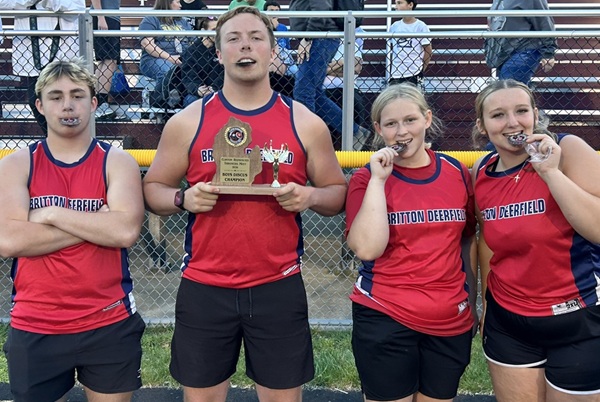
PHOTOS (Top) The Britton Deerfield boys track & field team gathers around coach Dustin Longnecker after winning its Bob Beckey Invitational. (Middle) Patriots throwers (from left) Drew Bunker, Zach Gonzalez, Kurina Dotson and McKenna Allshouse show off their trophy and medals won at the Clinton Throwers Meet. (Photos courtesy of the Britton Deerfield athletic department.)