

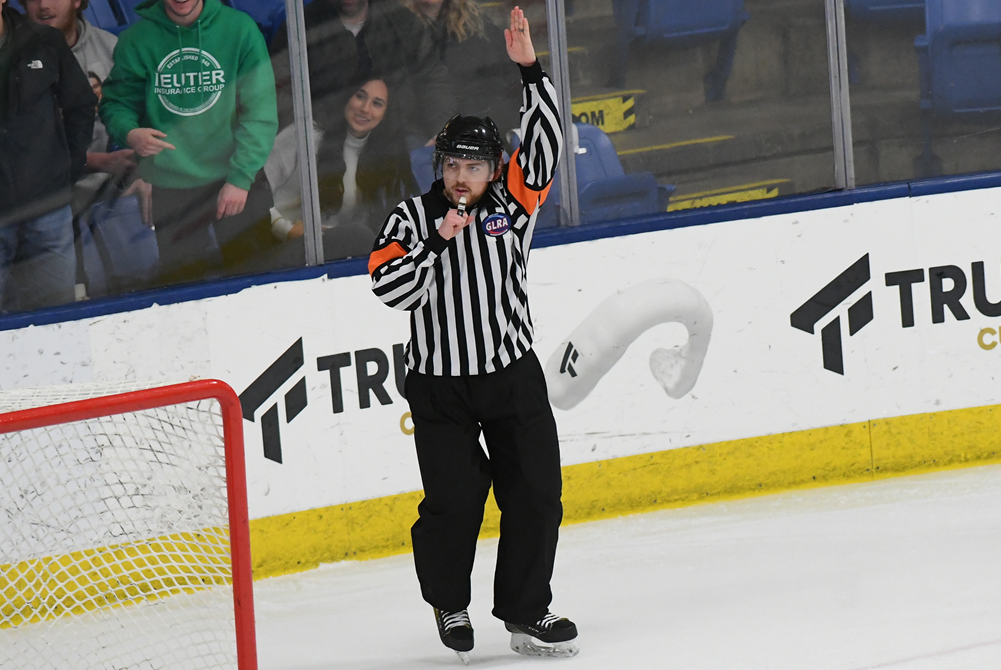
Be the Referee: Hockey Penalties
By
Paige Winne
MHSAA Marketing & Social Media Coordinator
February 6, 2024
Be The Referee is a series of short messages designed to help educate people on the rules of different sports, to help them better understand the art of officiating, and to recruit officials.
Below is this week's segment – Hockey Penalties - Listen
The three most common penalties in high school hockey are tripping, slashing, and hooking. What’s the difference between them?
It’s pretty self-explanatory.
Tripping is when a player uses the stick to make another player fall.
Slashing is when a player swings the stick at another player, whether contact is made or not.
And hooking is using your stick to slow an opponent down, usually the puck handler.
Hooking differs from holding in that hooking involves the use of the stick to slow an opponent down, while holding is done with the hands.
All of these penalties – tripping, slashing, hooking and holding – will result in at least two minutes in the penalty box.
Previous Editions
Jan. 30: Wrestling Tiebreakers - Listen
Jan. 23: Wrestling Technology - Listen
Jan. 9: 3 Seconds - Listen
Dec. 19: Unsuspecting Hockey Hits - Listen
Dec. 12: No More One-And-Ones - Listen
Nov. 21: Football Finals Replay - Listen
Nov. 14: Volleyball Unplayable Areas - Listen
Nov. 7: Pass/Kick Off Crossbar - Listen
Oct. 31: Cross Country Interference - Listen
Oct. 24: Soccer Overtime - Listen
Oct. 17: Tennis Spin - Listen
Oct. 10: Blocked Kick - Listen
Oct. 3: Volleyball Double & Lift - Listen
Sept. 26: Registration Process - Listen
Sept. 20: Animal Interference - Listen
Sept. 13: Feet Rule on Soccer Throw-In - Listen
Sept. 6: Volleyball Jewelry - Listen
Aug. 30: Football Rules Similarities - Listen
Aug. 23: Football Rules Differences - Listen
What's My Why: Official Jason Nickleby
July 22, 2026
Jason Nickleby, Lake Elmo (Minn.)
Nickleby serves as an Minnesota State High School League (MSHSL) assistant director and Big Ten football referee and officiated the College Football Playoff in 2024. He also is a past high school and small-college basketball, baseball, volleyball, and softball official.
My why as an official goes back to when my dad was a coach. He coached high school football, basketball, baseball, softball, track, many things over 35 years as a teacher and coach. And I was always fascinated with the officials. They were the best people. They had the most integrity. They were so professional, and I wanted to be part of that.
And as I grew up in my dads coaching career, I used to stand in the corner of the gym and mimic the calls of the officials, typically beating them to the punch. And I wanted to continue that and stayed a part of the officiating industry.
And now I'm so fortunate to be in the positions that I am. Being a part of officiating everyday.
But my why goes back to high school athletics, high school activities, the most important level out there. Your service as a high school official so critical. And my why is watching what all of you do each and every day as high school officials and giving back to the games that have given so much to us, as athletes, as community members.
“What’s My Why” is a weekly feature telling the stories of MHSAA-registered officials in their own words. If you’re an MHSAA official and would like to share your reason why, please submit a 15 to 45-second video, taken horizontally, to director of officials Sam Davis at [email protected].
Don't miss Officiate Michigan Day 2026, July 25 in Grand Rapids! Check out MHSAA.com/OMD to register and learn more.
What's My Why
July 15: Sam Davis, Lansing - Watch
July 9: Candace Cox, Quincy - Watch
July 1: Robert Williams, Redford - Watch
June 24: Will Godfrey, Jackson - Watch
June 19: Jarrett Skorup, Midland - Watch
June 12: Brady Driver, Sturgis - Watch
June 8: Cindy Tyzo, West Bloomfield - Watch
June 3: Jeff Spedoske, DeWitt - Watch
June 1: Mike Carrier, Commerce Township - Watch
May 27: Stan Wright, Warren - Watch
May 26: Murray Rose, Zeeland - Watch
May 22: Mike VanLaan, Alto - Watch
May 18: Clint Abbott, Newaygo - Watch