

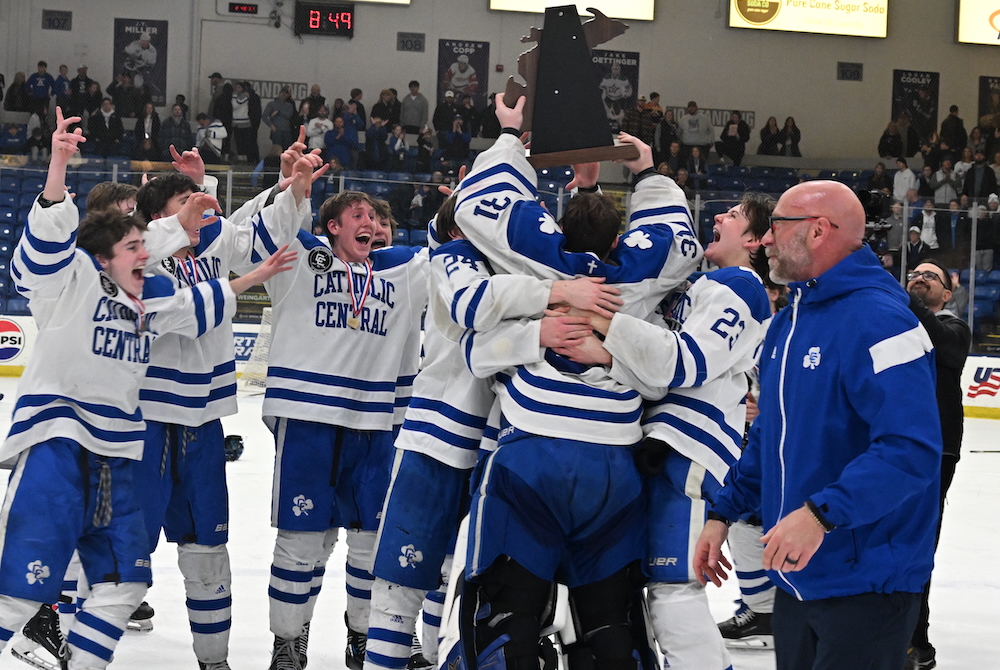
Detroit Catholic Central Raises Hockey Record with 6th-Straight Finals Title
March 8, 2025
PLYMOUTH — There’s no place Brandon Kaleniecki would rather make history as a coach than at the place he helped make history as a player.
Kaleniecki played two seasons at Detroit Catholic Central during its run of five consecutive MHSAA hockey championships from 1999 to 2003 before going on to play for the University of Michigan.
That was the record for most consecutive MHSAA hockey championships until now.
The Shamrocks broke the record they shared with their predecessors from more than two decades ago, winning a sixth title in a row with a 4-1 victory over Howell in the Division 1 championship game Saturday night at USA Hockey Arena.
“It’s fun as a player, because you’re part of it in such a different way,” Kaleniecki said. “Perhaps it’s more fun as a coach, because you get to sit back and kind of watch them enjoy it more. For a lot of guys, it might be their last years playing hockey. You just want them to go out with this experience, the same experience I was fortunate to have.
 “I think that’s what makes it special for me. It’s a different group in that run every year. I can look back and go, ‘It was that senior class or this senior class.’ That’s what makes it fun for me.”
Kaleniecki has won seven MHSAA championships in 10 seasons as the Shamrocks’ coach. From 2010-16, Catholic Central won four Division 1 titles in seven years under four head coaches. Kaleniecki won the fourth championship during that run and has given the Shamrocks stability at the head of the program.
“When I came back to be the coach here, it felt like I just belonged,” he said. “I knew the surroundings, even though it was a different building and school. It felt like that’s where I wanted to be. When I got into coaching, I couldn’t imagine anywhere else I’d rather be coaching than right here. It really makes it very special for me.”
And each championship is special in its own way for Kaleniecki, because every season brings different challenges and a different set of players.
For example, senior Joe Bedells won this championship as the starting goalie after being the backup last season. He split the starts during the regular season before then-senior Mathieu Chernauckas took the reins for the playoff run.
Bedells allowed only three goals in five postseason games over the last 15 days.
“Last year, I backed up for Mathieu Chernauckas,” Bedells said. “He was an excellent goalie. He rightfully had that starting position. It absolutely drove me to be the best I can for this team and for myself to help win the state championship.”
The Shamrocks took a 2-0 lead on goals by Matthew Naida at 5:25 of the first period and Elian Szerlip at 5:07 of the second.
The Highlanders got back to within a goal when Bryce Eskola backhanded the puck toward the net from the right boards and it went in off the stick of a Catholic Central player at 6:56 of the second.
Catholic Central (28-2) re-established its two-goal lead when Peter Sanin scored with 5:06 remaining in the second period.
The celebration was on once defenseman Ryan Dye scored into an empty net with 50.2 seconds left in the game. It was Dye who scored the biggest goal during the playoff run, an overtime goal in a 2-1 victory over second-ranked Hartland in the Regional championship game.
 Heading into the postseason, Warren De La Salle Collegiate defeated Catholic Central in overtime, handing the Shamrocks’ their first loss to a Michigan school in three years. Catholic Central kicked it into gear and went 5-0 in the playoffs, extending their MHSAA Tournament winning streak to 35 games.
“The loss to De La Salle, that was a real defining moment for us, because they kind of flipped the switch and had to find a way down the stretch when it wasn’t easy,” Kaleniecki said.
It was the third MHSAA Finals appearance for Howell, all of which ended with losses to Catholic Central. The first two were in 2009 and 2010.
The Highlanders lost only one game in regulation time all season before Saturday, ending 24-4-2.
“This year we feel like we changed the face of the program across the board,” first-year Howell coach Keith Robertson said. “I told the seniors they changed the trajectory of the program when you take it to the state Finals. It’s special. I couldn’t be more proud of this group. They’ve changed things forever in Howell.”
The Shamrocks outshot the Highlanders 41-10. Henry Lansky made 37 saves for Howell.
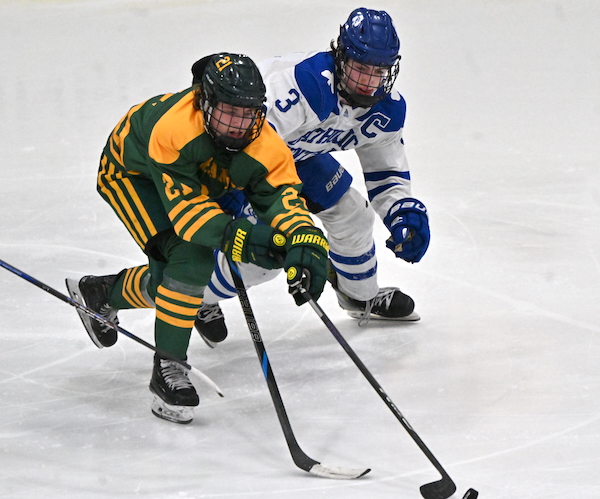
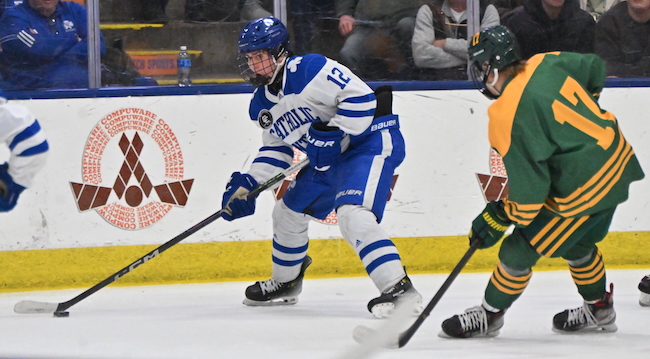
PHOTOS (Top) Detroit Catholic Central players raise their championship trophy Saturday at USA Hockey Arena. (Middle) The Shamrocks’ Nick Leiter (3) and Howell’s Ben Huotari contend for a loose puck. (Below) Matthew Naida (12) contemplates his next pass as Bryce Eskola (17) moves in to apply pressure.
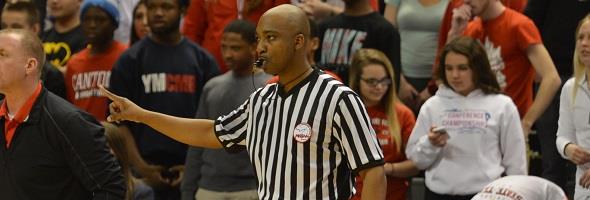
Be the Referee: Hockey Rules Chart
February 6, 2020
This week, MHSAA assistant director Brent Rice addresses some of the rules differences between high school and college hockey.
Be The Referee is a series of short messages designed to help educate people on the rules of different sports, to help them better understand the art of officiating, and to recruit officials.
Below is this week's segment - Hockey Rules Chart - Listen
Today we’d like to take a look at some of the differences between high school and college hockey.
• During pregame, the high school coach must meet with officials to verify that all players are properly equipped. There is no such rule in college hockey.
• Hand passes are permitted in the defensive zone in high school hockey, but not in college hockey.
• Goalies may play the puck with a high stick in college hockey, but not in high school hockey.
• A puck directed into the goal with a skate may be allowed in college hockey, but not in high school hockey.
Knowing the rules differences can help you better enjoy watching this sport. You can find the complete chart of rules differences on the Ice Hockey page of the MHSAA Website.
Past editions
Jan. 30: Cheer Safety - Listen
Jan. 23: Goaltending - Listen
Jan. 16: Wrestling Tie-Breaker - Listen
Jan. 9: Pregame Meeting - Listen
Dec. 19: Alternating Possession - Listen
Dec. 12: Ratings - Listen
Dec. 5: Video Review Success - Listen
Nov. 28: More Injury Time - Listen
Nov. 21: Football Review - Listen
Nov. 14: Sideline Safety - Listen
Nov. 7: Officials Playlist - Listen
Oct. 31: Most Important Line - Listen
Oct. 24: Automatic 1st Downs - Listen
Oct. 17: Catch Momentum - Listen
Oct. 10: Golf Rules Changes - Listen
Oct. 3: No Tackle Box - Listen
Sept. 26: You Make the Overtime Call - Listen
Sept. 19: Swimming Finishing Touch - Listen
Sept. 12: Curbing Gamesmanship By Substitution - Listen
Sept. 5: Football Safety Rules Changes - Listen
Aug. 29: 40-Second Play Clock - Listen