

Powers Pursuing Flint's 1st Hockey Title
January 26, 2016
By Bill Khan
Special for Second Half
BURTON — Flint Powers Catholic was on upset alert, locked in a 3-3 tie with unheralded Mount Pleasant after squandering a 3-0 lead. 
It was time for a hero to emerge for the Chargers.
But who?
The team's leading goal scorer left the game with an injury, as did another of the team's top point producers.
So, of course, it was a player who had only one goal all season (sophomore Josh Warda) who broke the tie with 6:09 remaining, propelling the second-ranked hockey team in Division 3 to a 6-3 victory at Crystal Fieldhouse.
Of course.
For Powers, there is no such thing as an unexpected hero.
The Chargers' seemingly endless quest to produce the Flint area's first MHSAA hockey championship isn't being spearheaded by one superstar player or one explosive line.
Rather, Powers has built a 14-1-1 record with a lineup that is remarkable in terms of sheer balance and depth.
The Chargers' top eight scorers are all within nine points of each other, led by Brendan Smith and Conor Witherspoon with 24 points each. Smith has 11 goals and 13 assists, while Witherspoon has 10 goals and 14 assists.
Following closely behind are Jon Thomas (6 goals, 17 assists), Chase Knoblock (12 goals, 7 assists), Mason Weiss (6 goals, 13 assists), Cam Lieffers (6 goals, 10 assists), Brendan Walker (3 goals, 13 assists) and Jake Polakowski (2 goals, 13 assists).
"We've had teams in the past that are pretty top-heavy," 10th-year Powers coach Travis Perry said. "Right now, you can't focus on one line. We have three lines that can score, and we've got a fourth line that can play, too. This is the first year since I've been here that we can roll four lines consistently."
One of those top-heavy teams was last year's squad. Powers got all the way to the MHSAA Division 3 Semifinals before losing 4-1 to Houghton. That team was led by all-stater Mike Forman, who had 61 points. Jeff Polakowski was second with 52 points. The drop-off was steep after that, with Witherspoon ranking third on the team at 23 points. The next two scorers tied for fourth with 18.
 "Mike Forman was our leading scorer last year," Smith said. "He could put up points. He always had a target on his back every game. It was tough for him sometimes to get open and score goals. On this team, we have a group of guys who are all pretty close in stats. It's hard for teams to target one of our guys. They get one of our guys, and another one of our guys is going to be open all game long."
Powers hopes this balanced approach will finally pay off with an MHSAA championship March 12 at USA Hockey Arena in Plymouth.
The Chargers have the most successful hockey program in Michigan that hasn't won it all. They own a record 32 Regional championships, one more than Trenton. Trenton, of course, has 14 MHSAA Finals championships, second only to Bloomfield Hills Cranbrook Kingswood's 17.
Powers has been to 19 MHSAA Semifinals and seven title games. The Chargers' best shot at the championship came in 2008 when they controlled play for most of the game, only to lose 1-0 in overtime to Calumet in the Division 3 Final. It's a loss that still haunts Perry, whose team lost 3-1 to Cranbrook Kingswood in the championship game two years later.
Although Genesee County at one time had more than 20 schools playing hockey, it still has not won an MHSAA championship. Teams from Genesee County are 0-12 in the Finals, with five schools reaching the title game at least once. After coming two victories short of ending that streak last season, the returning Chargers immediately focused on this season.
"It was a heartbreaker, but I know everybody was determined at the end of the season to come back out and have a better result this year," senior forward Charlie Start said. "It'd be amazing having that reputation of being the first team in Genesee County to win a state championship."
Powers typically plays a tough regular-season schedule, expecting to take some lumps that will pay off come playoff time. Last year's team, for instance, went 17-8 in the regular season before reaching the Semifinals. The schedule remains tough, but the lumps have been few.
The only loss for the Chargers was a 3-1 decision to ninth-ranked Sault Ste. Marie on Dec. 11 in the Division 3 Showcase in Gaylord. Powers played a 3-3 tie on Jan. 9 against Detroit U-D Jesuit, the third-ranked team in Division 1.
The only team ranked ahead of Powers in Division 3 is Grand Rapids Catholic Central (13-1), which eliminated the Chargers in the 2011, 2012 and 2014 MHSAA Quarterfinals. If they meet this season, it will be in the Quarterfinals on March 9 at Munn Arena in East Lansing.
 "Really, it's just a number," Smith said of Powers' ranking. "We don't come in thinking, 'Hey, we're No. 2 in the state.' We're coming in trying to be consistent every game, playing how we know. We're not letting that No. 2 get to our heads and get our egos up."
Before Powers can entertain thoughts of a matchup with Grand Rapids Catholic Central or hoisting the championship hardware in Plymouth, the Chargers must first get past one of their toughest opening-round assignments ever. Powers will travel to Saginaw-Bay Ice Arena on Feb. 29 to play a Pre-Regional game against No. 5 Saginaw Heritage on the Hawks' home ice.
"It's one of those things where one of the top five teams in the state goes home the first night," Perry said.
Asked if this was his best team yet at Powers, Perry hesitated.
"Uh," he said. "I don't want to say that yet. We'll see what happens when we get to March. It's definitely been the most enjoyable season so far, just because of the lack of seniors. Seniors usually run your team, and they're the core. We have three great seniors and they've done a great job, but we're bottom-heavy right now.
"This is one of those weird years where this is the least amount of seniors we've had in my 10 years. We have almost every guy coming back. I'd think we'd be just as strong next year, if not stronger."
 Bill Khan served as a sportswriter at The Flint Journal from 1981-2011 and currently contributes to the State Champs! Sports Network. He can be reached at [email protected] with story ideas for Genesee, Lapeer, St. Clair, Sanilac, Huron, Tuscola, Saginaw, Bay, Arenac, Midland and Gladwin counties.
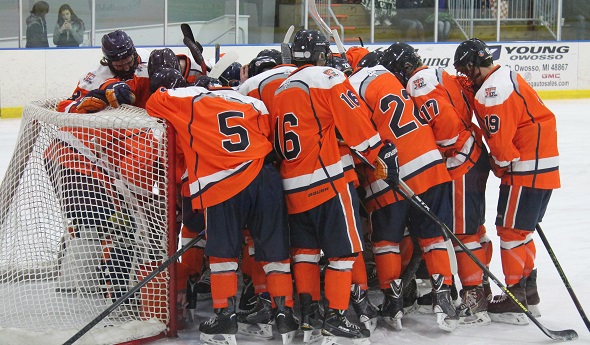
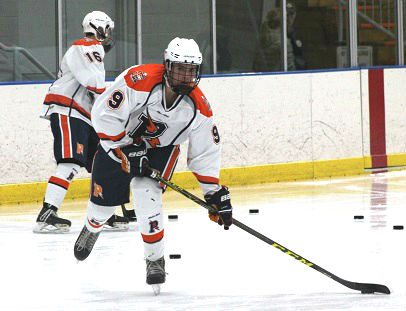
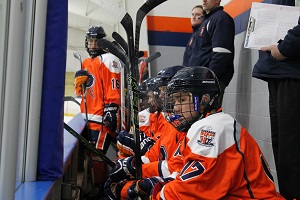
PHOTOS: (Top) Flint Powers Catholic hockey players huddle up in front of the net this season. (Middle) Forward Conor Owen prepares to unload a shot during pregame warmups. (Below) The Chargers are paced by a large group of contributors, and this group catches a quick break. (Photos courtesy of Flint Powers Catholic.)
Trenton's Turner Takes Turn at No. 1
February 26, 2014
By Geoff Kimmerly
Second Half editor
Trenton's Mike Turner became the winningest hockey coach in MHSAA history Tuesday with his team's 6-0 victory over Wyandotte in a Division 2 Pre-Regional game.
The win pushed Turner's career record to 624-122-41 and past East Kentwood's Ron Baum (623-219-30 from 1973-2007) into the top spot. Turner has coached Trenton from 1974-81 and again since 1995.
His teams have won 10 MHSAA championships. Turner's 624 wins also rank fifth on the national hockey coaching list.
Click to check out the media coverage from the Detroit Free Press, Oakland Press and Detroit News and the video below from WXYZ.