

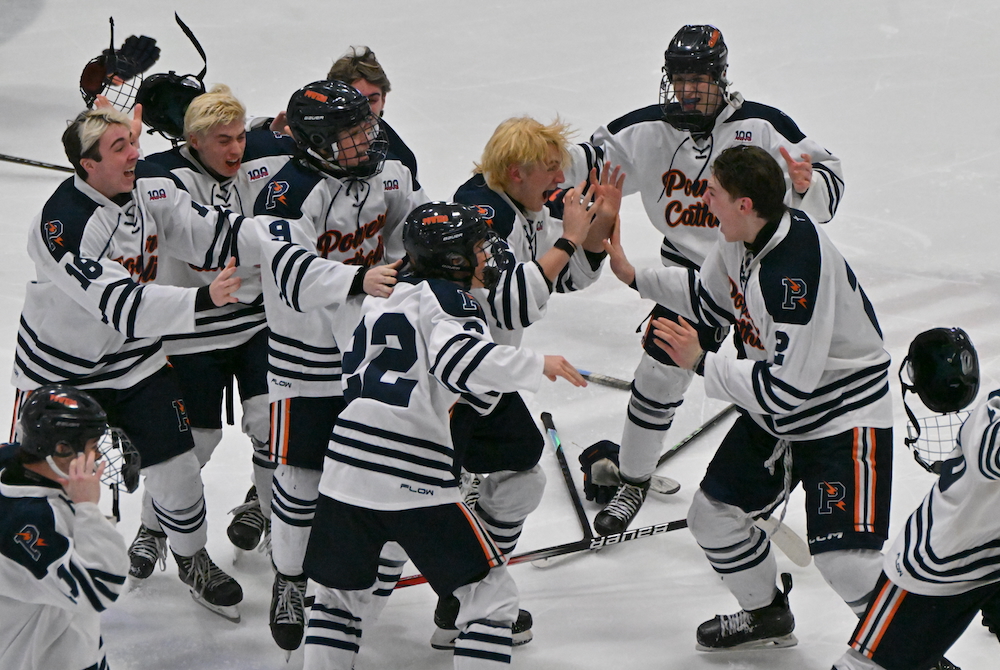
Surprise Scorer Nets Powers' Unforgettable Championship Clincher
March 8, 2025
PLYMOUTH – Ethan Haley’s hockey season for Flint Powers Catholic could have ended in late January when he suffered a broken ankle.
“I thought I was going to miss more time than I did,” Haley said. “The doctor cleared me sooner, so it was very exciting to get back playing with everyone and going to practice every day.”
After missing only four games and a little more than two weeks, Haley rejoined the Chargers late in the regular season, putting him in a position to score one of the biggest goals in school history.
Haley’s shot from the right point 1 minute and 53 seconds into overtime gave Powers a 3-2 victory over Livonia Stevenson in the MHSAA Division 2 championship game Saturday at USA Hockey Arena.
It wasn’t a particularly hard shot, but the Chargers got traffic in front of the net, making it difficult for Stevenson’s goalie to track the puck.
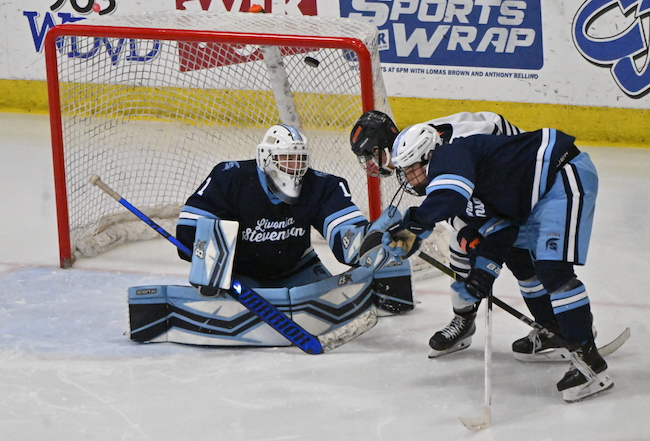 “Before that, Coach said to get pucks on net, get pucks out of our zone, which we did,” Haley said. “I saw a guy on Cooky (Ayden Cook). He slid it down and passed it to me. I just shot it. I thank Parker (Bendall) for screening the goalie. He couldn’t see it.”
Haley, a sophomore defenseman, goes down in history as one of the more unlikely heroes to score an overtime winner in an MHSAA championship game.
It was his fourth goal in 22 games this season and the second in his last 19 games. He scored twice in the first three games.
“My role is definitely an energy guy, I would say,” Haley said.
The championship was the second for Powers over the last three seasons. The Chargers were perhaps the top program in Michigan not to win an MHSAA title until breaking through two years ago in their eighth appearance in a championship game.
Powers finally broke through that time when Mason Czarnecki scored on a breakaway with 4.6 seconds left in the third period, giving the Chargers a 3-2 victory over East Grand Rapids.
“It’s a lot different this time around,” Powers coach Travis Perry said. “The first time, it’d been 50 years of frustration, anger. I’d been coaching 17 years, and we lost a couple down here. That was really a monkey off our back. This one really solidifies our program. The biggest thing I told the guys is probably five years ago we came down here looking to compete, not just hoping to compete.”
The Chargers have only three holdovers from the team that was a Division 3 champion two years ago in seniors Andrew Parmentier, Brody Neelands and Andrew Burny. As sophomores, they learned how to win on a team that had 11 seniors and eight juniors.
“It feels like a dream,” Burny said. “We came here and made history twice. I wouldn’t have rather done it with any other group of guys.”
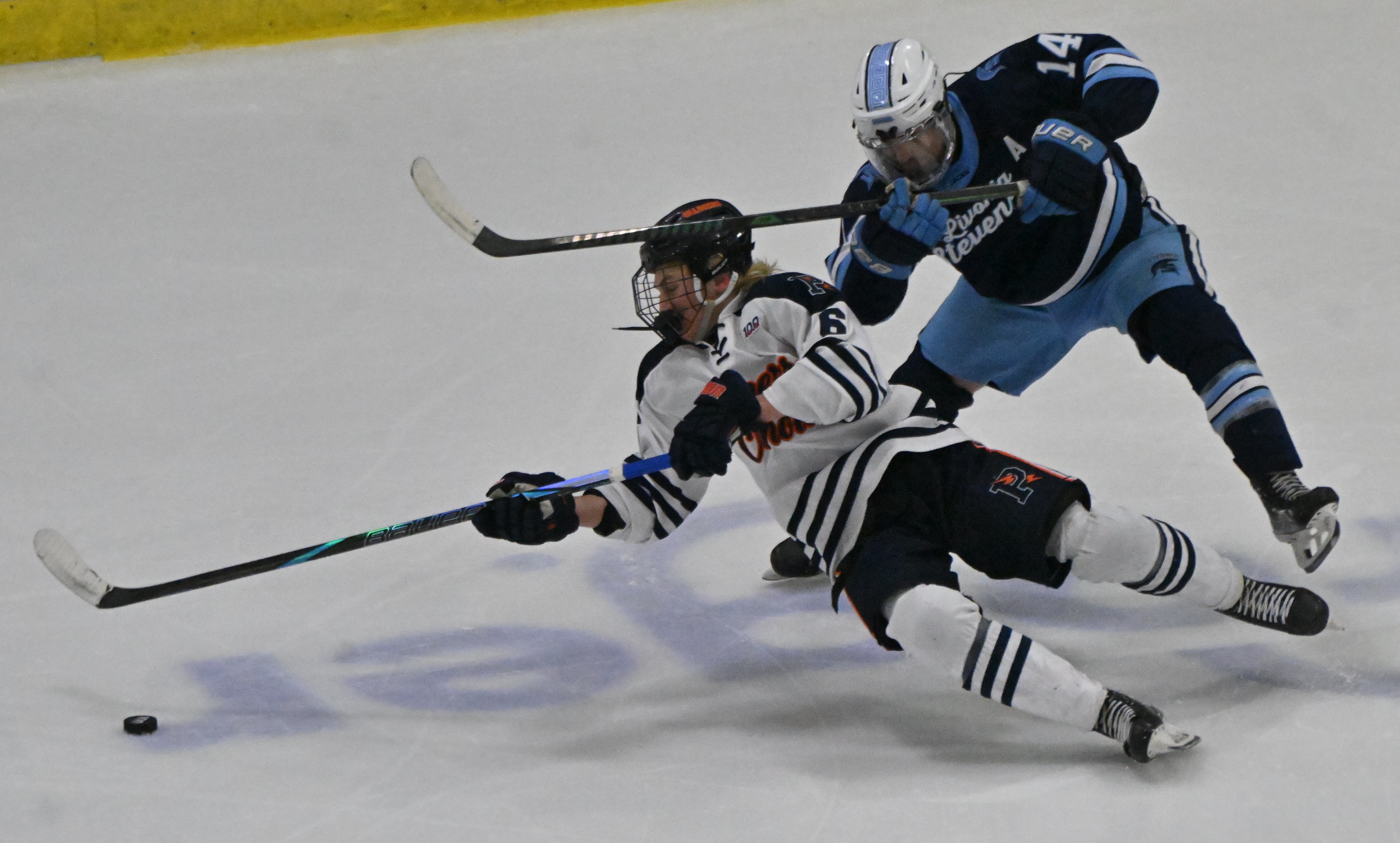 The Chargers finished with a 25-4 record and were ranked No. 1 in Division 2, but had to battle from behind in many of their games. The victory over Stevenson was their second in overtime during the playoffs, the other a 5-4 decision over Marquette in the Quarterfinals.
So, there was no panic when goals by Colin Stroble and Riley Rorabacher gave Stevenson a 2-1 lead with 12:53 left in the second period after Powers had taken an early 1-0 lead on a goal by Jack Johnson. There was no panic when Stevenson tilted the ice for most of the second, dominating puck possession.
Cook put Powers in a position to win in overtime when he tied the game with his 40th goal of the season with 6:45 remaining in regulation.
Stevenson (18-9-2) made a run to its first championship game since 2016 by winning its final five regular-season games, then four more in the playoffs. The Spartans lost four straight games prior to their winning streak, allowing 19 goals during that stretch.
Coach David Mitchell met with his four captains in early February, and they responded by leading Stevenson's late-season charge.
“We’ve all had our ups and downs, me included,” Stevenson senior forward Owen Hall said. “I just watched everyone on the team grow into the fine person they are today. I watched everyone grow on the team, even our coaching staff. It was successful, because we’ve grown so much over time. I couldn’t be more proud.”
For veteran Stevenson coach David Mitchell, it was gratifying to get the program back on the biggest stage. The Spartans made three Finals in four seasons from 2013-16, winning the 2013 Division 2 title.
“I told them they put Stevenson hockey, I don’t want to say on the map, because we’ve never really been off it,” Mitchell said. “But they got us back to the point we try to achieve to get to. I think they did that not only as players on the ice, but as a community. People like Mr. (Arnold) Muscat (Stevenson’s athletic director) and the Stevenson community not only made this an enjoyable ride, but made this a memorable one. It made it easier for us to get inspired to play for a bigger cause.”
PHOTOS (Top) Flint Powers Catholic players celebrate after clinching their championship with an overtime win Saturday. (Middle) The winning goal makes its way into the top corner of the Stevenson net 1:53 into overtime. (Below) Powers’ Ethan Haley (6) and Stevenson’s Riley Rorabacher chase a loose puck.
Seniors Earn Spot in Trenton Title History
March 8, 2014
By Geoff Kimmerly
Second Half editor
PLYMOUTH – Trenton senior Andrew Sawyer remembers attending every Trojans home hockey game growing up. He said his parents didn’t miss one for 15 years.
And he and the rest of Trenton’s seniors had contributed their share of memorable moments to one of the most storied programs in MHSAA history – including helping longtime coach Michael Turner become the state’s winningest at the high school level a few weeks ago.
But until Saturday, they had never been part of an MHSAA Finals championship.
Sawyer and six of his classmates closed their careers by helping Trenton to an 8-3 victory over Hartland in the Division 2 Final at Compuware Arena – and in doing so, became the 14th Trojans team to win the highest title and first since 2010.
“I grew up every day of my childhood, … looked up to every single player,” Sawyer said. “It feels amazing to finally be one of the guys I was looking up to at one point in my life.”
Turner, who upped his career record to 628-126-52 over 28 seasons, took his team in front of Trenton’s championship banners earlier this week to give them one last reminder of Saturday’s opportunity.
The Trojans (26-4-1) also received messages from past players wishing them luck with hopes they might enjoy what those past champions once experienced. Trenton trailed only Bloomfield Hills Cranbrook-Kingswood (16) in all-time hockey titles.
“It’s my best moment ever in hockey. It will be my best memory no matter what happens, whether I go on or whatever I do,” senior goaltender Nick Ramirez said. “It was amazing. And it was great to celebrate with my teammates.”
Trenton opened the weekend with a 7-0 Semifinal win over Warren DeLaSalle, then watched as Hartland – last season’s Division 2 runner-up as well – got on the board first in the Final with a goal 4:17 into the game.
But if the Trojans were worried at all, that was the last time during the 2013-14 season.
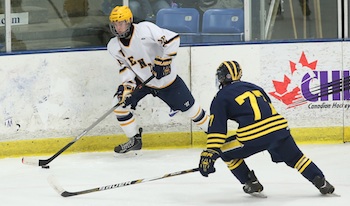 Trenton scored the next six goals, with three from senior Justin Dunn and two within 12 seconds from senior Mitchell Galea to start the third period. Turner preached to his team all tournament to attack the goal, and Saturday the Trojans took 52 shots as Hartland goalie Nick Wineka made 42 saves, fourth most in MHSAA Finals history.
The Eagles finished 20-10-1 after giving coach Rick Gadwa his third Regional title in three seasons leading the program. They fell to Trenton 5-3 earlier as part of a 1-8 skid to finish the regular season. But they battled back with four one-goal wins during the MHSAA tournament.
Wineka was one of six seniors who were part of all three Regional title teams. They led a lineup that rebuilt this winter with a young defensive corps, and leave having helped build Hartland into an elite program.
“They pulled off some things this year that flashed through my head, and I can’t believe it,” Gadwa said. “To come back this year, you’ve got high hopes, you’ve got a target on your back, and we didn’t have all that we’ve had. … Unbelievable.”
Dunn – whose older brother Cory starred for Turner and dad had him as a teacher – also had two assists for Trenton. Galea added an assist on Dunn’s first goal, and junior Philip Pugliese had one of each.
Trenton opened this season 3-3 before winning its next two games by a combined score of 22-2. Turner watched Ramirez raise his game and knew he could have another contender – a point reinforced when the Trojans finished the regular season on a 9-1 run after going 5-5 over the same stretch a year ago.
Six games later, they stamped their place in Trenton hockey history.
“It’s a tradition. It’s a family atmosphere down here,” Turner said. “They can now take their mark. This is one of 14, and they certainly are going to have that memory for a long, long time.”
Click for a complete box score.
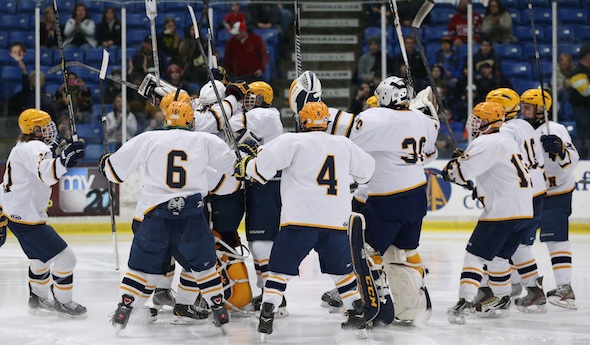
PHOTOS: (Top) Trenton celebrates an 8-3 win and its 14th MHSAA championship. (Middle) Trenton's Nickolas Bondy (10) looks to move the puck around Hartland senior Austin Flores (77).
HIGHLIGHTS: (1) Hartland’s first goal by Josh Ruthig. (2) Trenton’s Justin Dunn completes his hat trick with 1 second left in the second period. (3) Mitchell Galea of Trenton completes his hat trick – all three goals came in the third period.