

Surprise Scorer Nets Powers' Unforgettable Championship Clincher
March 8, 2025
PLYMOUTH – Ethan Haley’s hockey season for Flint Powers Catholic could have ended in late January when he suffered a broken ankle.
“I thought I was going to miss more time than I did,” Haley said. “The doctor cleared me sooner, so it was very exciting to get back playing with everyone and going to practice every day.”
After missing only four games and a little more than two weeks, Haley rejoined the Chargers late in the regular season, putting him in a position to score one of the biggest goals in school history.
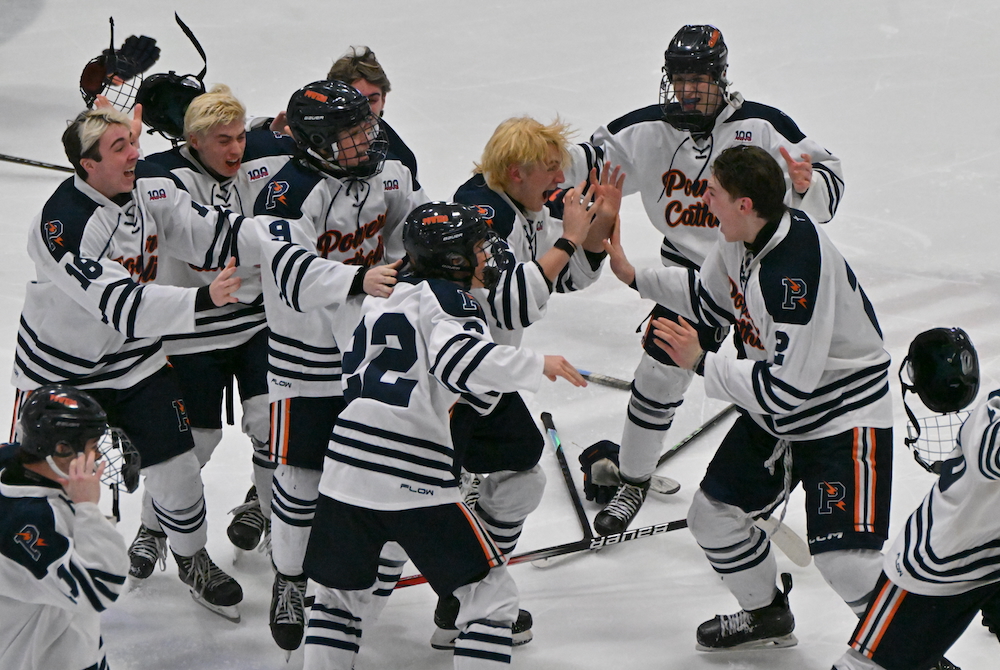
Haley’s shot from the right point 1 minute and 53 seconds into overtime gave Powers a 3-2 victory over Livonia Stevenson in the MHSAA Division 2 championship game Saturday at USA Hockey Arena.
It wasn’t a particularly hard shot, but the Chargers got traffic in front of the net, making it difficult for Stevenson’s goalie to track the puck.
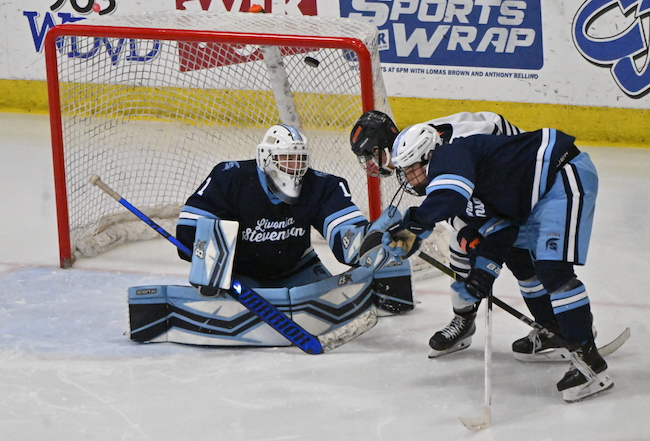 “Before that, Coach said to get pucks on net, get pucks out of our zone, which we did,” Haley said. “I saw a guy on Cooky (Ayden Cook). He slid it down and passed it to me. I just shot it. I thank Parker (Bendall) for screening the goalie. He couldn’t see it.”
Haley, a sophomore defenseman, goes down in history as one of the more unlikely heroes to score an overtime winner in an MHSAA championship game.
It was his fourth goal in 22 games this season and the second in his last 19 games. He scored twice in the first three games.
“My role is definitely an energy guy, I would say,” Haley said.
The championship was the second for Powers over the last three seasons. The Chargers were perhaps the top program in Michigan not to win an MHSAA title until breaking through two years ago in their eighth appearance in a championship game.
Powers finally broke through that time when Mason Czarnecki scored on a breakaway with 4.6 seconds left in the third period, giving the Chargers a 3-2 victory over East Grand Rapids.
“It’s a lot different this time around,” Powers coach Travis Perry said. “The first time, it’d been 50 years of frustration, anger. I’d been coaching 17 years, and we lost a couple down here. That was really a monkey off our back. This one really solidifies our program. The biggest thing I told the guys is probably five years ago we came down here looking to compete, not just hoping to compete.”
The Chargers have only three holdovers from the team that was a Division 3 champion two years ago in seniors Andrew Parmentier, Brody Neelands and Andrew Burny. As sophomores, they learned how to win on a team that had 11 seniors and eight juniors.
“It feels like a dream,” Burny said. “We came here and made history twice. I wouldn’t have rather done it with any other group of guys.”
 The Chargers finished with a 25-4 record and were ranked No. 1 in Division 2, but had to battle from behind in many of their games. The victory over Stevenson was their second in overtime during the playoffs, the other a 5-4 decision over Marquette in the Quarterfinals.
So, there was no panic when goals by Colin Stroble and Riley Rorabacher gave Stevenson a 2-1 lead with 12:53 left in the second period after Powers had taken an early 1-0 lead on a goal by Jack Johnson. There was no panic when Stevenson tilted the ice for most of the second, dominating puck possession.
Cook put Powers in a position to win in overtime when he tied the game with his 40th goal of the season with 6:45 remaining in regulation.
Stevenson (18-9-2) made a run to its first championship game since 2016 by winning its final five regular-season games, then four more in the playoffs. The Spartans lost four straight games prior to their winning streak, allowing 19 goals during that stretch.
Coach David Mitchell met with his four captains in early February, and they responded by leading Stevenson's late-season charge.
“We’ve all had our ups and downs, me included,” Stevenson senior forward Owen Hall said. “I just watched everyone on the team grow into the fine person they are today. I watched everyone grow on the team, even our coaching staff. It was successful, because we’ve grown so much over time. I couldn’t be more proud.”
For veteran Stevenson coach David Mitchell, it was gratifying to get the program back on the biggest stage. The Spartans made three Finals in four seasons from 2013-16, winning the 2013 Division 2 title.
“I told them they put Stevenson hockey, I don’t want to say on the map, because we’ve never really been off it,” Mitchell said. “But they got us back to the point we try to achieve to get to. I think they did that not only as players on the ice, but as a community. People like Mr. (Arnold) Muscat (Stevenson’s athletic director) and the Stevenson community not only made this an enjoyable ride, but made this a memorable one. It made it easier for us to get inspired to play for a bigger cause.”
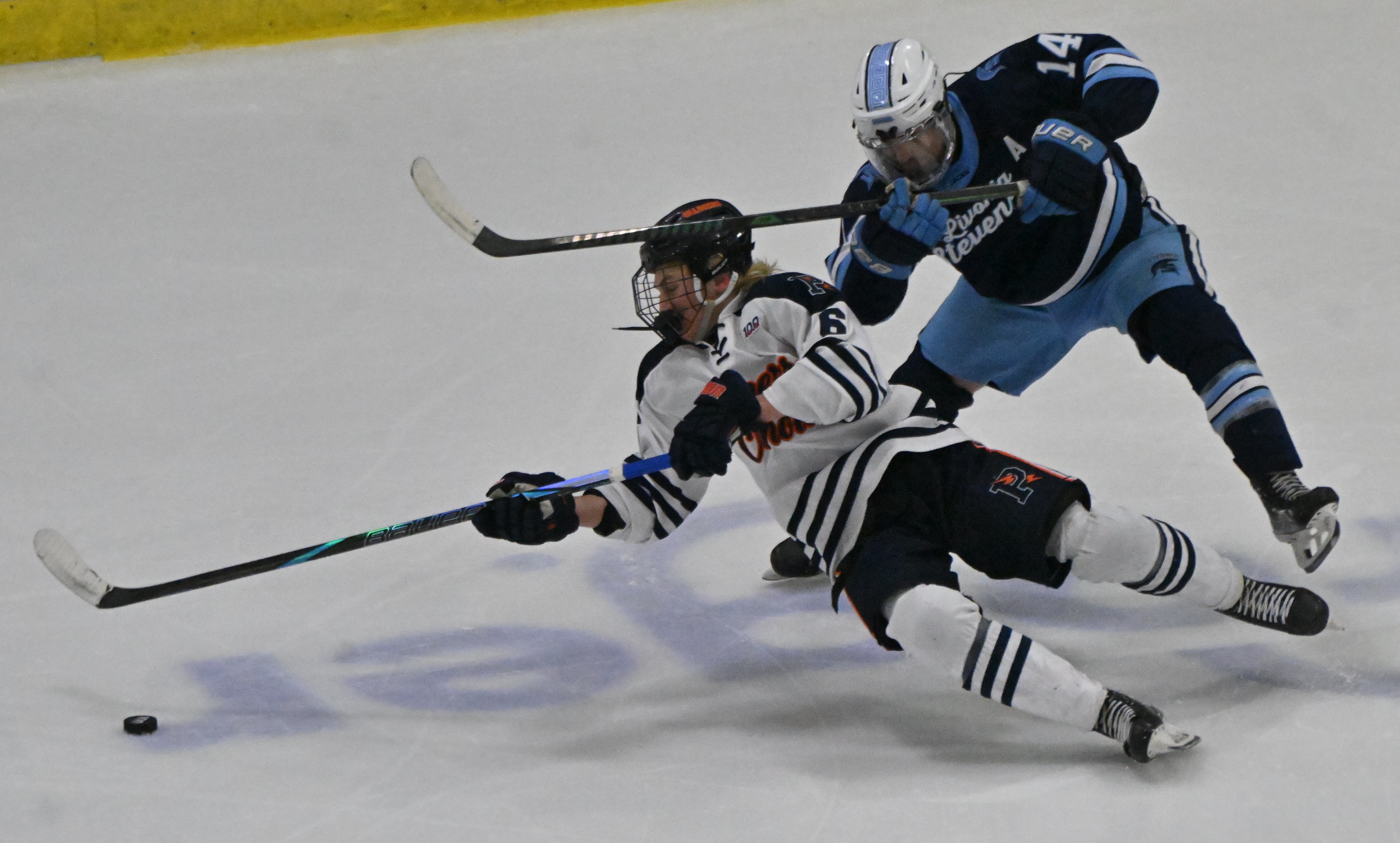
PHOTOS (Top) Flint Powers Catholic players celebrate after clinching their championship with an overtime win Saturday. (Middle) The winning goal makes its way into the top corner of the Stevenson net 1:53 into overtime. (Below) Powers’ Ethan Haley (6) and Stevenson’s Riley Rorabacher chase a loose puck.
Clarkston Eying Postseason Possibilities with Challenging Regular-Season Schedule
By
Keith Dunlap
Special for MHSAA.com
December 20, 2023
It might not be January just yet, but the Clarkston hockey team has probably already felt like it has competed in the MHSAA Tournament for the 2023-24 season.
 The Wolves have gone through a gauntlet of a nonleague schedule, with two games against last season’s Division 1 runner-up Brighton, a game against reigning Division 3 ion Flint Powers Catholic and a contest against Grand Rapids Forest Hills Central, a Division 1 semifinalist last winter.
However, there has been a method to the madness for a Clarkston team that’s normally not so ambitious with nonleague scheduling.
The Wolves saw a 20-win season end with a 6-1 Regional Final loss to Hartland in March, and the idea is that playing some of the state’s best so early will toughen Clarkston up further for when this season’s playoffs arrive.
“I think we’ve already kind of went through hard times and had moments of adversity,” Clarkston head coach Nathan Bryer said. “We’re already a team that has faced a lot more hardship than our team last year at this point. I think last year at this point, we were still undefeated and had an easier time with it.”
So far, Clarkston has done a good job navigating the tough early slate, with wins over Powers and Forest Hills Central and close defeats to Brighton (4-3 and 3-1).
It’s all in an effort to eventually do something no team in school history or any squad in the Oakland Activities Association has done – win a Division 1 Finals championship.
No OAA squad has reached the championship game in Division 1 since Clarkston did so in 2005, and only two have reached the Division 1 Semifinal round since 2011 (Lake Orion in 2011 and Rochester United in 2019).
Farmington is the only OAA school to ever win a Finals hockey title, doing so in Division 3 in 2014.
 Based on who returns from last year’s team, Clarkston likely will be in the conversation and could represent the OAA’s best chance in recent years to have a team make it back to Plymouth and the season’s final weekend, and perhaps do some winning there also.
The Wolves return 15 players off a team that dominated the OAA last season, finishing 8-1-1 in league play.
Junior forward Ron Wade was a first-team all-state performer in Division 1, while defenseman Evan Adams was named second-team all-state.
Those two along with forward Owen Croston are the team’s captains this winter.
The Wolves are 7-2 going into a Thursday night contest against league rival Rochester Hills Stoney Creek.
With so much familiarity among players and coaches, not as much time needed to be spent during the offseason getting to know one another.
“The team is already pretty bonded this year,” Adams said. “We didn’t really have to worry that much about being a big group, or chemistry, this year.”
In January, the toughening-up process won’t end for Clarkston, given the Wolves will have a game against four-time reigning Division 1 champion Detroit Catholic Central.
“We haven’t had a hard (nonleague) schedule before until this year,” Croston said. “We just have to be ready for those games.”
When the MHSAA Tournament does roll around, Clarkston will have to jump over the same hurdles it usually must in its Regional – Hartland and Lake Orion.
Wade said the team still has lessons learned from the playoff loss to Hartland on its mind.
“We just learned that we really have to stick to our identity in those games,” he said. “This year, we have to rely on our forecheck and all of us pushing for the same thing.”
Indeed, it might not be 2024 yet, but Clarkston already has found out a lot about itself as it tries to replicate the postseason in November and December before the real one arrives.
“I think those teams who play a rigorous schedule all year, they are a little bit more battle-tested when Regionals come around,” Bryer said. “That was our goal this year, to have a team that’s played against top-10 opponents consistently all year. I think we’ll be better for it throughout the regular season, and better for it in Regionals.”
 Keith Dunlap has served in Detroit-area sports media for more than two decades, including as a sportswriter at the Oakland Press from 2001-16 primarily covering high school sports but also college and professional teams. His bylines also have appeared in USA Today, the Washington Post, the Detroit Free Press, the Houston Chronicle and the Boston Globe. He served as the administrator for the Oakland Activities Association’s website from 2017-2020. Contact him at [email protected] with story ideas for Oakland, Macomb and Wayne counties
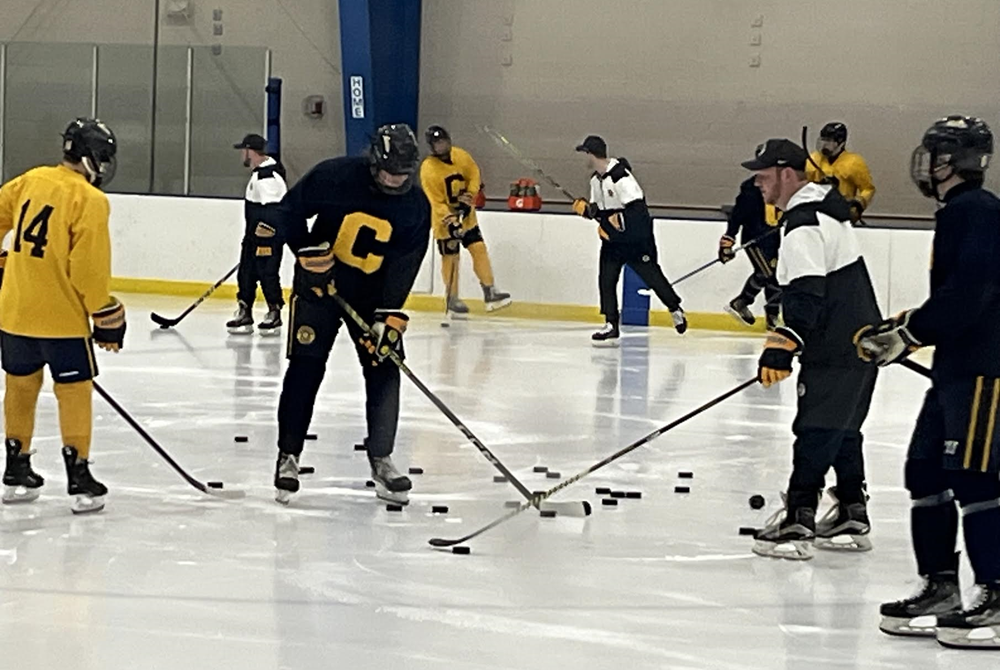
PHOTOS (Top) Clarkston warms up before a recent practice at Detroit Skate Club. (Middle) Clarkston warms up before a recent practice at Detroit Skate Club. (Photos by Keith Dunlap.)