

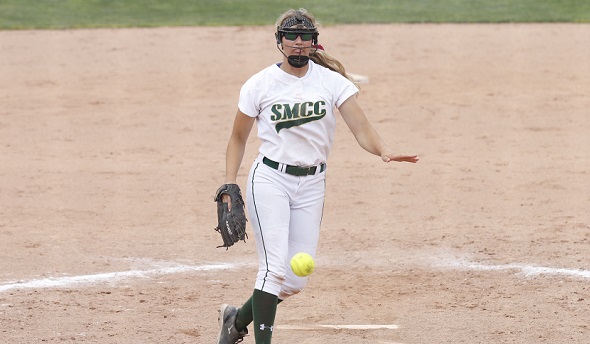
Kestrels' Ace Off to Near-Perfect Encore
By
Chip Mundy
Special for Second Half
May 12, 2016
By Chip Mundy
Special for Second Half
MONROE – Monroe St. Mary Catholic Central junior pitcher Meghan Beaubien is a self-proclaimed perfectionist playing in a sport that rarely sees perfection.
 She comes close enough. Actually, she is such an outstanding softball pitcher that she recently was named the No. 5 high school softball player of the 2017 graduating class in the country by one publication, and last year she was the Gatorade state Softball Player of the Year for Michigan.
Beaubien, who stands 5 feet, 8 inches tall, capped her sophomore season by leading SMCC to the Division 3 championship. She threw her 10th no-hitter of the season in the Semifinal against Pinconning, and then flirted with a perfect game before settling for a one-hitter in the title game. She also had a two-run home run in the finale – a 2-0 victory.
The numbers are eye-popping:
As a freshman, Beaubien was 19-9 with a 0.69 ERA and 254 strikeouts.
As a sophomore, she was 33-3 with a 0.31 ERA and 456 strikeouts.
So far this year, Beaubien is 9-0 with a 0.51 ERA and 141 strikeouts.
Beaubien, however, is not consumed with the numbers. She doesn’t even know them.
“I don’t look at my numbers,” she said. “Maybe I’ll look at them at the end of the year.”
She also knows the expectations that come with such numbers.
“I’m a bit of a perfectionist myself in school and in sports,” she said. “There is no way you can be perfect, so you just have to forget what other people expect you to do and just go out there and do what you’re trying to do one pitch at a time.”
Bread-and-butter pitch
Beaubien, obviously, isn’t a typical high school softball pitcher. However, she isn’t even a typical elite high school softball pitcher. Although she throws hard, the change-up is her go-to pitch, and she is left-handed.
“It is a predominantly right-handed pitching game,” SMCC softball coach John Morningstar said. “You don’t see a lot of lefties, and when you bring the speed that she brings it at – even to right-handed hitters – it’s still very deceptive. She can go in and out and up, and then you have the change-up, so coming from the left side is a look that you don’t see very often. You can’t create that.”
Beaubien’s parents, Jason and Kimberly, recognized her talent at an early age and encouraged her to become more than just a hard thrower.
“She started playing grade-school ball, and I knew then that she had talent, so I started getting her to the right coaches,” Jason Beaubien said. “She had a lot of good pitching coaches along the way, but it all started with speed, which is how it all starts.
“As things progressed, speed is the prerequisite to all of the other things you have to do to become at a high level. Then the movement and changing speeds comes into it. She hit 65 on the radar gun when she was 13, and I knew at that point that she really needed to have some off-speed pitch to complement the other parts of her game.”
To throw the change-up effectively, a pitcher has to deceive the batter into thinking the pitch will be thrown harder. That is a science all in itself.
“Her change-up is one of the best I’ve ever seen, particularly because you don’t know it’s coming,” Morningstar said. “It is coming from the left side, the arm speed never changes, the mechanics never change.
“A lot of kids can throw hard, but when you can throw hard and have that mix of speed and the command, which she has, that’s special.”
Beaubien was asked which was more fun, overpowering a batter with heat or fooling them with the change-up. She thought about it a minute and said, “I have fun with the change-up.”
“I probably started working with that in seventh or eighth grade, and in the summer after my freshman year it got good, but it really got to where it’s at now after my sophomore year,” she said. “The whole point of a change-up is to make the batter expect something hard and throw something not hard. You have to be able to sell it and make your motion look like you’re going to throw it hard.
“Also, if you release it the right way and you get good downspin on it, the ball is going to drop off the table, too.”
Hitting counts, too
Because Beaubien is such an outstanding pitcher, it is easy to think of her as just a pitcher. But she can hit, too, as she showed last year with the two-run homer in the championship game.
Last year, she hit .430 with three home runs, 29 RBIs and a slugging percentage of .640.
However, hitting did not come as naturally to her as pitching did.
“At the plate, I used to just be a slapper, and I never used to swing away,” she said. “I think it’s because I focused a lot more on my pitching, and now I focus on my hitting as well. I want to be equally recognized as both a hitter and a pitcher because I don’t want to be a one-dimensional player.
“I want to be able to help our team out as many ways as I can.”
It also helps her relate to stepping into the batter’s box to face an above-average pitcher and the mental approach that goes with it.
“I can tell with individual hitters what their attitude is by their body language, how they carry themselves and how they look when they step into the box,” she said. “I’ve been there, I’m a hitter, too, and sometimes I go in confident that I’m going to get a hit off a pitcher and sometimes you are kind of thinking, ‘Oh gosh, I hope I don’t strike out.’
“You can tell when a hitter is not feeling confident or they are a little intimated. Then you know, ‘OK, I’m coming right at this person.’ ”
Michigan all the way
Beaubien had never thrown a pitch as a high school pitcher when she gave a verbal agreement to accept a scholarship to play at the University of Michigan. She received her offer letter on the field at Michigan Stadium prior to the Ohio State football game on Nov. 30, 2013.
“That was really cool,” Jason Beaubien said. “Michigan came up short by a point that day, but she didn’t. That was a very exciting time for her mother and me.”
 Michigan had always been her first choice, so the decision was an easy one for her, but there was still a process.
“A lot of the recruiting process is hard,” she said. “I was 14, and it’s hard to make that big of a decision about your life at that point. A lot of schools will give you deadlines when they offer scholarships, and I didn’t have any schools tell me, ‘You need to decide by this date.’ I didn’t have any of that, thankfully.
“That was the age that the pitchers I knew were committing, so I knew I had to make a decision. I visited enough schools and knew what I wanted, so the decision was easy for me.”
Beaubien is an outstanding student – again with eye-popping numbers. Her GPA is 4.7, and she scored a 34 on her ACT. So her desire to find a school with top-notch academics as well as a top-notch softball program fit perfectly with Michigan, and Michigan wanted her.
“There is a stereotype that if you are a really good athlete, then you are not going to be smart in school,” she said. “I want to be both. I want to be successful in school and in softball.
“My parents taught me at a young age that my grades come first, and that is what will get you through the rest of your life, so I’ve always put a lot of emphasis on being successful in school. I don’t let that slide.”
The work in the classroom has attracted attention from some of the finest colleges in the nation.
“She is probably most proud of her grades,” Jason Beaubien said. “She is getting letters from Harvard and Princeton and all the Ivy League schools, which would be awesome, and she would love to go to those schools, but she also loves softball.
“She has the best of both worlds at Michigan.”
Staying grounded
The summer travel leagues offer players a chance to play at a different level and in different surroundings. Last summer, Beaubien played on a team based in Chicago, leaving her a five-hour, one-way trip to the games.
The Bandits 16 and under team lost its first game in the Premier Girls Fastpitch (PGF) Nationals before winning 10 games in a row to get into the championship game in the double-elimination tournament. The Bandits lost 1-0, but she finished the tournament with a 7-2 record and a 1.12 ERA with 75 strikeouts in 62 1/3 innings.
Beaubien handled all of the pressure quite well, and her father said she might have handled it better than he did.
“It was stressful,” he said. “We were travelling and there were a lot of showcases in the fall, and it’s tough. There were times when she was out there competing with 25 coaches behind the fence all clocking her and watching her.
“That’s a lot of pressure to put on any kid in that spot, and that’s just how it is. She has competed under pressure situations that I would wilt under. I can barely watch, and she’s out there competing and executing. It’s cool to watch and cool to see.”
The kind of success that Beaubien has enjoyed easily could go to the head of a teenager, but she has showed maturity and leadership beyond her years. After a game this week, she joined the rest of the team raking the infield.
That sort of thing is not something that happens by accident with Morningstar.
“The biggest thing I’ve ever learned is that you use the team as the catalyst and revert everything back to the team,” he said. “I set a premise that nobody is above the team, and she does a very good job as far as leadership is concerned and taking it seriously.
“She leads by example and works hard and shows the rest of the girls what it takes to compete at the next level. She’s a fun kid to coach.”
Beaubien is talented and successful on the field and in the classroom. And as focused as she is, there is little time for other activities. She still is able to find time for other things.
“When she does have some free time, she just wants to relax,” Jason Beaubien said. “Like any kid, she will watch Netflix or hang out with her friends. She’s a big Star Wars geek – she likes that.”
She also said she enjoys watching baseball, and she watches the Detroit Tigers on television as much as possible.
It hasn’t all been easy, either. She did lose nine games as a freshman, even though her numbers were fantastic.
“There are days when she struggles, but her struggle is someone else’s best game,” Morningstar said. “She picks the team up and puts it on her back when she wants to, and that’s what you want out of a leader.”
 Chip Mundy served as sports editor at the Brooklyn Exponent and Albion Recorder from 1980-86, and then as a reporter and later copy editor at the Jackson Citizen-Patriot from 1986-2011. He also co-authored Michigan Sports Trivia. E-mail him at [email protected] with story ideas for Jackson, Washtenaw, Hillsdale, Lenawee and Monroe counties.
PHOTOS: (Top) Meghan Beaubien launches a pitch; she has a combined 851 strikeouts over her first three high school seasons. (Middle) Beaubien also is a strong hitter and had a home run in last season's Division 3 championship game. (Photos courtesy of the Beaubien family.)

Joseph Coaching Tree Continues to Bloom
By
Tom Markowski
Special for Second Half
May 17, 2017
STERLING HEIGHTS – Annis Joseph died last year at the age of 92, and the former baseball coach, husband, father and grandfather supplied his extended family stories to tell that will last a lifetime.
 Ryan Joseph is one of his grandsons and forever in debt to the person who created such a love for sports, whether playing or coaching, for so many members of his family.
One such story touched Ryan at an early age and represents a chord that connects this family through more than 60 years of coaching.
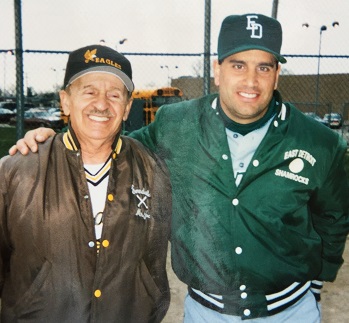
Ryan Joseph, 29, is in his second season as the varsity baseball coach at Utica Ford. Back in the mid-to-late 1990s he watched East Detroit’s baseball team, coached by his father, Matt, play against Ferndale, coached by his grandfather.
“My dad ran a squeeze play to win the game,” Ryan said. “It was a play my grandfather used all the time, and my dad learned from that. The newspapers were there, taking pictures afterward of my dad and my grandfather together. That was the first memory I have of my grandfather.”
Annis Joseph coached for 53 years, and most of his time as a coach was spent on a baseball diamond in Ferndale. He and his wife, Josephine, raised seven children, four boys and three girls, and all of the boys played a variety of sports throughout high school. All also eventually became coaches.
Matt Joseph is the seventh child, and what his father started in the 1940s, coaching and working with the youth in the area, will continue for years to come.
Matt Joseph and his wife, Darlene, have three children, and all three are coaches. Matt is in his 32nd season. He’s currently the head coach of two varsity sports at Utica Ford, softball and girls basketball. He’s also a counselor at the school.
“Sports has always been a big part of my life,” Matt said. “I love it. I love coaching. I love working with young adults, and the camaraderie you build with coaches and referees. (Being a coach) has helped me in my life. You have to have patience (to coach). It’s becoming a family thing.”
His son is not only the baseball coach at Ford, but he just completed his first season assisting his father with the girls basketball team. Ryan started coaching in 2010 at Jeanette Junior High in Sterling Heights working with the eighth grade boys basketball team. He also coached freshmen baseball at Sterling Heights Stevenson for five seasons before going over to Ford. Ryan also coached football for four seasons including one at the freshmen level at Stevenson. This season he started coaching a 13-and-under summer league baseball team as well.
Matt’s eldest daughter, Emily, 27, just completed her fifth season as the girls junior varsity basketball coach at Macomb Dakota. Emily is also a mathematics teacher at the school.
The Josephs’ third child, Teresa, 25, just completed her third season as the girls varsity basketball coach at Grand River Prep in Kentwood near Grand Rapids. Teresa also teaches math at the school.
 Matt, 54, began his career in education as a math teacher. He graduated from Madison Heights Bishop Foley in 1981, and he said there was a math teacher he had as a junior who sparked his interest in the subject.
His children followed his lead, all except his son who chose a slightly different path. Ryan is a French teacher.
One of Matt’s brothers, Mike, switched careers after a spell. He quit his job, went back to college and earned his teaching certificate. Mike teaches at Hartland and is the girls varsity golf coach there.
It’s in the blood.
“I knew in high school I wanted to be a teacher,” Matt Joseph said. “I love what I do. I wake up and it’s not a chore going to work. I knew I wasn’t going to make a lot of money. Looking back, I wouldn’t change a thing.”
The other male offspring of Annis and Josephine are Dave, 64, and Ray, 63. Mike is the eldest son at age 69.
Dave and Ray spent a majority of their careers coaching girls basketball. Dave spent the last 12 seasons as the varsity coach at Bishop Foley before recently resigning. Ray was Dave’s junior varsity coach the past 21 seasons.
“My dad started it all,” Dave said. “He owned Annis Market on 9 Mile (Road) and Hilton in Ferndale. He coached federation ball, and each team had to have a sponsor. The market was ours for a number of years. Growing up we would go along with Mom and Dad to the ball field. My dad coached, and my mom would sell concessions. So we were in sports all of our lives. We all started at a very young age. My dad coached me until I was 18. It was fun. Those were great times.”
Dave Joseph said what he’ll miss most is watching the improvement of the players coinciding with the improvement of the teams. What happened in between was what adults would call the foolishness of youth, what Dave termed ‘giddiness’.
Matt has had the most success. He started coaching at the varsity level in 1990 at East Detroit as he ran both the baseball and boys basketball programs. From 1996-2000 he coached three varsity teams adding girls basketball to the list. After the 2000-01 school year, Matt left East Detroit and accepted a counseling position at Ford. He remained the baseball coach at East Detroit, and in 2004 he was hired as the girls varsity basketball coach at Ford.
It was during this time that Ford’s baseball coach Dan Barnabo switched over to coaching softball. It took Barnabo time to convince Matt to make the same switch.
 “He convinced me to help him,” Matt said. “At first I said, ‘No, I’m a baseball guy.’ I finally did it. Then we switched again. (In 2011) I became the head coach and Dan’s my assistant. And he still is.”
As a school, Ford has never been to an MHSAA Softball Final, but Matt took his Falcons to the program’s first Semifinal in 2014 as Ford lost in Division 1 to Portage Central, 1-0.
Ford is 20-4 this season, ranked No. 6 in the state coaches poll, and could play No. 2 Macomb Dakota, last season’s Division 1 runner-up, in a District Final.
Dave Joseph’s teams didn’t make it as far as Matt’s in softball, but Dave’s 2013-14 Bishop Foley team did win the Detroit Catholic League C-D title.
And success is measured in many more ways than District or league titles. As a person, Matt Joseph is content. He’s lived a good and happy life and is proud of where he came from and the guidance he and his wife gave their three children.
“I just believed in what I was doing,” he said. “And my kids did all the things I did when I was growing up. They came with me to East Detroit as a water boy or water girl and a bat boy. It’s what we did as a family. And they all played at least two varsity sports.”
Evidently Annis Joseph sold more than fruits and vegetables at his market. He was able to convince many in his family that by participating in athletics, and becoming passionate about them, those experiences could lead one to riches not measured in dollars and cents, but where commitment and family are their own rewards.
 Tom Markowski is a columnist and directs website coverage for the State Champs! Sports Network. He previously covered primarily high school sports for the The Detroit News from 1984-2014, focusing on the Detroit area and contributing to statewide coverage of football and basketball. Contact him at [email protected] with story ideas for Oakland, Macomb and Wayne counties.
PHOTOS: (Top) One branch of the coaching Josephs surrounds grandfather Annis, clockwise from top left, Ryan, Matt, Emily and Teresa. (Middle) Annis, left, and Matt Joseph when Annis was coaching at Ferndale and Matt at East Detroit. (Below) Matt Joseph celebrates a basketball championship with daughter Teresa during her playing days. (Photos courtesy of the Joseph family).