

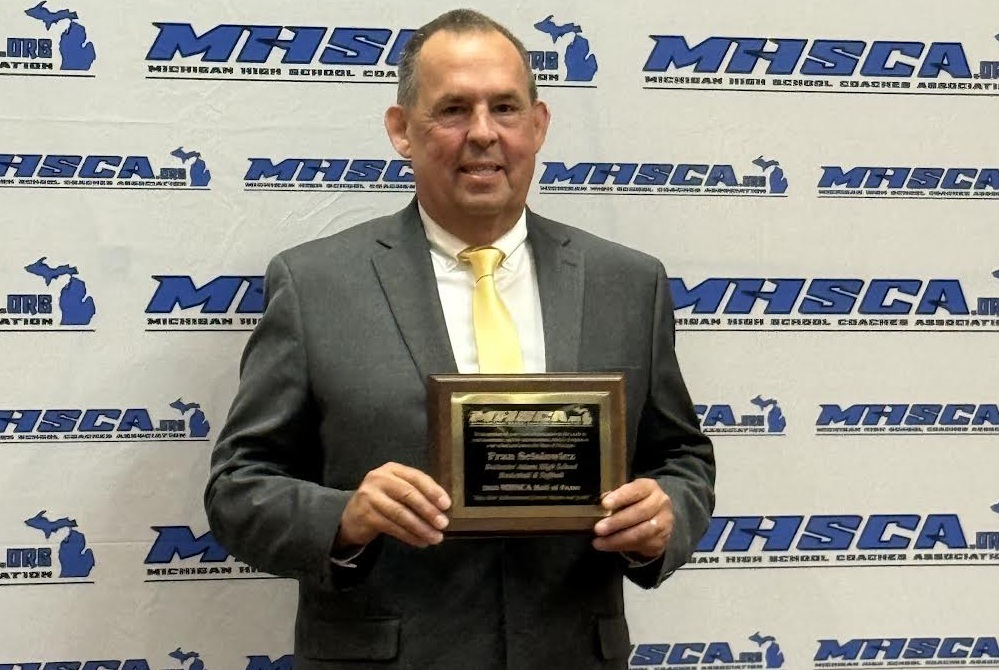
Scislowicz Selected to MHSCA Hall of Fame After Decades Serving in Multiple Sports
By
Keith Dunlap
Special for MHSAA.com
September 18, 2025
Fran Scislowicz admitted he went back and forth about what to say in his speech as he was inducted into the Michigan High School Coaches Association Hall of Fame on Sunday.
 But as the time approached to deliver it, he just harkened back to what was a principal trait during his coaching career: making sure everything was about others and not himself.
“It was a neat experience to be able to say thank you back,” Scislowicz said of what he primarily said in his speech in front of family and friends, including a brother who drove from Colorado for the ceremony. “I can’t find a head coach that doesn’t have that village behind them to support them in so many different ways.”
Scislowicz certainly had a big village throughout a long career in several sports at Rochester Adams. He was the head varsity softball coach for 37 years before retiring from that post in 2024, the head girls basketball coach for 23 years before retiring in 2013, the defensive coordinator on the varsity football team in the late 1980s and early 90s and this season is in his 28th year serving on the chain gang at Adams’ football games.
In this modern age, it’s not easy to find coaches who stick around one school in one sport for a great length of time. It should be noted that the two other coaches from the Detroit area who were inducted Sunday – Troy basketball coach Gary Fralick and Richmond softball coach Howard Stuart – fit that bill perfectly as well.
But having a coach stick around in several sports for such a long time is even rarer, which made Scislowicz an obvious choice to be inducted.
A retired elementary physical education teacher in the Rochester district, Scislowicz developed the dream to teach and coach as a youth while attending practices and games his older brothers were involved in.
“I go, ‘If I could be a physical education teacher during the day and then coach after school, that would be wonderful,’” he said. “I kind of had that passion and idea to do it really young.”
The highlight of his coaching career on the field came during the 1993-94 school year, when both his Adams girls basketball and softball teams made the MHSAA Semifinals. It was the only time those programs made the semifinals during his tenure, and they did so over a span of months.
“I was told back then by some wise, veteran coaches, ‘Fran, you don’t realize how hard it is to do what you just did, and you might never get back,’” he said. “And we didn’t.”
Scislowicz is listed among the state’s winningest coaches on the diamond with a record of 803-487 from 1988-2024. But if his original ambitions had played out, he wouldn’t have had long careers coaching softball and girls basketball at Adams.
While serving as the football team’s defensive coordinator under then-head coach Jack Runchey during the late 1980s and early 90s, he thought he was next in line to become the program’s head coach.
But in 1991, the girls basketball program was a blossoming state power in need of a leader, so Scislowicz gave up football to focus his fall seasons (girls basketball was played during the fall then) on hoops.
More important than his coaching on the court or field was his faith-based mentoring off of it.
Scislowicz to this day is actively involved in the area’s Fellowship of Christian Athletes organization and put together regular meetings before school for students and athletes to attend.
In the end, that’s what he hopes his biggest coaching legacy remains.
“We had a saying that you don’t have to be great to serve, but you have to serve to be great,” he said. “We really tried to give back to kids that way, by serving and doing that way. The wins and losses were going to take care of themselves. It’s the impact of seeing what kids are like at 30, 40 or 50 years old. As I’ve been around one community, trying to be a difference maker is what I enjoy most.”
 Keith Dunlap has served in Detroit-area sports media for more than two decades, including as a sportswriter at the Oakland Press from 2001-16 primarily covering high school sports but also college and professional teams. His bylines also have appeared in USA Today, the Washington Post, the Detroit Free Press, the Houston Chronicle and the Boston Globe. He served as the administrator for the Oakland Activities Association’s website from 2017-2020. Contact him at [email protected] with story ideas for Oakland, Macomb and Wayne counties.
(Photo courtesy of Fran Scislowicz.)
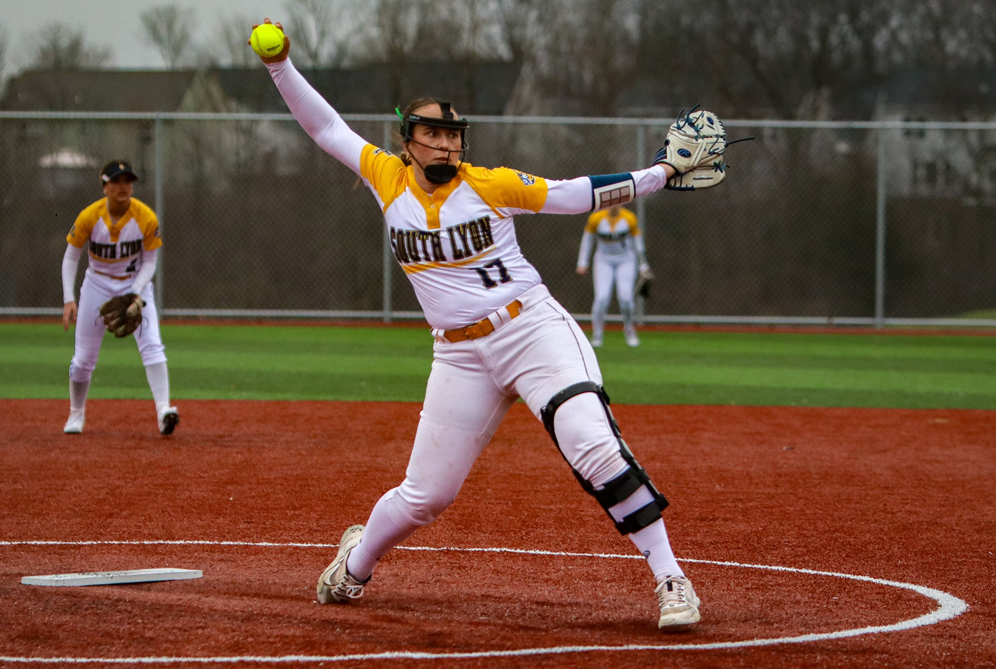
She's Back: South Lyon Ace Bradshaw Returns for Another Title Pursuit
By
Keith Dunlap
Special for MHSAA.com
April 11, 2024
SOUTH LYON — Two words likely won’t sit well with a lot of Division 1 softball teams around the state this year.
She’s back.
Or to play on the words of former Texas Longhorns quarterback Sam Ehlinger after a Sugar Bowl win in 2019, and others who before and since have added dramatics to the phrase: “She’s baaaaaaaaaaaack.”
“She” is South Lyon senior pitcher Ava Bradshaw. And if anyone who follows high school softball in the state happened to forget that name, let’s do a little refresher.
Back in 2021, Bradshaw burst onto the scene in her first year of high school and played like a freshman …. in college.
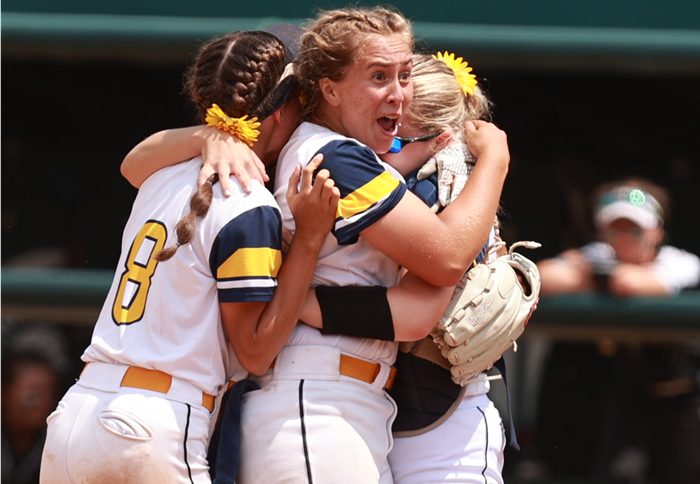
Bradshaw was a dominant two-way force both pitching and hitting, so much so that behind her, South Lyon won its first MHSAA Finals title, in Division 1.
In the championship game against Allen Park, Bradshaw threw a three-hit shutout, striking out nine and walking one in a 5-0 South Lyon victory. She also had two RBI.
“I didn’t realize how crazy what we did was,” Bradshaw said. “We really did make that run.”
Bradshaw was even better as a sophomore and seemed destined to lead South Lyon to a repeat.
However, a first inning against Mattawan during which everything that could go wrong seemingly did started a 3-1 Quarterfinal loss that stunningly ended those 2022 aspirations.
But hey, no problem. Bradshaw had two more years to win another championship, right?
 Then came the summer prior to her junior year, when Bradshaw suffered a torn ACL during her travel ball season. She was hoping to come back at some point last year as a junior, but understandably didn’t want to push anything too hard, especially since by that point she had committed to play in college for Duke.
This year, it would have been understandable if Bradshaw would have just wanted to sit out her senior year, enjoy the countdown to graduation and simply gear up for the next chapter.
But Bradshaw was having none of that.
“In high school ball, every day I’m practicing and I’m playing with my friends, playing for my town and for my school,” she said. “That’s an honor, and I have so much fun. I couldn’t imagine not playing my senior year. That would be so sad. When I look back on my high school experience, some of the biggest memories I have come from softball. I couldn’t imagine not finishing what I started.”
So Bradshaw is indeed back and not only fully healthy, but stronger and hungrier than she ever has been during her high school career.
Bradshaw said going through rehabilitation for her injury last year has made her better physically.
“I was forced to do certain movements and exercises that I never would have done had I not been forced to go to (physical therapy),” she said. “I became a more well-rounded athlete. I improved flexibility and mobility.”
In her first game this season, Bradshaw struck 12 of the 15 batters she faced and went 4-for-4 at the plate.
“We just plugged her right in,” South Lyon head coach Dave Langlois said.
Not having Bradshaw last year actually could end up making South Lyon even better this year.
“I think we were the only ones to score a run on the state champs, Hartland, in our Regional,” Langlois said. “We were one hit away with a young, inexperienced team for the most part. Those kids got to get experience in crucial times (without Bradshaw) when they may not have gotten (it).”
South Lyon probably still would’ve been formidable if Bradshaw decided not to play this year. But adding her back to a talented roster of underclassmen who are a year older and better?
It’s no wonder why “she’s back” might be the most terrifying two words for softball teams not named South Lyon this spring.
Keith Dunlap has served in Detroit-area sports media for more than two decades, including as a sportswriter at the Oakland Press from 2001-16 primarily covering high school sports but also college and professional teams. His bylines also have appeared in USA Today, the Washington Post, the Detroit Free Press, the Houston Chronicle and the Boston Globe. He served as the administrator for the Oakland Activities Association’s website from 2017-2020. Contact him at [email protected] with story ideas for Oakland, Macomb and Wayne counties
PHOTOS (Top) South Lyon’s Ava Bradshaw makes her move toward the plate during a game against Flat Rock this spring. (Middle) Bradshaw, middle, celebrates with teammates after they won the 2021 Division 1 championship at Secchia Stadium. (Top photo by Conner Lipke; middle photo by Hockey Weekly Action Photos.)